Custom Packaging for Dubai Startups: How to Brief a Printer for Your First Box Run
A practical guide for Dubai startups covering dielines, choosing board and finishes, barcodes and legal details, proofing and test runs—so your first custom boxes arrive professional and ready to scale.

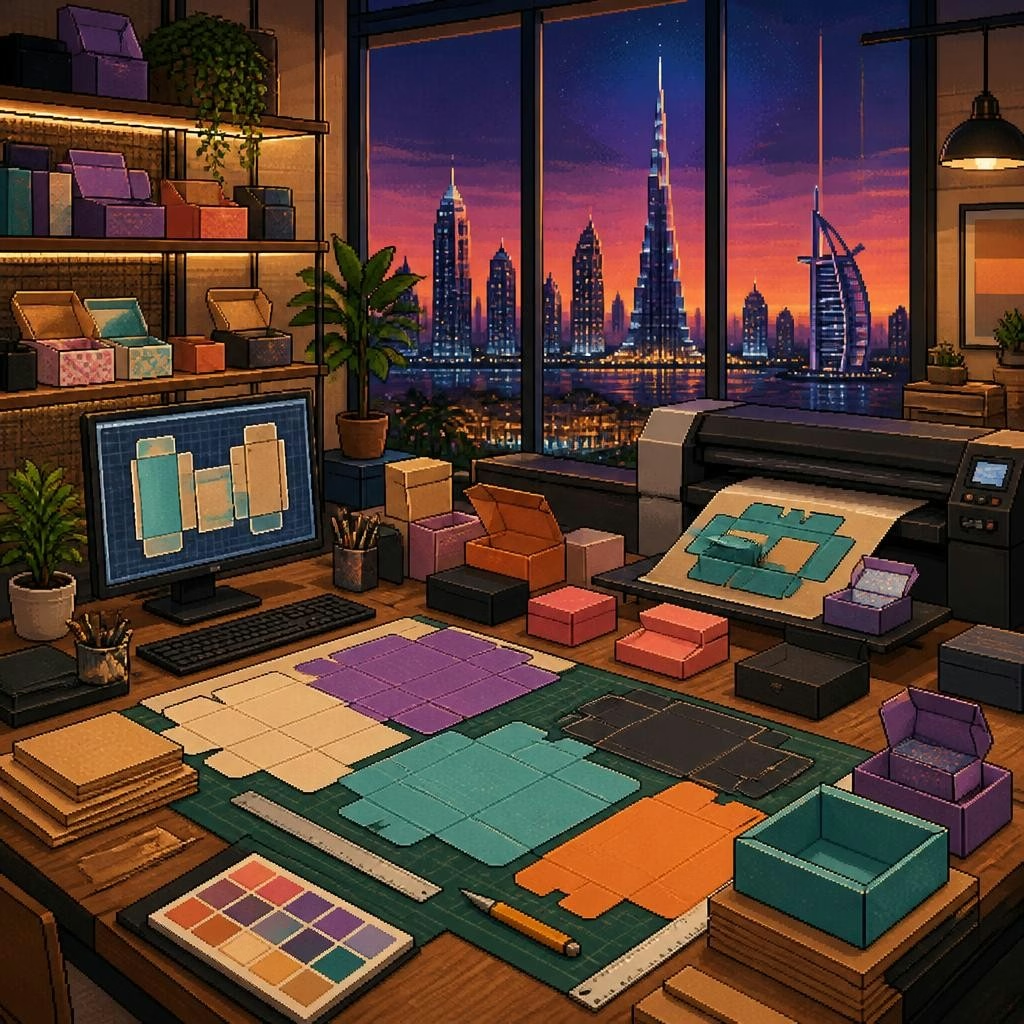
Why your packaging brief matters
Your packaging is more than protection—it's the first physical touchpoint of your brand. For startups in Dubai competing on retail shelves and online marketplaces, clear packaging helps control costs, avoid production delays, and ensures the finished box matches your brand expectations. A practical, detailed brief reduces back-and-forth with the printer and speeds up time to market.
Begin with goals, timelines, and quantities
Start your brief by stating the project goal: retail presentation, e‑commerce shipping, promotional giveaways, or product protection. Add a target timeline and any hard deadlines (launch date, trade show). Provide initial order quantities and an expected growth plan—this helps the printer advise on cost-effective methods and suitable printing processes for both small runs and future scale-ups.
Dielines and structural design basics
A dieline (flat template) shows the box’s folds, cuts and glue tabs. If you have an in-house designer, supply a vector dieline in AI, EPS or PDF with layers for the dieline and artwork separated. If not, tell the printer the internal product dimensions and weight so they can recommend a structure. Always mark score lines, glue flaps, and indicate which panel is the front and top.
File preparation: bleed, safe area and fonts
Art files should include at least 2–3 mm bleed beyond the dieline to avoid white edges after trimming. Identify a safe zone inside cut lines where no essential text or logos sit, to avoid being cut off during finishing. Supply images at 300 dpi and outline or embed fonts. Provide pantone spot colors or clear CMYK equivalents for accurate color matching.
Choosing board and material for purpose
Match board type to function: lightweight folding cartons are good for retail lightweight goods; sturdier board or corrugated solutions suit shipping and heavier items. Consider finish and rigidity needs (presentation vs. transit). Describe how the product will be stored and shipped so the printer can recommend materials that balance protection, aesthetics and cost.
Printing method, color control and proofs
Digital printing is ideal for short runs and fast turnarounds; offset printing can be more economical for larger quantities and offers consistent color across big batches. Ask the printer about color-management workflows and request a color proof or a press-check sample before full production. Where brand colors are critical, supply Pantone references and approve a physical proof to avoid surprises.
Finishing options: coatings, foils and cutouts
Finishes affect look, feel and durability. Common choices include gloss or matte lamination, aqueous varnish, spot UV for highlights, or foil stamping for premium accents. Consider window cutouts if the product should be visible. Discuss abrasion resistance and moisture protection if boxes will travel long distances or be stored in variable conditions.
Barcodes, legal details and product information
Include any mandatory labeling in your brief: barcode (EAN/UPC), product name, net quantity, manufacturer or company address, and any regulatory text required for your category. Indicate where the barcode should be placed on the dieline and supply the barcode artwork with human‑readable numbers. If local regulations apply to your product, mention them and ask the printer if they can accommodate label panels or additional prints.
Test runs, samples and scaling sensibly
Order a small pre‑production batch or a fully finished prototype before committing to full production. A test run lets you evaluate material, print fidelity, structural folds and fit with the actual product. After approving the prototype, discuss staggered production—smaller follow-up batches as you scale—to balance inventory and cash flow while maintaining consistent quality across runs.
Working with your Dubai printer: checklist and next steps
When you contact a printer, provide: project brief, dieline file, artwork with embedded fonts, preferred materials, target quantities and deadline, and any legal/barcode requirements. Al Wasl Printing Press, a local printing press dubai and printing company dubai, offers custom packaging among its services and can advise on structure, materials and finishes; customers note reliable delivery and strong collaboration when planning box projects. Also consider complementary needs—signage, banners or point-of-sale displays—so your launch visuals are consistent. Finally, confirm lead times, proof approval steps and delivery logistics before signing off on production.
Customer review


Article by
Al Wasal Printing Press - Printing Company in Dubai
Al Wasl Printing Press is one of the leading printing press companies in Dubai. We are your one-stop commercial printing company for all of your branding and publishing needs. We strive to provide our customers with the best and highest quality products available in the industry. Our Services Includes:- Digital Printing, Offset Printing Commercial Printing (Brochures, Flyers, Catalogues) Business Card Printing Letterhead & Stationery Printing Magazine & Book Printing Advertising & Display Printing Banner & Flex Printing Signage & Sign Board Printing (LED, Acrylic, etc.) Vehicle Branding & Wrapping Window Graphics & Glass Printing Packaging & Specialized Printing Packaging & Box Printing (Custom Packaging)