Knee Replacement in Dubai: Deciding Between Partial and Total Knee Arthroplasty
A practical guide for middle‑aged and older adults on how surgeons decide between partial and total knee replacement, what imaging and clinical findings matter, how lifestyle in the UAE affects the choice, and realistic recovery expectations for walking, stairs, and prayer.
Why this decision matters
Choosing between a partial (unicompartmental) and a total knee arthroplasty is an important clinical decision that affects pain relief, knee function, recovery, and long‑term outcomes. The right option depends on the pattern and severity of arthritis, ligament stability, alignment, overall health and activity goals. This article explains the clinical and imaging findings surgeons consider, how everyday activities common in the UAE influence the choice, and what patients can reasonably expect after surgery at DHCC under the Emirates Hospital Group.
Partial versus total: a clear distinction
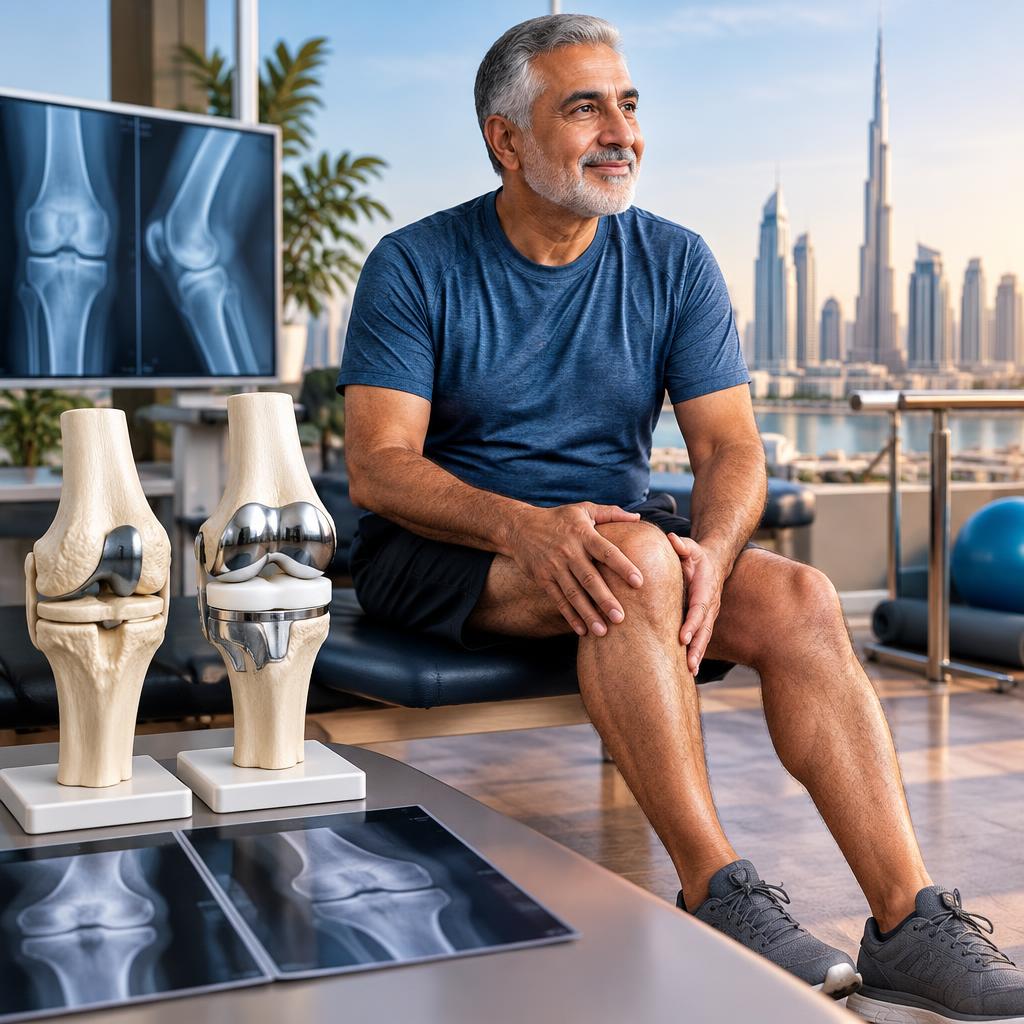
Partial knee replacement replaces only the damaged compartment of the knee (for example the medial or lateral compartment or the patellofemoral joint), preserving healthy bone, cartilage and some ligaments. Total knee replacement resurfaces all major compartments of the knee and is intended when degeneration is widespread. Each approach has different implications for surgical invasiveness, rehabilitation focus and long‑term joint mechanics.
When partial knee replacement is considered
Surgeons generally consider a partial replacement when arthritis is limited to a single compartment, the remaining cartilage and other compartments look healthy, the knee has preserved range of motion and the main knee ligaments are intact. Patients who have pain confined to one area on clinical exam and corresponding, localized changes on imaging are potential candidates. The goal of a partial procedure is to relieve pain while preserving as much of the native knee as possible.
When total knee replacement is the safer option
Total knee replacement is typically recommended when multiple compartments show significant joint surface loss, when there is marked angular deformity, widespread cartilage damage, or when ligament instability or inflammatory arthritis affects the entire joint. In such situations a total replacement provides a more reliable, comprehensive solution to restore joint alignment and reduce pain across the whole knee.
Imaging and clinical findings surgeons rely on
Decision making combines clinical examination with imaging. Weight‑bearing X‑rays show joint space narrowing, alignment and deformity patterns; MRI can clarify the extent of cartilage loss, meniscal damage and soft tissue status when needed. Important clinical elements include the distribution of pain, knee swelling, range of motion, ligament stability and response to non‑surgical treatments. A surgeon will integrate these findings rather than base the choice on a single test.
Activity, culture and lifestyle considerations in the UAE
Lifestyle goals influence the choice of procedure. Many patients in our region prioritise walking, climbing stairs, daily prayer (which may include kneeling and prostration), and a return to family and social activities. For patients whose arthritis is limited and who wish to preserve more native knee function, partial replacement can be attractive. For those with broad joint damage or who need a robust, long‑term solution for high‑demand activities, total replacement may be the safer option. Discussing personal priorities and specific activities with your surgeon is essential so the plan matches both clinical findings and lifestyle needs.
What to expect at DHCC and from the care team
Dr. Farivar Bagheri practices in Dubai Healthcare City (DHCC) as part of the Emirates Hospital Group. The usual care pathway involves a detailed preoperative assessment, a clear discussion of options, and coordinated perioperative planning with the nursing and physiotherapy teams. The practice offers a 24/7 emergency contact line for urgent concerns. Patients consistently report that explanations are thorough and follow‑up care is attentive, which helps make the surgical experience more predictable and reassuring.
Realistic recovery milestones for walking, stairs and prayer
Recovery progresses in stages and varies by procedure and individual health. Most patients begin assisted mobilisation soon after surgery, focusing first on walking short distances with support and practising safe transfers. Climbing stairs typically follows once strength and coordination improve under physiotherapy guidance, using step techniques advised by the team. Activities that place deep flexion on the knee—such as kneeling or full prostration during prayer—often take longer to regain comfortably and are addressed as part of a graded rehabilitation plan. Your surgeon and physiotherapist will set personalised milestones and advise when to resume specific activities safely.
Balancing risks and benefits
Partial replacement can offer advantages such as less soft‑tissue disruption and preservation of native knee mechanics, which may support a quicker, more natural feeling recovery for selected patients. However, it is not appropriate when arthritis is widespread, and some patients with a partial replacement may later require conversion to a total knee if disease progresses. Total replacement is a comprehensive solution for advanced or multi‑compartment disease and tends to provide dependable long‑term pain relief when indicated. An informed discussion of these trade‑offs with your surgeon is essential.
How Dr. Farivar approaches the decision and next steps
Dr. Farivar and his team emphasise a patient‑centred process: careful clinical assessment, review of appropriate imaging, clear explanation of options and shared decision making that reflects the patient’s goals and lifestyle. Many patients highlight the team’s supportive follow‑up during recovery. If you are considering knee replacement, prepare for your consultation by listing daily activities that are important to you, bringing recent imaging when available, and noting previous treatments. A consultation will establish whether a partial or total approach is the better path forward and outline a personalised rehabilitation plan.
Article by
𝐃𝐫. 𝐅𝐚𝐫𝐢𝐯𝐚𝐫 𝐁𝐚𝐠𝐡𝐞𝐫𝐢
Orthopedic Surgeon & Sports Surgeon in Dubai – Specialized in Knee, Shoulder & Ankle Arthroscopy, Joint Replacement (Knee & Hip), Foot Surgery (Flat Foot & Hallux Valgus), and Trauma Surgery. With over 15 years of experience, practicing in Dubai under the Emirates Hospital Group. 📞 Emergency Line Available 24/7 – Our mobile and WhatsApp number is always active. Emergency cases are accepted anytime, regardless of the clinic schedule.