Meniscus Tear vs. Ligament Injury: A Practical Guide for Patients in Dubai, Sharjah & Ajman
A clear, practical guide to help residents of Dubai, Sharjah and Ajman recognise the differences between meniscus tears and ligament (ACL/MCL) injuries after a twist or sports incident, decide when to rest versus seek urgent assessment at DHCC, and understand how early diagnosis protects long‑term knee health.

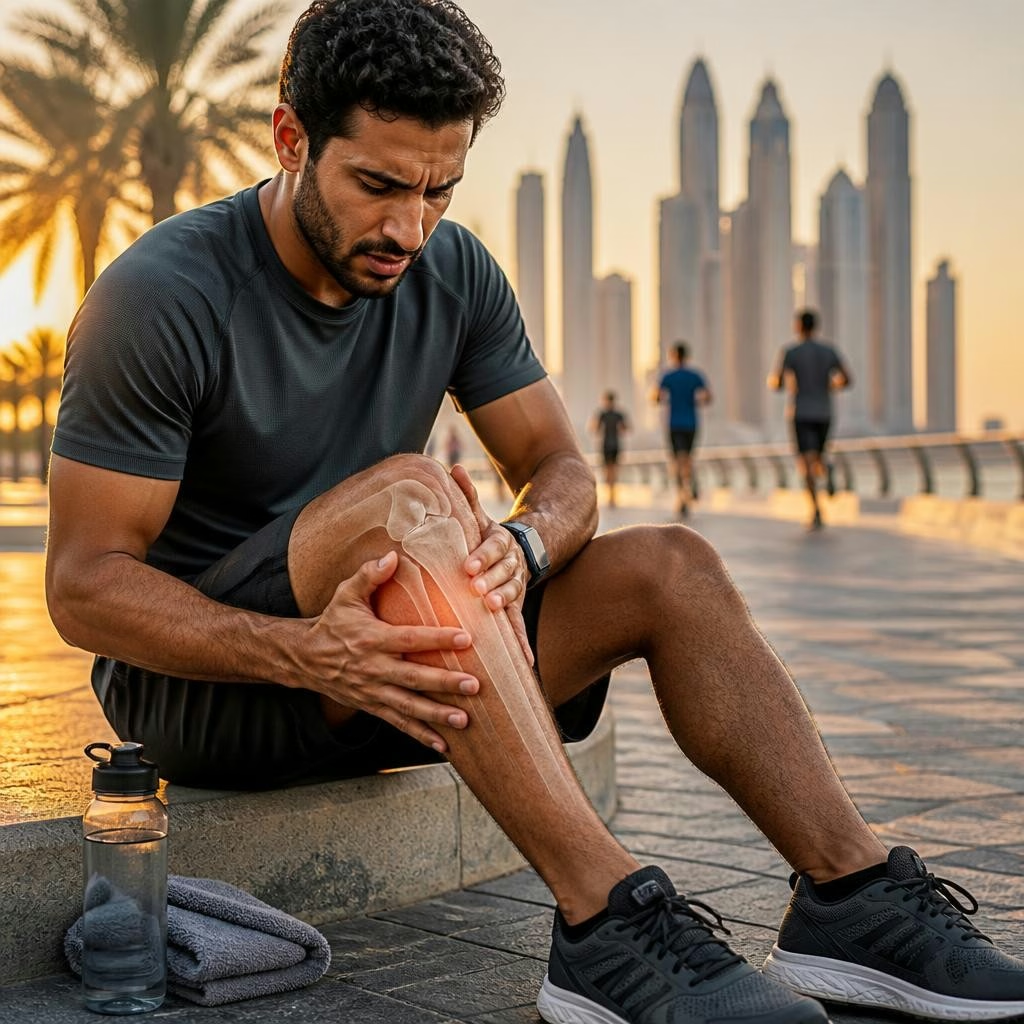
Why knowing the difference matters
A twisting injury to the knee can cause different problems with very different consequences. Meniscus cartilage tears, and ligament injuries such as ACL or MCL tears, may produce similar pain at first but require different treatments and rehabilitation. Early recognition and timely assessment help preserve knee function and lower the risk of future pain, instability, or early joint degeneration.
Knee anatomy at a glance
Two types of structures are commonly injured in twisting events: the menisci—crescent-shaped cartilage pads that cushion and stabilise the joint—and the major ligaments such as the anterior cruciate ligament (ACL) and the medial collateral ligament (MCL), which keep the knee stable. Damage to cartilage primarily affects shock absorption and smooth movement; ligament damage mainly causes instability.
Typical signs of a meniscus tear
Meniscus tears often follow a twisting movement while the foot is planted. Common features include joint line pain (a sharp or aching pain along the inner or outer knee), swelling that may develop over 24–48 hours, catching, locking, or a sensation of the knee not moving smoothly. Pain is usually worse on activities that load the knee in rotation such as squatting or twisting.
Typical signs of ACL or MCL injury
ACL injuries frequently occur with a sudden change of direction, pivot, or a direct blow; patients often report a 'pop' at the time of injury followed by immediate swelling and a feeling of instability or giving way. MCL injuries commonly result from a blow to the outside of the knee and cause pain and tenderness along the inner knee. Ligament injuries are more likely than isolated meniscus tears to cause significant instability during walking or sport.
How these injuries commonly happen
Common scenarios include sports that involve pivoting, sudden stops, or collisions, recreational activities, and falls. A simple awkward twist while stepping off a curb or turning can injure the meniscus; high‑energy twists, direct impact, or rapid deceleration are more likely to damage ligaments. Age and pre-existing joint wear also influence what structure is injured and how it heals.
Immediate self-care: rest, protect, and watch for red flags
After a knee injury begin with basic first aid: protect the knee from further strain, apply ice, compress with a bandage if appropriate, and elevate to reduce swelling. Avoid heavy weight-bearing if the knee feels unstable or if pain is severe. Seek urgent assessment if you cannot put weight on the leg, if the knee looks deformed, if there is rapid increasing swelling, numbness, or loss of circulation—these are red flags that need prompt medical attention.
When to seek an orthopedic assessment in DHCC
If pain and swelling persist beyond a few days, if the knee locks or repeatedly gives way, or if you have difficulty walking, arrange an orthopedic assessment. In Dubai Healthcare City (DHCC) an orthopedic surgeon will perform a focused clinical exam and arrange targeted investigations as needed. Early assessment clarifies whether conservative care is appropriate or if referral for arthroscopy, repair, or reconstruction is required.
Non‑surgical treatment options commonly used
Many meniscus tears and mild ligament sprains respond to non‑operative care: a tailored physiotherapy programme, activity modification, bracing where indicated, and image‑guided injections when appropriate. Dr. Farivar’s practice offers non‑surgical options such as intra‑articular injections and regenerative PRP treatments for selected knee conditions, together with structured rehabilitation aimed at restoring function and delaying or avoiding surgery when safe.
When surgery is considered and typical procedures
Surgery may be advised for large or mechanically symptomatic meniscus tears, persistent instability from ACL tears, or when conservative care fails to relieve symptoms. Common procedures include arthroscopic meniscus repair or partial meniscectomy, and ACL reconstruction for instability that affects daily life or sport. Decisions are made case‑by‑case based on symptoms, activity goals, knee stability, and overall knee health.
Recovery, long‑term knee health, and getting help locally
Rehabilitation after either non‑surgical or surgical treatment is essential: guided physiotherapy, progressive strengthening, and gradual return to activities protect repair sites and reduce reinjury risk. Early diagnosis and appropriate treatment help preserve cartilage and joint function over time. Patients in Dubai, Sharjah and Ajman can access assessment and care at DHCC; many local patients value clear explanations and close follow‑up—one recent patient with a complex knee problem reported feeling well informed and reassured before and after surgery, which supported a confident recovery. For urgent needs the clinic maintains a 24/7 emergency line and provides coordinated follow‑up with the clinical team and nursing support.
Customer review


Article by
𝐃𝐫. 𝐅𝐚𝐫𝐢𝐯𝐚𝐫 𝐁𝐚𝐠𝐡𝐞𝐫𝐢
Orthopedic Surgeon & Sports Surgeon in Dubai – Specialized in Knee, Shoulder & Ankle Arthroscopy, Joint Replacement (Knee & Hip), Foot Surgery (Flat Foot & Hallux Valgus), and Trauma Surgery. With over 15 years of experience, practicing in Dubai under the Emirates Hospital Group. 📞 Emergency Line Available 24/7 – Our mobile and WhatsApp number is always active. Emergency cases are accepted anytime, regardless of the clinic schedule.