When Is Knee Arthroscopy Better Than Open Surgery? A Dubai Patient’s Guide
A practical guide for active adults and athletes in Dubai that explains when minimally invasive knee arthroscopy is the preferred choice, how it compares to open surgery for meniscus, cartilage and ligament problems, and what to ask your surgeon before deciding.
Why this question matters
Choosing between knee arthroscopy and open surgery affects pain, recovery time, function and the chance of returning to sport or daily activities. For active adults and athletes in Dubai, understanding the differences helps you make an informed decision with your surgeon — especially for meniscal tears, cartilage damage and ligament injuries where both approaches may be considered.
What is knee arthroscopy?
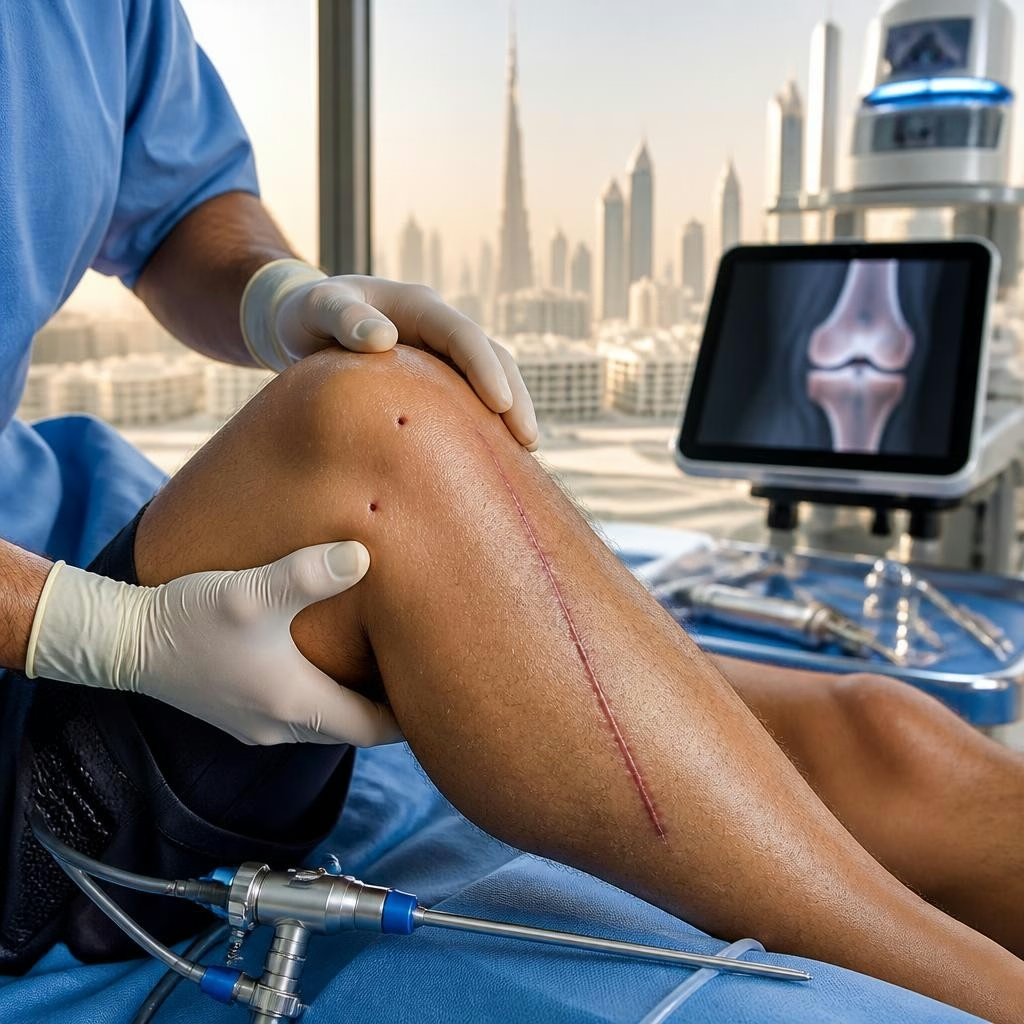
Knee arthroscopy is a minimally invasive procedure that uses a small camera (arthroscope) and specially designed instruments through 2–3 small incisions. Common arthroscopic procedures include meniscus repair or partial meniscectomy, arthroscopic ACL reconstruction, removal of loose bodies, cartilage debridement and targeted cartilage-restoration techniques. Arthroscopy is designed to treat internal joint problems while preserving surrounding tissues.
What is open knee surgery?
Open knee surgery involves a larger incision and direct exposure of the joint. It’s the standard approach for procedures that require wide access to bone and soft tissues, such as total knee replacement, complex fracture fixation, major realignment or revision joint replacement. Open techniques allow reconstruction or replacement when structural damage is extensive or when implants must be positioned precisely.
When arthroscopy is often the better option
Arthroscopy is typically preferred when the problem is limited to internal structures that can be reached through small portals. Indications where arthroscopy often offers clear advantages include repairable meniscus tears, isolated cartilage lesions that can be trimmed or treated with microfracture/arthroscopic cartilage procedures, arthroscopic ACL reconstruction, and removal of loose fragments. Benefits include smaller scars, less soft-tissue trauma, lower short-term pain, and often a faster early rehabilitation.
When open surgery is usually necessary
Open surgery becomes the recommended choice when damage is extensive, when a joint needs replacement, or when fracture fixation requires plates or larger implants. Examples include end-stage osteoarthritis needing total knee replacement, complex peri-articular fractures that require open reduction and internal fixation, nonunion surgeries, or major bone and soft-tissue reconstructions. In such cases, open exposure enables the surgeon to restore alignment and stability in ways arthroscopy cannot.
Comparing risks and trade-offs
Both approaches carry risks such as infection, stiffness or persistent symptoms; however, arthroscopy generally has lower blood loss and a smaller wound-related complication profile. The trade-off is that arthroscopy may not fully address large-scale deformity, widespread arthritis or certain complex injuries, and in some cases an initial arthroscopic procedure may be followed later by open surgery if the joint requires more definitive treatment.
Recovery and rehabilitation differences
Recovery after arthroscopy is usually quicker in the early phase: patients often have less pain, earlier range-of-motion and faster return to walking. Rehabilitation remains essential — structured physiotherapy and a staged strengthening program are key to good outcomes after both arthroscopic and open procedures. Open surgeries such as joint replacement require a longer, supervised rehabilitation period to restore strength and function.
Scars, function and long‑term results
Arthroscopy leaves small puncture scars and aims to preserve joint tissues, which can be important for younger, active patients. Open surgery leaves a larger incision but may offer more durable solutions for severe degeneration or large structural problems (for example, total knee replacement for advanced arthritis). The right approach balances short-term recovery with expected long-term function based on the individual’s pathology and goals.
How your surgeon decides — diagnostics and discussion
Surgeons base the decision on a careful history, clinical exam and imaging (X-rays, MRI or CT as needed). The choice depends on factors such as the type and size of a meniscus tear, cartilage status, ligament stability, presence of arthritis, patient age and activity level. Patients frequently cite clear, reassuring explanations and follow-up from their surgeon and team as decisive when choosing the right procedure.
A patient example of an arthroscopic pathway
One patient who underwent ACL reconstruction with an arthroscopic technique described feeling confident after the surgeon explained the plan and during recovery. That experience highlights two practical points: first, arthroscopic reconstruction is well suited for stabilizing ligament injuries while minimizing tissue trauma; second, detailed preoperative counselling and close postoperative follow-up are important for a successful recovery.
Practical checklist for patients in Dubai
Before you decide, ask your surgeon: (1) What specific diagnosis explains my symptoms on exam and imaging? (2) Can arthroscopy fully treat the problem, or might I need open surgery now or later? (3) What does the rehabilitation timeline look like for this option? (4) What risks are specific to my case? In Dubai, choose a surgeon who takes time to explain options and follow up closely. Dr. Farivar Bagheri and his team practise in Dubai Healthcare City and serve patients across the emirates; they also provide a 24/7 emergency line and coordinated post-op support to help with urgent concerns and rehabilitation planning.
Making a shared decision
There is no one-size-fits-all answer. For isolated meniscal or ligament problems in active adults, arthroscopy commonly offers faster recovery and less scarring. For advanced arthritis, major deformity or complex fractures, open surgery is often the correct path. Discuss your goals, activity level and imaging findings with your surgeon, seek a clear rehabilitation plan and choose a team that prioritises follow-up — these steps lead to the best functional outcome.
Customer review


Article by
𝐃𝐫. 𝐅𝐚𝐫𝐢𝐯𝐚𝐫 𝐁𝐚𝐠𝐡𝐞𝐫𝐢
Orthopedic Surgeon & Sports Surgeon in Dubai – Specialized in Knee, Shoulder & Ankle Arthroscopy, Joint Replacement (Knee & Hip), Foot Surgery (Flat Foot & Hallux Valgus), and Trauma Surgery. With over 15 years of experience, practicing in Dubai under the Emirates Hospital Group. 📞 Emergency Line Available 24/7 – Our mobile and WhatsApp number is always active. Emergency cases are accepted anytime, regardless of the clinic schedule.