Understanding Your ECG Report: A Patient’s Guide from a Kollam Cardiology Clinic
A clear, patient-focused explanation of common ECG terms—heart rate, rhythm, and basic wave changes—why minor findings aren’t always alarming, and when you should rely on a cardiologist’s interpretation and follow-up tests.

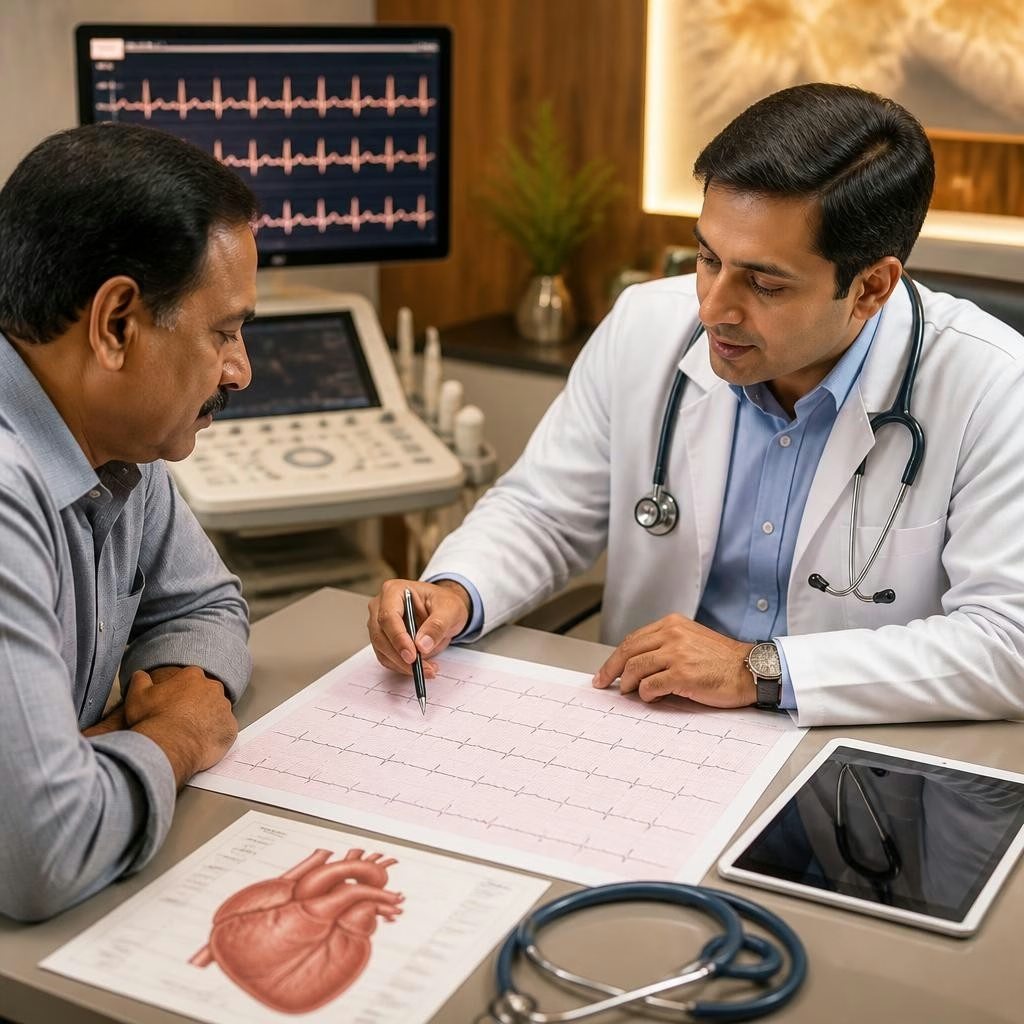
Why an ECG Matters
An electrocardiogram (ECG) is a quick, noninvasive test that records the heart’s electrical activity. It is one of the first tools a cardiologist uses to check for abnormal rhythms, some signs of reduced blood flow to the heart, or problems with how the heart’s electrical signals travel. At Dr. Sujay Renga’s clinic in Kollam, ECGs are routinely used alongside consultation, echocardiography and other tests to build a complete picture of heart health.
Heart Rate: What the Number Means
Your ECG report usually shows a heart rate in beats per minute (bpm). A typical resting rate for adults is about 60–100 bpm. Rates below or above this range can be normal for some people (athletes, anxiety, fever, medications), but persistent slow or fast rates may need further assessment. Heart rate on an ECG is a snapshot; additional monitoring such as a Holter may be recommended if symptoms are intermittent.
Rhythm: Regular vs Irregular
The report will also comment on rhythm — whether the heart’s beats are regular or irregular. Common rhythms a cardiologist looks for include normal sinus rhythm and arrhythmias such as atrial fibrillation. An irregular rhythm on a single ECG could be a transient finding or an indication of an ongoing rhythm problem that requires further testing and clinical correlation.
The Basic Waves: P, QRS, and T in Plain Language
An ECG trace is made of repeating wave groups. The small P wave reflects the electrical activity that starts each heartbeat; the tall, narrow QRS complex shows the main pumping action; and the T wave represents recovery of the heart muscle after a beat. Your report will note whether these parts look normal in size and timing. Small variations often have benign explanations, while marked changes may prompt further evaluation.
Common Changes and What They May Suggest
Certain ECG changes can point to specific issues: prolonged PR or QRS durations may suggest conduction delays, obvious ST-segment shifts can be associated with reduced blood flow to the heart, and abnormal T waves sometimes indicate strain or electrolyte changes. However, these findings are not diagnoses by themselves — they are clues that must be interpreted together with symptoms, physical examination and other tests like an echocardiogram or blood work.
Why a Cardiologist’s Interpretation Is Essential
An ECG report contains technical observations; a cardiologist translates those into clinical meaning for you. Experienced clinicians consider your symptoms, medical history, medications and other investigations before making recommendations. Many patients at Dr. Sujay Renga’s clinic report that the doctor takes time to explain results clearly and answer questions, which helps them feel informed and confident about next steps.
When Additional Tests or Urgent Care Are Needed
An abnormal ECG may lead to further testing such as an echocardiogram, Holter monitoring, ambulatory blood-pressure monitoring or targeted blood tests. If you experience acute symptoms like persistent chest pain, fainting, sudden severe breathlessness or alarming palpitations, seek immediate medical attention — the ECG is only one part of urgent assessment. For non-urgent concerns, schedule a follow-up consultation to discuss results and possible monitoring plans.
Preparing for Your ECG and Discussing Results
Before your test, wear loose clothing and tell staff about medications or implanted devices. After the ECG, ask your clinician to explain the heart rate, rhythm, and any notable wave changes in plain language, and whether further tests are advised. At Dr. Sujay Renga’s Heart Care Clinic in Kollam, ECGs are offered alongside consultations, echocardiograms, Holter monitoring and blood-test packages to ensure coordinated follow-up when needed.
Customer review


Article by
Dr.Sujay Renga
Dr. Sujay Renga is a Senior Interventional Cardiologist at NS Memorial Institute of Medical Sciences, a 500-bed multispecialty tertiary care centre in Kollam, Kerala. In addition he runs his own clinic at the heart of Kollam city. Dr. Renga holds an MD in Internal Medicine from Government Medical College, Thiruvananthapuram, and a DM in Cardiology from the Post Graduate Institute of Medical Education and Research (PGIMER), Chandigarh. He has also done postgraduate diploma in medico legal systems and quality in healthcare from Symbiosis university, Pune. He is a fellow of American College of Cardiology (FACC), European Society of Cardiology (FESC) and Scociety for Cadiovascular Angiography and Interventions (FSCAI).