How a 1.2 GW Amravati Manufacturing Facility Strengthens Solar Reliability in India
This article explains how a large local solar panel manufacturing facility improves product availability, technical support, and service response for residential, commercial, and utility-scale solar projects across India—and what customers should ask before they buy.

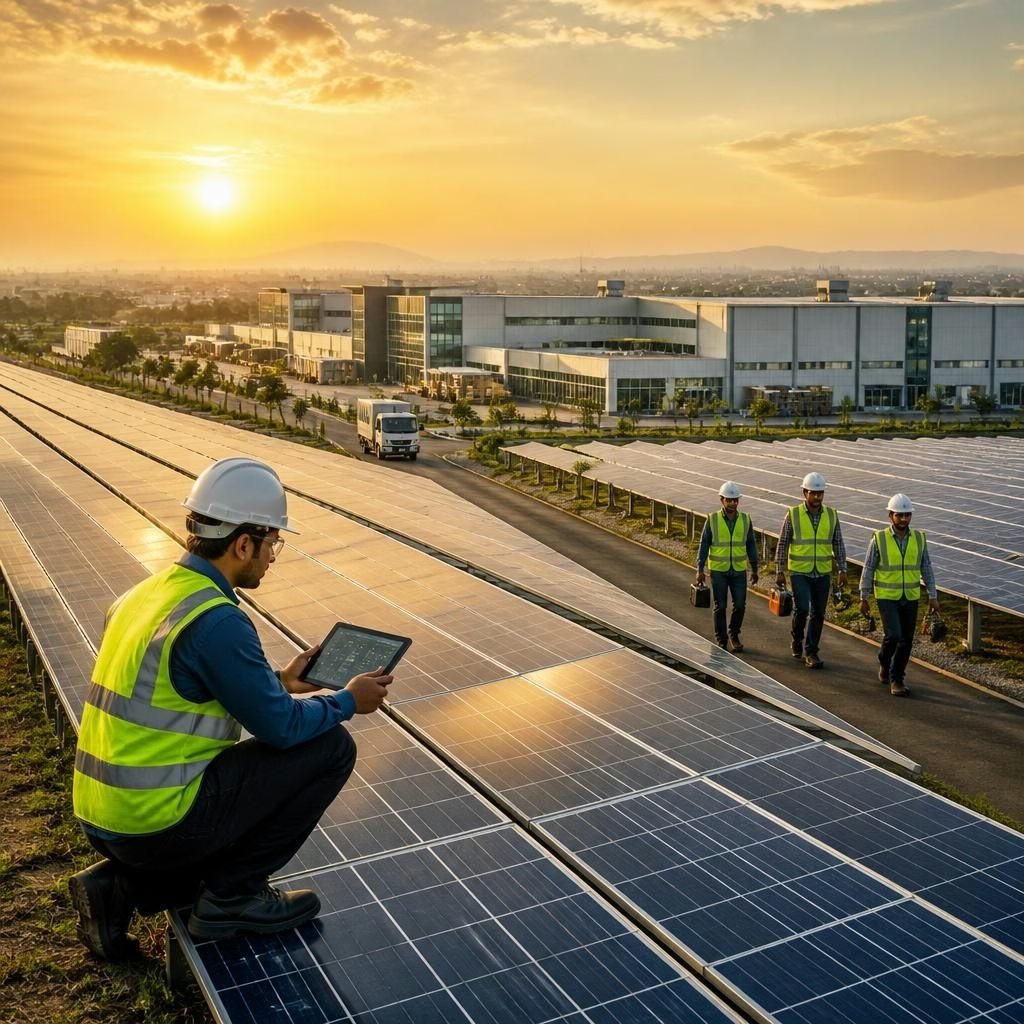
Why local manufacturing matters for solar reliability
Manufacturing panels close to major markets reduces several practical risks that affect system reliability: delayed deliveries, long wait times for spare parts, and slow fault diagnosis. A high-capacity facility in Amravati that serves PAN India helps ensure steady production of panels across common power classes, which lowers lead times for installations and replacements and makes ongoing maintenance more straightforward for installers and end users.
Product availability and shorter lead times
Large local capacity means a wider, more consistent inventory of panels — from standard 340 Wp modules up to higher-power panels in the 650 Wp class — and multiple cell technologies. Faster availability matters most for commercial and utility-scale projects where delays can raise costs, but it also benefits homeowners who need timely replacements or expansions. Several customers have noted the company’s regional production scale and plans for expansion as a reason for confidence in supply continuity.
Quicker technical support and on-the-ground service
When manufacturing, warehouse, and technical teams operate in the same region, diagnostic feedback loops become much faster. Field teams can get replacement panels or specific parts without long-distance shipping, and factory engineers can collaborate directly with site technicians on uncommon failures. Customers’ experiences are mixed overall—many reviews praise friendly, helpful teams and good service, while other feedback highlights inconsistent after-sales response—so it’s important to confirm local service arrangements before purchase.
How in-house manufacturing improves quality control
A consolidated manufacturing line lets a factory implement consistent quality-control steps: cell sorting, stringing and lamination controls, EL testing, and final power sorting. Producing different technologies—monocrystalline, polycrystalline, TOPCon and bifacial—under one roof can speed iterative improvements and troubleshooting. For buyers, that translates into more predictable performance and faster corrective action when defects appear. Always ask manufacturers for their specific testing protocols and whether modules meet the relevant national or international standards required for your project.
Technology choices: TOPCon vs mono‑PERC and bifacial panels
Choosing the right panel chemistry affects both energy yield and long-term reliability. Mono‑PERC panels are a mature, widely deployed option; TOPCon cells typically offer improved efficiency and potentially lower degradation rates, while bifacial modules can increase energy harvest where reflected light is available. Local manufacturing enables quicker access to the specific technology you need and simplifies comparisons across product lines, because samples, datasheets and performance testing can be arranged more rapidly with nearby production teams.
Practical benefits across project types
For residential rooftop systems, local manufacturing shortens timelines for installation, warranty replacements and compatibility checks with inverters and net-metering setups. Commercial and industrial rooftop projects gain from predictable bulk deliveries and easier coordination with EPC partners. For utility-scale projects, a large local plant helps meet large-volume schedules and reduces freight complexity. In all cases, confirm how the manufacturer supports commissioning, spare-part supply, and long-term maintenance.
Questions to ask before you buy
Before finalizing a purchase, request clear answers on these points: the exact panel wattages available and their power-sorting tolerance; expected degradation rate and warranty terms; lead time for replacements and spare parts; local service or authorized repair partners; whether modules comply with applicable standards and subsidy/approval lists for your scheme; and how on-site support is handled. Verifying these items helps you convert the advantages of local manufacturing into real reliability for your system.
Customer review


Article by
ECE (India) Energies Limited
ECE (India) Energies Private Limited Now known as ECE India Energies Limited was established to provide fruitful services to the stakeholders through value addition with an eye for quality, a clean environment, and safe life. Though the region of Vidarbha, Maharashtra, India is lacking industrial environment and employment, ECE has managed to become an employment creator starting from a handful of people in 2010. Manufacturing of Solar panels & Road Safety based products formed the initial base of the company, which later on went on to become a multi-faceted enterprise of green and solar energy products as well as services.