Questions to Ask Before Installing a Solar System at Your Home or Business
A practical checklist of technical, financial and service-related questions buyers in India should ask EPCs or manufacturers before signing a solar contract, with tips to compare offers and protect long-term performance.

Why asking the right questions matters
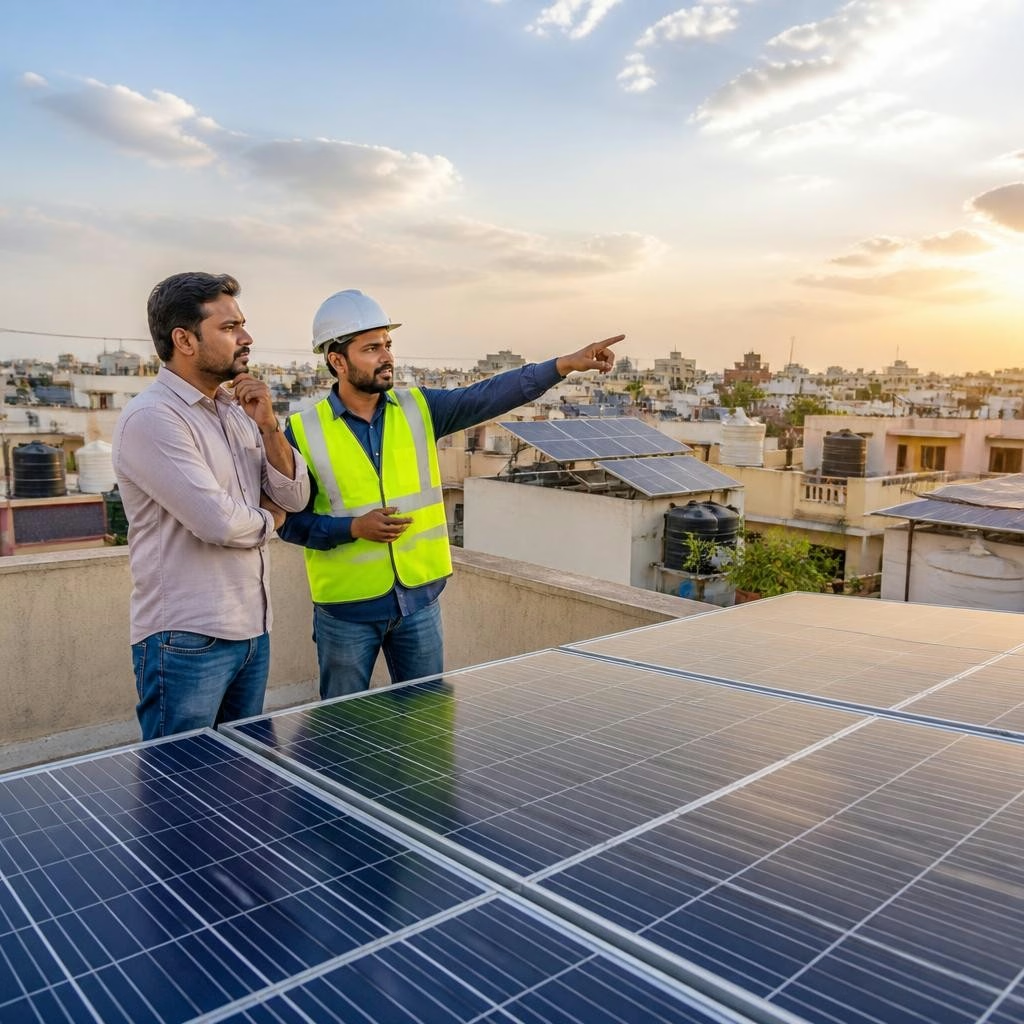
Installing a solar system is both a technical decision and a long-term relationship with an EPC or manufacturer. Asking focused questions up front reduces surprises, helps you compare proposals on the same basis, and protects system performance and value over time. Customer feedback shows many buyers are happy with product quality and helpful teams, while others experienced slow after‑sales response—so clarifying responsibilities and response times before signing is crucial.
Site assessment and system sizing
Request a detailed site survey and an energy audit. Ask for the proposed system size in kWp, expected annual generation (kWh) with assumptions used, and the basis for calculations (irradiance data, tilt, orientation, shading analysis). Confirm roof loading and structural checks if rooftop, and whether the proposal includes any changes to roof waterproofing or civil work.
Modules and technology choices
Ask which module types are being offered and why—for example monocrystalline, TOPCon, bifacial or polycrystalline—and how each choice affects yield, degradation and shading tolerance. If module specifics are important to you, request datasheets showing power rating (noting industry ranges such as 340 Wp–650 Wp), efficiency, temperature coefficient and manufacturer test reports. Also ask whether the modules are listed on government or industry approved lists (for example ALMM) if you plan to claim subsidies.
Inverters, batteries and balance-of-system components
Clarify the inverter brand, model and topology (string, central, hybrid), its efficiency, IP rating and protection features. If battery backup is included, ask about battery chemistry, usable capacity, round‑trip efficiency and end‑of‑warranty state of health assumptions. For all BOS items (mounting, cables, connectors), ask for specifications, corrosion protection and expected service life.
Installation, commissioning and timelines
Get a clear schedule: start and completion dates, milestones for permits and grid connection, and responsibilities for obtaining approvals and net‑metering. Ask who will perform the installation (in‑house team or subcontractor), the qualifications of site supervisors, and whether commissioning tests and a handover report with as‑built drawings will be provided.
Operations, monitoring and after‑sales support
Confirm what monitoring is provided—real‑time portal, alerts and mobile access—and who monitors performance. Ask for the defined service‑level agreements (response time for faults, escalation path), spare parts availability and whether periodic preventive maintenance/cleaning is included or available as an add‑on. Given mixed reviews in the market about after‑sales responsiveness, insist on written contact details and SLA terms in the contract.
Financials, subsidies and ROI assumptions
Ask for an itemized cost breakdown (modules, inverters, BOS, installation, O&M) and the payment schedule. If you expect subsidies or incentives (state/local or schemes such as PM Surya Ghar), ask who will apply on your behalf and how subsidy shortfalls are handled. Request a site‑specific ROI and payback estimate that lists all assumptions (tariff inflation, annual performance degradation, net‑metering rules) so you can compare proposals objectively.
Warranties, documentation and final checks
Before signing, get written details on product warranties and performance warranties (what percentage of nameplate power is guaranteed after a specified term), inverter and workmanship warranties, and insurance responsibilities. Request datasheets, test reports, the scope of maintenance, transferability of warranties, and a dispute resolution clause. Practical final steps: compare at least three quotes using the same metrics, ask for recent local references, and if possible visit a manufacturing plant or production line to see quality checks firsthand.
Article by
ECE (India) Energies Limited
ECE (India) Energies Private Limited Now known as ECE India Energies Limited was established to provide fruitful services to the stakeholders through value addition with an eye for quality, a clean environment, and safe life. Though the region of Vidarbha, Maharashtra, India is lacking industrial environment and employment, ECE has managed to become an employment creator starting from a handful of people in 2010. Manufacturing of Solar panels & Road Safety based products formed the initial base of the company, which later on went on to become a multi-faceted enterprise of green and solar energy products as well as services.