Questions to Ask During a Solar Factory Visit in Amravati
A practical checklist of technical and practical questions students, homeowners, and investors should ask on a solar panel manufacturing plant tour to get the most useful, decision-ready information.

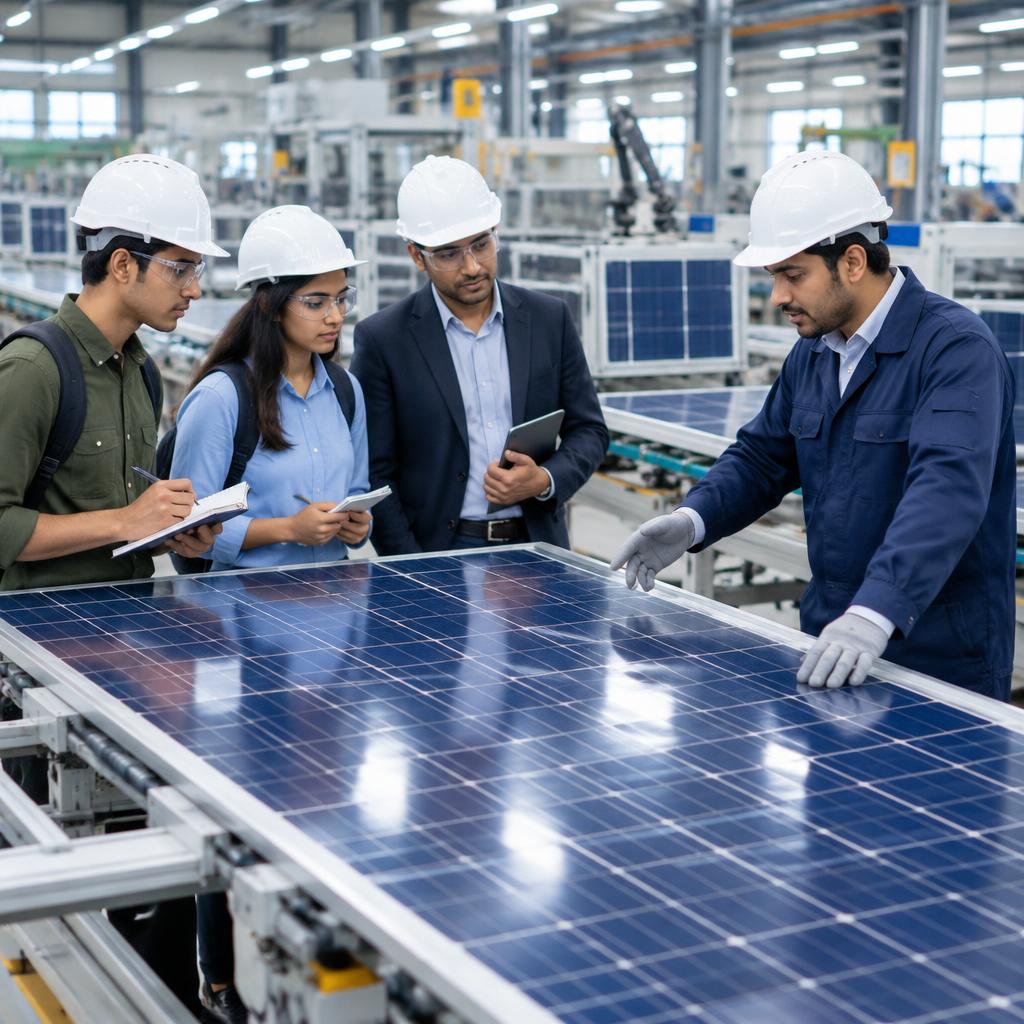
Why prepare a question list before the tour
A factory visit can be fast-paced and full of technical detail; arriving with a focused set of questions helps you leave with meaningful information. Many visitors report that plant tours make complex manufacturing steps clearer and help them understand product quality and testing processes. This checklist is designed for three common visitor types—students wanting to learn how panels are made, homeowners evaluating product quality and long‑term performance, and investors assessing manufacturing capability and risk.
Before you arrive: logistics and safety questions
Clarify practicalities so your visit runs smoothly. Ask for a proposed agenda, the expected duration, and whether there will be a guided presentation or Q&A. Confirm safety rules, required personal protective equipment (PPE), and photography or recording policies. Request the names and roles of staff who will lead the tour and whether you can meet R&D, quality or service teams. For groups, ask about maximum group size and whether a demonstration or hands‑on station is available.
Understanding the manufacturing steps
Use the tour to trace the product from raw materials to finished module. Ask which steps are performed on site (for example cell sorting, stringing, lamination, framing and testing) and which are outsourced. Inquire about automation levels on each line and whether the plant can show a sample flow of one panel through major steps. For a deeper view, ask about throughput and typical lead times for small sample batches versus full orders (without requesting confidential figures).
Materials and panel technologies to question
Probe the technology and components that affect performance and lifetime. Ask which cell technologies the factory manufactures or integrates (monocrystalline, polycrystalline, TOPCon, bifacial, half‑cut, etc.), and the panel power range—many modern manufacturers produce modules in ranges such as 340 Wp up to 650 Wp. Ask about glass and frame specifications, encapsulant type, backsheet durability, junction box and connector brands, anti‑PID measures, and whether modules are optimized for bifacial installations. For homeowners and investors, ask how the chosen technologies change real‑world energy yield and degradation.
Quality control and testing procedures
Quality assurance is a central reason to visit a factory. Ask which laboratory tests are performed in‑house and which are done by third parties. Useful questions include: Do you perform electroluminescence (EL) inspection and flash testing on every module? Are modules subjected to thermal cycling, humidity‑freeze, salt mist and mechanical load tests according to IEC standards? How are power bins assigned and tracked? Request to see sample test reports, the process for handling failed modules, and whether batch traceability exists from cell to serial number.
Standards, certification and compliance to verify
Ask specifically which international and national standards the products meet and whether the manufacturer can provide up‑to‑date certificates and report references. Typical points: IEC testing compliance, BIS registration where applicable, and whether module models appear on official procurement lists such as ALMM. For investors, ask about factory audit results, third‑party test house reports, and any ongoing compliance schedules that affect shipment and market access.
Warranty, after‑sales service and real‑world support
Warranty terms and support arrangements are often where customer experience matters most. Ask for the written product and performance warranties, the guaranteed degradation rate, and the power tolerance on module nameplate ratings. Ask how warranty claims are handled locally, typical response times, whether on‑site replacement stock is kept, and who handles inverter or BOS component failures. Given mixed customer reports in the market, it is sensible to request examples of past warranty cases (anonymized) and the escalation path if local service is delayed. Also ask whether the factory assists with subsidy paperwork or net‑metering documentation for buyers.
Questions for students and investors — deeper technical and business checks
Students can request demonstrations of lab equipment, sample IV curves, and electroluminescence images to learn failure modes. Investors should ask about R&D resources, product roadmaps, quality yield statistics, and environmental or sustainability practices (waste handling, green manufacturing steps). Request monitored performance data from installed projects or a sample module’s field yield report. Before you leave, ask for contact details to request follow‑up documentation—third‑party test reports, sample certificates, and a written summary of the factory’s QC procedures—so you can verify claims after the visit.
Customer review


Article by
ECE (India) Energies Limited
ECE (India) Energies Private Limited Now known as ECE India Energies Limited was established to provide fruitful services to the stakeholders through value addition with an eye for quality, a clean environment, and safe life. Though the region of Vidarbha, Maharashtra, India is lacking industrial environment and employment, ECE has managed to become an employment creator starting from a handful of people in 2010. Manufacturing of Solar panels & Road Safety based products formed the initial base of the company, which later on went on to become a multi-faceted enterprise of green and solar energy products as well as services. Currently having 1.2 GW fully automatic manufacturing facility