Solar for Educational Institutions: Turning Colleges and Schools into Learning Labs
Practical guidance for schools and colleges in Amravati and central India on using rooftop solar and factory visits to cut energy costs, enrich curricula, and give students hands-on exposure to renewable energy.

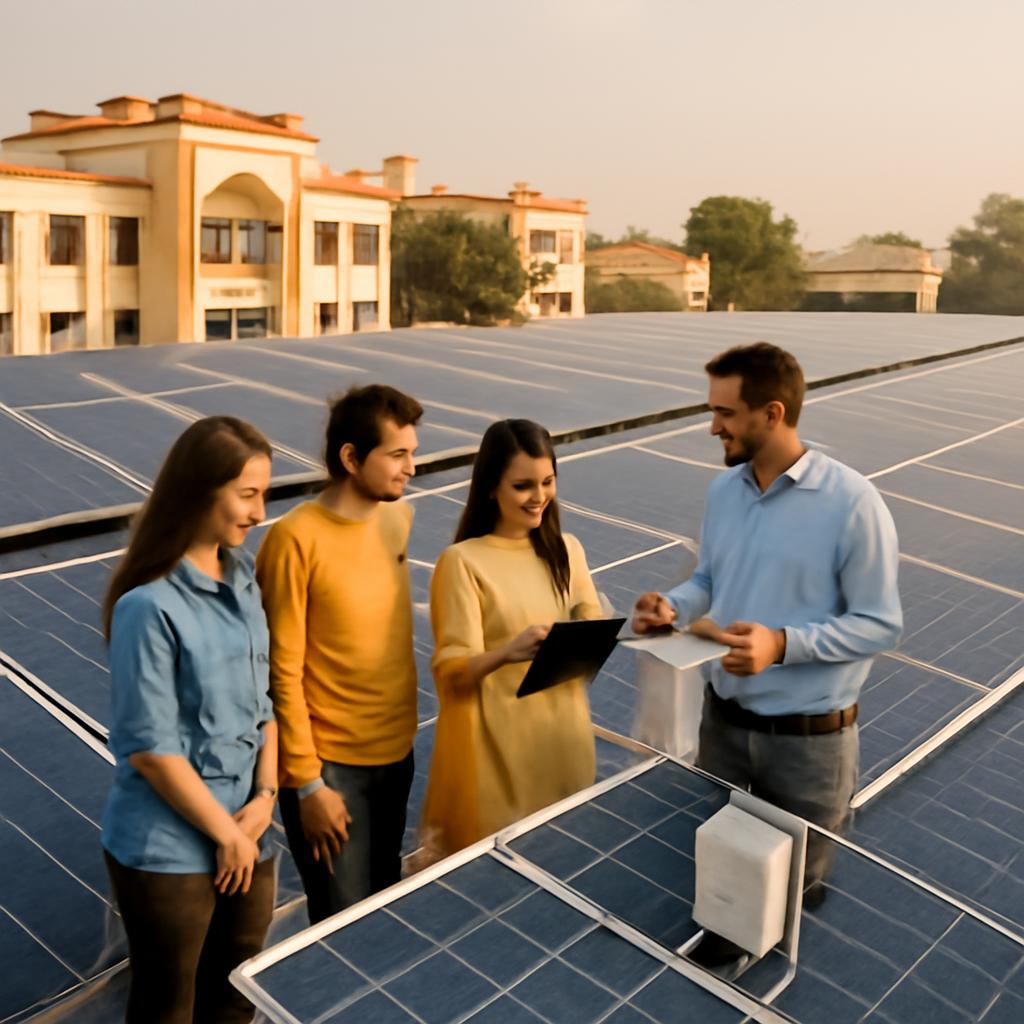
Why educational institutions should consider rooftop solar
Rooftop solar is a practical investment for schools and colleges: it reduces electricity bills, lowers carbon emissions, and demonstrates institutional leadership on sustainability. Beyond financial savings, an on-site solar system becomes a visible teaching resource that reinforces lessons in physics, environmental science, and engineering while giving students direct contact with clean-energy technology.
Financial and operational benefits for campuses
A properly sized rooftop system can offset a large portion of daytime load for classrooms, laboratories, and hostels, improving monthly cash flow. Institutions can explore net metering and relevant central or state incentive programs to improve payback, and phased installations let campuses start small and expand as budgets permit. Operationally, solar reduces dependence on grid supply during peak hours and can be combined with basic battery storage or demand-management to smooth campus loads.
How to plan a school or college rooftop solar project
Start with an energy audit to map typical loads, peak demand and roof availability. Next, commission a structural and shade assessment of roof areas to identify usable capacity. With that data, work with a solar engineer to size the array, select mounting (flat roof, pitched roof, or shaded carports) and determine inverter and monitoring needs. Finally, confirm local interconnection rules, net-metering procedures, and any subsidy schemes before contract signing.
Making the system a teaching and research asset
Turn the solar installation into a campus lab: install a simple real-time monitoring display in a common area, incorporate data into STEM coursework (energy yield, performance ratio, weather correlation) and host student projects on panel performance, shading studies or small-scale storage. Factory or plant visits complement on-site learning by showing manufacturing, testing and quality-control steps, which many visitors find inspiring and educational.
What to look for in a solar partner
When selecting a supplier, prioritize transparent manufacturing and testing processes, clear warranty terms, and responsive after-sales service. Ask potential vendors about their quality testing procedures, monitoring options and escalation paths for service requests. Reviews from institutional visits and presentations are useful indicators of how well a supplier explains technology and supports educational outreach; equally important is documentation about warranties and maintenance commitments.
Installation, maintenance and avoiding common pitfalls
Plan for safe, phased installation that minimizes disruption to classes. Include a maintenance agreement that covers periodic cleaning, electrical checks and inverter servicing, and ensure remote monitoring is in place to detect faults quickly. While many customers report high product performance and helpful staff, some experience inconsistent after-sales responsiveness—so define response times and escalation steps in the contract to protect your institution’s uptime.
Next steps and working with local manufacturers
Educational institutions in Amravati and central India can benefit from combining rooftop installations with plant visits to deepen student learning and community engagement. Consider arranging a factory visit with a local manufacturer to see panel production and testing firsthand before finalizing procurement. A visit can clarify manufacturing quality and help your institution design curricula around real-world renewable-energy examples while advancing sustainability goals.
Article by
ECE (India) Energies Limited
ECE (India) Energies Private Limited Now known as ECE India Energies Limited was established to provide fruitful services to the stakeholders through value addition with an eye for quality, a clean environment, and safe life. Though the region of Vidarbha, Maharashtra, India is lacking industrial environment and employment, ECE has managed to become an employment creator starting from a handful of people in 2010. Manufacturing of Solar panels & Road Safety based products formed the initial base of the company, which later on went on to become a multi-faceted enterprise of green and solar energy products as well as services. Currently having 1.2 GW fully automatic manufacturing facility