Solar for Small Industries: How to Size Systems to Cut Bills and Prevent Outages
Practical guidance for small and medium industrial businesses on assessing loads, choosing panels and backup, and planning solar installations that lower electricity costs and improve reliability.

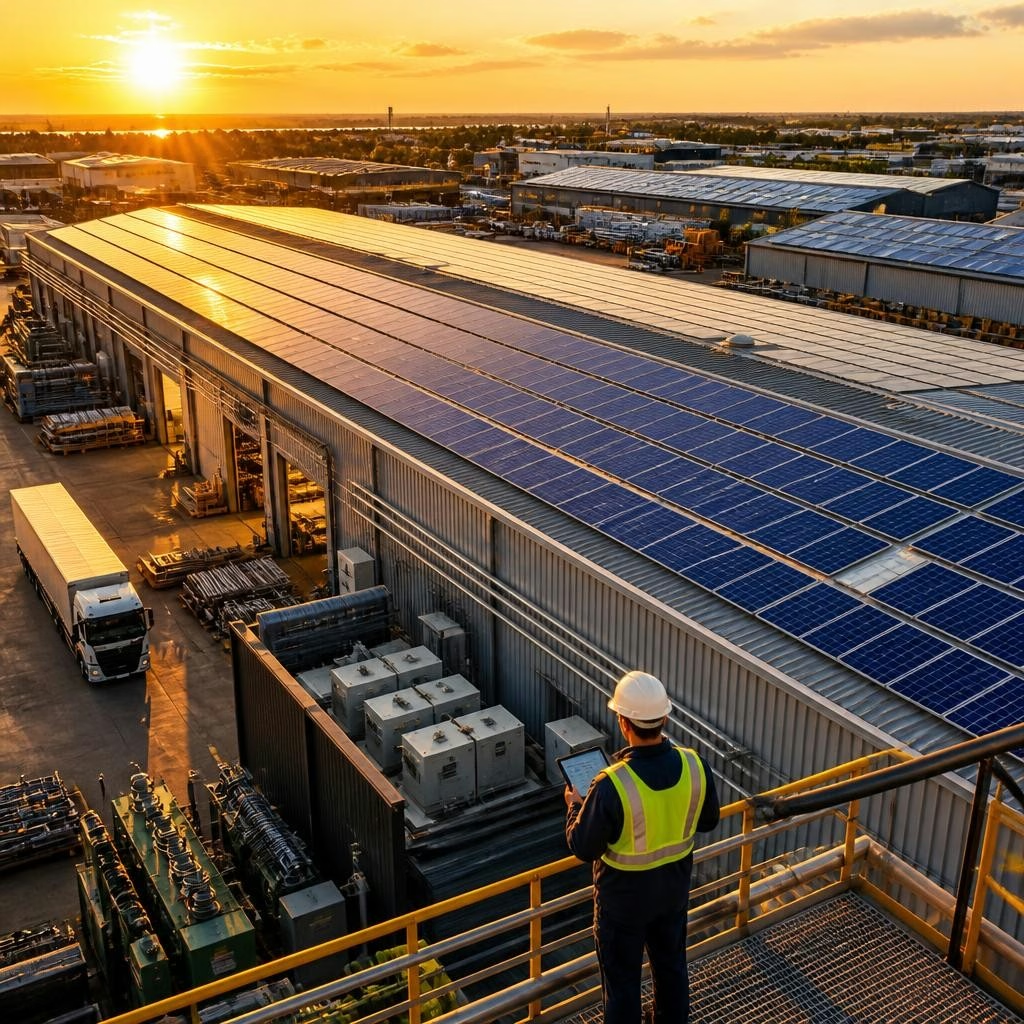
Why small industries should consider solar now
Small and medium industrial units face two common problems: high electricity bills and costly interruptions when power dips or fails. A properly sized solar system can reduce monthly energy costs, shave peak demand charges, and — when paired with storage or smart controls — supply reliable power during outages. For firms seeking greater energy independence and lower operating costs, solar is no longer just an environmental choice; it’s a business decision.
Start with a clear load and demand assessment
Sizing begins with data. Gather your recent electricity bills and runtime information for heavy machines (motors, compressors, HVAC, pumps). Key numbers are average daily kWh, peak kW (demand), and the times when heavy loads run. Note seasonal changes and shift patterns. From this you can identify how much of your consumption you can realistically offset with solar (for example daytime loads are easiest) and where batteries or generator integration will be needed to cover night shifts or critical processes.
Selecting solar array capacity and panel types
Translate your target kWh offset into array capacity (kW). A simple approach: divide the daily kWh you want to cover by the site’s average peak sun-hours to estimate required kW. When choosing modules, consider long-term performance and footprint. Manufacturers produce modules in ranges such as 340 Wp to 650 Wp; higher-watt panels (e.g., 400–650 Wp) reduce space needs and wiring complexity. Decide between technologies—monocrystalline for compact high-efficiency arrays, TOPCon for improved cell efficiency and potential long-term yields, bifacial if you can gain reflected light from a reflective surface or elevated mounting, and polycrystalline where budget and availability make sense. Check datasheets for temperature coefficients and degradation rates to estimate real-world energy output.
Inverters, batteries and handling heavy loads
Inverters must match the array and the nature of your loads. For continuous heavy machinery, choose inverters rated for the peak and surge demands and consider multiple strings or modular inverters for redundancy. If you need blackout protection, include battery storage sized to supply the critical loads you must keep running and sized by usable kWh and desired backup hours. For very large or highly critical loads, hybrid systems that coordinate grid, generator (DG), batteries, and solar can provide reliable cover while limiting fuel use. Work with engineers to model start-up currents and motor surges; undersized inverters or batteries can cause faults and downtime.
Layout options and operational strategies
Commercial rooftop installations are often most convenient, but ground-mounted or elevated racks can allow bifacial gains and easier cooling. Consider orientation and tilt to match your peak production needs (e.g., east-west arrays can flatten production over the day). Operational strategies that reduce bills include load-shifting (running heavy processes when solar is abundant), peak shaving (using batteries to reduce demand during highest tariff windows), and scheduling noncritical tasks to daylight hours. A smart energy management system helps coordinate these actions and gives visibility into savings.
Economics: ROI, incentives and standards to check
Estimate ROI by comparing the system cost to expected annual savings (reduced consumption from the grid, lower demand charges, and any fuel savings). Factor in maintenance and realistic annual degradation. Explore local net metering rules and available subsidies or schemes; these can materially affect payback timelines. When selecting equipment and suppliers, insist on modules and inverters that meet recognized standards (IEC, BIS) and check manufacturer listings such as the Approved List of Models and Manufacturers (ALMM) where applicable. Quality testing and factory inspection reports help verify long-term performance.
Installation, maintenance and choosing a partner
Successful industrial solar projects combine good equipment and reliable execution. Ask installers for references, O&M plans, and warranties on panels and inverters. Regular maintenance—cleaning panels, checking electrical connections, and monitoring inverter logs—keeps production near expected levels. When evaluating manufacturers and teams, practical support matters: customers often report better outcomes when the project team explains system behavior clearly and responds promptly to service requests. Manufacturer transparency about panel specifications and factory testing is a useful sign when comparing suppliers.
Customer review


Article by
ECE (India) Energies Limited
ECE (India) Energies Private Limited Now known as ECE India Energies Limited was established to provide fruitful services to the stakeholders through value addition with an eye for quality, a clean environment, and safe life. Though the region of Vidarbha, Maharashtra, India is lacking industrial environment and employment, ECE has managed to become an employment creator starting from a handful of people in 2010. Manufacturing of Solar panels & Road Safety based products formed the initial base of the company, which later on went on to become a multi-faceted enterprise of green and solar energy products as well as services.