Solar Panel Manufacturing at ECE’s Amravati Plant: Step-by-Step from Cell to Finished Module
A clear, stepwise walkthrough of how solar panels are built at ECE’s Amravati plant — from cells and soldering to lamination, framing, testing and shipment — plus what visitors and local students can learn about quality and performance.

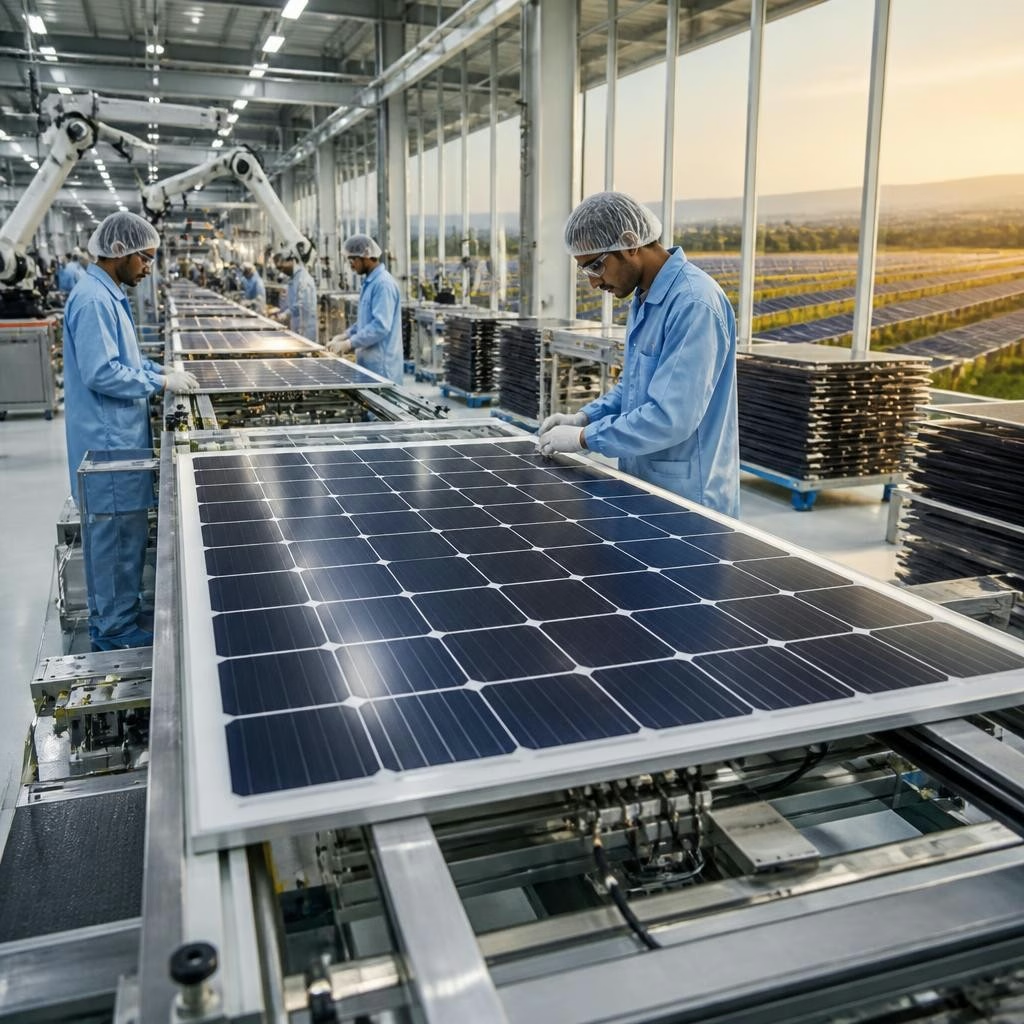
Why understanding manufacturing matters
Knowing how a solar panel is made helps homeowners, students, and commercial buyers evaluate quality, longevity, and performance. Using ECE’s Amravati manufacturing facility as a case study, this article outlines the typical production stages used to build modules (ECE produces modules in ranges used across residential and commercial projects) and highlights what to look for when assessing a finished panel.
Raw materials and cell types
Manufacturing begins with solar cells — the active semiconductor pieces that convert sunlight to electricity. Modern factories work with several cell technologies, including monocrystalline, TOPCon, bifacial and polycrystalline variants. The choice of cell type affects module efficiency, behavior in partial shade, and suitability for rooftop, commercial or utility-scale applications. Consistent incoming inspection of cells, encapsulants (EVA or other polymers), backsheets and glass is the first line of quality control.
Stringing and soldering: forming the electrical backbone
Cells are arranged into strings and electrically connected with tabbing and soldering. Precision in cell alignment, soldering quality and the number of busbars influences internal resistance and power output. Stringing can be semi-automated or fully automated; important checks at this stage include verifying solder joints, alignment tolerances and series/parallel wiring so the panel reaches its rated wattage reliably.
Lamination: encapsulation for durability
After stringing, cells are laid between the front glass and backsheet with encapsulant material. The laminate stack is vacuum-bagged and passed through a controlled-temperature laminator where heat and pressure cure the encapsulant. Proper lamination removes air pockets, secures cells against vibration and moisture ingress, and is critical to long-term performance. Visual inspection after lamination checks for bubbles, delamination and correct cell placement.
Framing, junction box and mechanical assembly
Once laminated, modules are trimmed, fitted into an aluminium frame and equipped with a junction box and bypass diodes. The frame provides structural rigidity and mounting points; correct sealing and gasketing prevent water ingress. The junction box must be securely sealed and wired; workmanship here affects field reliability, ease of installation and safety. Final mechanical checks include torque verification, corner integrity and handling labels.
Electrical and visual testing: ensuring rated performance
Completed modules undergo electrical tests (IV curve measurement to confirm rated power, open-circuit voltage and short-circuit current) and visual/functional inspections. Advanced inspections may include electroluminescence imaging to reveal microcracks and hot-spot risks, insulation/leakage tests, and thermal checks. Several visitors to ECE’s plant have noted the emphasis on testing and the clarity of demonstration during tours, which reflects how testing is central to quality assurance.
Traceability, packaging and customer follow-up
Manufacturers typically apply serial numbers, labels with electrical ratings, and packing lists so modules can be traced through warranty and service lifecycles. ECE supplies modules across India and, as with many manufacturers, customers comment positively about product performance and informative presentations. At the same time, reviews indicate that after‑sales responsiveness can vary; prospective buyers should confirm warranty terms, replacement procedures and local service arrangements before purchase.
What visitors and students should look for during a plant tour
A factory visit is one of the best ways to learn. When touring a plant, observe cleanliness, the flow between stations (incoming inspection → assembly → lamination → testing → packing), and how operators and engineers explain processes. Ask to see IV test results, electroluminescence reports and batch traceability. For practical project decisions, ask about the panel’s technology (e.g., TOPCon vs mono), expected degradation rate, recommended mounting, net metering and local subsidy interactions. A well-run tour will leave you with specific questions and greater confidence in choosing the right module for your needs.
Article by
ECE (India) Energies Limited
ECE (India) Energies Private Limited Now known as ECE India Energies Limited was established to provide fruitful services to the stakeholders through value addition with an eye for quality, a clean environment, and safe life. Though the region of Vidarbha, Maharashtra, India is lacking industrial environment and employment, ECE has managed to become an employment creator starting from a handful of people in 2010. Manufacturing of Solar panels & Road Safety based products formed the initial base of the company, which later on went on to become a multi-faceted enterprise of green and solar energy products as well as services.