Why a Solar Plant Visit in Amravati Is Valuable for Students, Farmers and Businesses
This article explains what visitors learn on a guided solar manufacturing plant tour—manufacturing steps, quality testing, practical questions to ask, and how students, farmers and business owners can turn what they see into better decisions about renewable energy projects.

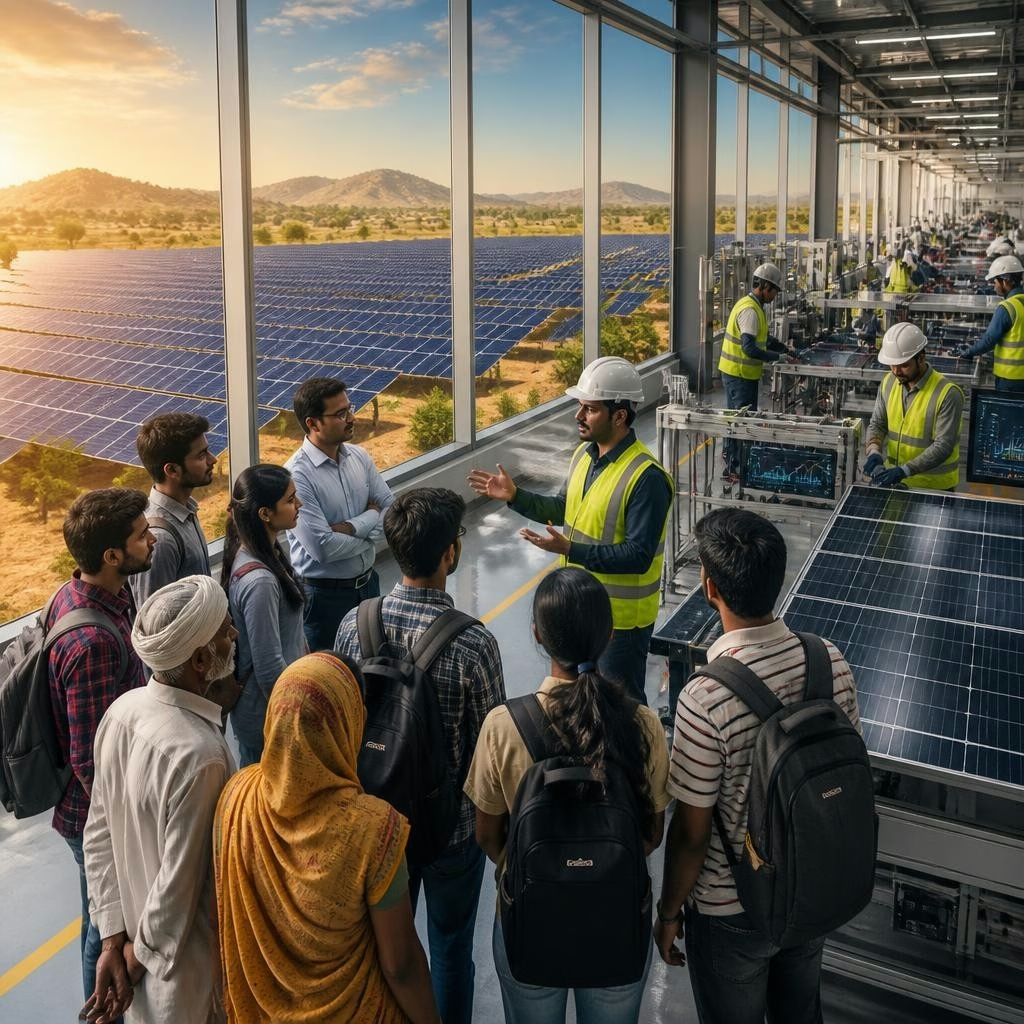
A practical window into how solar panels are made
A guided visit to a solar manufacturing plant turns abstract classroom topics into visible processes: cell sorting and stringing, lamination, framing and junction-box assembly, and final performance testing. For manufacturers like ECE India Energies, visitors can see modules across the commercial Wp range (for example 340 Wp to 650 Wp) and learn how different cell and module types—monocrystalline, TOPCon, bifacial and polycrystalline—translate into real products. Observing the production line helps visitors appreciate the precision, material choices and production controls behind the modules they read about.
Quality checks you can observe and why they matter
A key benefit of a plant tour is watching the testing that underpins long-term performance. Typical demonstrations include electroluminescence imaging, IV-curve and flash testing, insulation and wet-leakage checks, and environmental stress tests such as thermal cycling or humidity exposure. These visible checks are the practical side of meeting widely used benchmarks like IEC and BIS testing approaches. Seeing equipment and data firsthand makes it easier to compare datasheets, understand degradation factors, and ask informed questions about warranty and expected output.
What students gain from a hands-on visit
For students, a plant visit links theory to practice. Engineering and science students can observe manufacturing workflows, quality-control instrumentation, and data readouts; environmental and business students see how sustainability and supply-chain decisions interact. Visits often include presentations by staff who explain technology choices and testing procedures in plain language—an approach multiple visitors have praised—so students leave with concrete examples for projects, clearer career perspectives, and a better grasp of the skills solar manufacturing requires.
How farmers can use the visit to plan practical systems
Farmers benefit by seeing modules and testing processes up close and by asking practical, site-related questions. During a tour they can learn how panel type and orientation affect yield, what module power (Wp) means for irrigation pumps, and which tests indicate long-term reliability in humid or dusty environments. Visitors should use the opportunity to discuss financing options, subsidy programs and net-metering basics so they can judge system economics and payback timelines for agricultural installs.
What business owners should focus on during a tour
Commercial and industrial owners should treat a plant visit as due diligence. Key topics to investigate include module power ratings and degradation, bifacial gains for open installations, compatibility with inverters, and maintenance practices that reduce downtime. Ask about typical field performance, warranty-handling procedures and how the manufacturer supports EPC or O&M partners. Seeing production and testing firsthand helps businesses compare suppliers beyond marketing claims and make procurement choices aligned with rooftop, industrial or utility-scale needs.
Questions to ask and practical items to bring
Prepare a short list of focused questions: request module datasheets, inquire about expected degradation rates, ask what tests are performed and how warranty claims are handled, and get clarity on inverter compatibility and mounting recommendations. Bring site photos or a simple load profile if you want system-sizing advice. Also ask how the manufacturer supports net-metering applications, subsidy processes (including central or state schemes) and post-sale service—areas that commonly shape long-term satisfaction.
Making the most of the visit and next steps
To get maximum value, schedule the visit in advance, confirm whether safety gear or group-size limits apply, and ask for a short presentation that describes product range, testing protocols and after-sales support. If an in-person tour isn’t practical, many manufacturers provide virtual tours or detailed test reports. Whether you are a student evaluating career paths, a farmer planning a solar pump, or a business owner comparing suppliers, a plant visit converts technical detail into actionable insight—helping you evaluate performance, reliability and total cost more confidently.
Article by
ECE (India) Energies Limited
ECE (India) Energies Private Limited Now known as ECE India Energies Limited was established to provide fruitful services to the stakeholders through value addition with an eye for quality, a clean environment, and safe life. Though the region of Vidarbha, Maharashtra, India is lacking industrial environment and employment, ECE has managed to become an employment creator starting from a handful of people in 2010. Manufacturing of Solar panels & Road Safety based products formed the initial base of the company, which later on went on to become a multi-faceted enterprise of green and solar energy products as well as services.