Childhood Apraxia of Speech vs. ‘Late Talking’: A Gurgaon Parent’s Guide
A practical, parent-friendly guide to telling childhood apraxia of speech apart from late talking, what assessments Gurgaon speech therapists use, and what a realistic therapy plan looks like at a centre like Rainbow Child Development Centre.
Why this matters for Gurgaon parents
If your toddler isn’t talking as much as other kids, it can be hard to know whether they’re a typical ‘late talker’ or need more specialised help for something like Childhood Apraxia of Speech (CAS). Early clarity helps you get the right kind of support. At local centres in Gurugram such as Rainbow Child Development Centre, parents often report clear, practical guidance and steady progress once the right plan is in place.
Quick: what’s the difference?
Late talking generally means a child is behind in expressive language but follows typical patterns of sound development and can often catch up with language-rich input and targeted speech therapy. Childhood Apraxia of Speech is a motor-planning difficulty: the brain has trouble coordinating the precise movements needed for speech. That results in inconsistent errors, difficulty imitating sounds, and speech that’s hard to understand even when the child seems to know what they want to say.
Signs that suggest CAS rather than simple delay
Look for features such as: inconsistent speech errors (the same word sounds different each time), difficulty imitating sounds or syllables, limited variety of consonant and vowel sounds compared with peers, groping or visible effort when trying to form words, and greater difficulty with longer or more complex words. Children with CAS may also have delayed babbling as infants. These are signals to seek a detailed speech-motor evaluation rather than waiting to see if they ‘catch up.’
Signs more typical of late talking
Late talkers usually have a smaller vocabulary for their age but produce words consistently and follow predictable error patterns. They often respond to language, understand instructions, and use gestures to communicate. If hearing, cognition, and interaction appear otherwise typical, a focused language-stimulation approach and regular speech therapy can often help late talkers make steady gains.
When to seek an assessment in Gurugram
If your child isn’t using many words by 18–24 months, has unclear speech beyond age 2, avoids speaking, or shows any of the CAS indicators above, book a speech and language assessment. At a multidisciplinary centre in Gurugram parents are encouraged to begin evaluation early — especially if speech sounds effortful or inconsistent. A hearing check is also a routine and important first step to rule out hearing-related causes.
What assessments speech therapists use
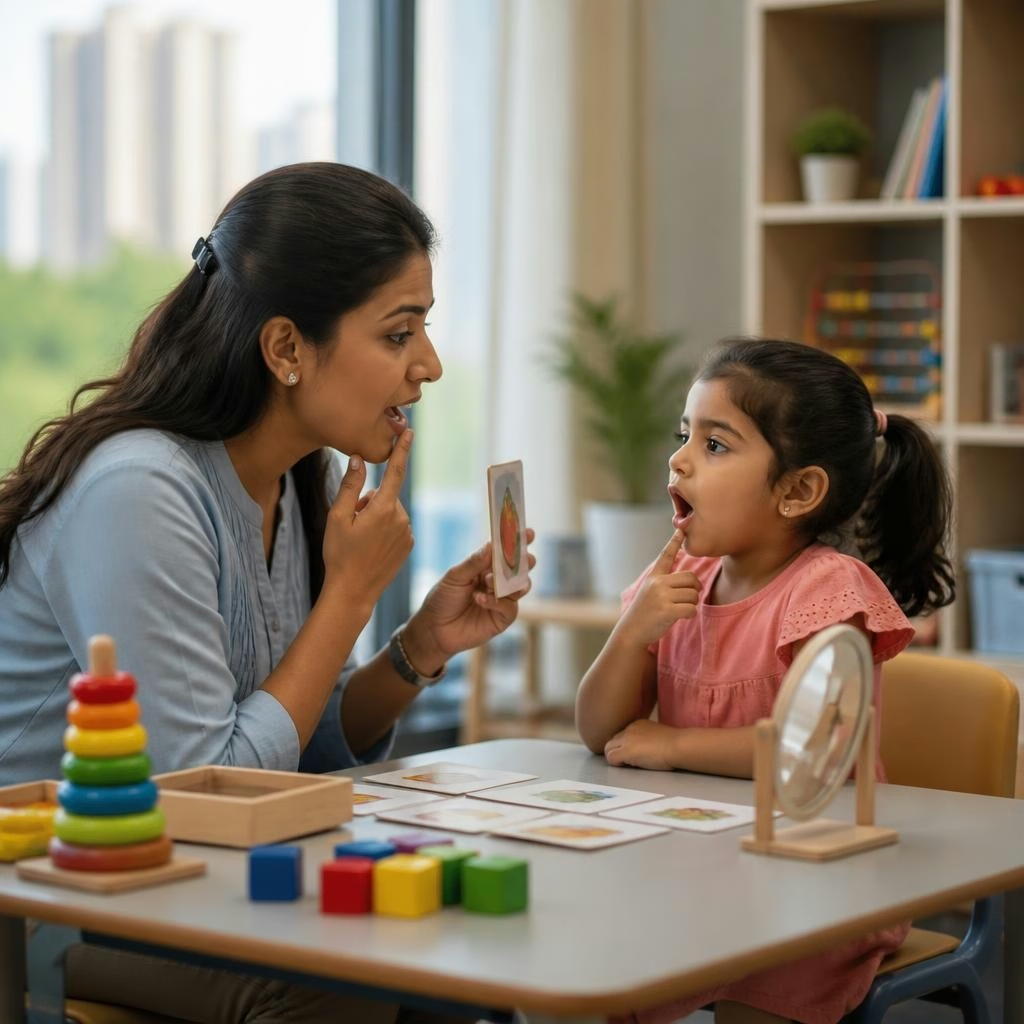
Therapists typically combine formal speech and language assessment with an oral-motor (oral placement) examination and naturalistic observation in play. Centres in Gurugram offer Speech and Language Assessment and Oral Placement Therapy as part of the evaluation. A comprehensive approach often includes input from occupational therapists or psychologists when sensory, motor, attention, or behavioural factors could affect communication.
How diagnosis leads to a personalised plan
A diagnosis (or working hypothesis) guides targeted goals. For suspected CAS, the plan usually focuses on motor planning: repetitive, structured practice of sounds/words in gradually increasing complexity, with lots of visual and tactile cues, and consistent homework for caregivers. For late talkers, the emphasis may be on expanding vocabulary, modelling language, and parent-led strategies. At Rainbow, parents note that plans are explained clearly and include practical home activities so therapy continues beyond clinic time.
What realistic progress looks like
Progress for CAS is typically gradual and measured in small gains — clearer production of specific sounds, improved imitation, longer word combinations, and more intelligible speech in familiar contexts. For late talkers, the pace may be faster once intervention starts, with vocabulary and phrase use expanding over weeks to months. Centres in Gurugram report steady improvements when families commit to regular sessions plus consistent home practice, with therapists providing regular updates and guidance.
Simple tips parents can use at home
Keep instructions simple, model short phrases, follow your child’s interests, and give choices so they’re motivated to use words. Use repetition in play, slow your own speech a little, and celebrate attempts rather than insisting on perfect sounds. Record short videos of the child talking to share with the therapist — that helps track change. Also, follow through on recommended hearing checks and any suggested allied therapies like occupational therapy when fine motor or sensory issues are present.
How to get started at Rainbow Child Development Centre (Gurugram)
If you’re in Gurugram and worried about speech development, arrange a Speech and Language Assessment to clarify whether your child is a late talker or showing signs of CAS. Centres like Rainbow offer multidisciplinary evaluation (speech, OT, psychological assessment) and family-focused plans. Many local parents describe patient therapists, clear explanations, and useful home strategies — a helpful starting point when you want a practical, realistic path forward for your child.
Customer review


Article by
Rainbow Child Development Center | Occupational Therapy in Gurugram | Speech Therapy | ABA Therapy | Special Educator
Rainbow Child Development Centre in Gurgaon, Haryana, provides specialized care for children through occupational therapy, speech and hearing therapy, ABA, special education, and child psychiatry. As a leading occupational therapy centre in Gurgaon, we enhance motor skills, sensory processing, and independence. We also offer expert speech therapy in Gurgaon to improve communication and language. Renowned for effective autism treatment in Gurgaon, we deliver personalized programs, making us a trusted autism centre in Gurgaon. Our skilled special educators in Gurgaon provide tailored learning plans, positioning us among the top special schools in Gurgaon, special education schools in Gurgaon, and centers for comprehensive therapy in Gurgaon.