Early Signs of Speech Delay in Toddlers: When Gurgaon Parents Shouldn’t ‘Wait and Watch’
A practical, age‑by‑age guide for Gurgaon parents on milestones for 1–4 year olds, clear red flags that mean you should get an assessment, and how early speech therapy and multidisciplinary care can improve long‑term communication.
Why you shouldn’t simply ‘wait and watch’
It’s tempting to hope a child will ‘catch up’ on their own, but early communication skills are the foundation for learning, social interaction, and behaviour. Identifying delays early gives you more options—simple strategies you can do at home, targeted speech therapy, or a multidisciplinary plan that includes occupational therapy or special education if needed. Many families who seek help early see clearer progress and feel more confident supporting their child’s development.
Milestones to look for around 12 months
By about a year, most children are babbling with varied sounds, responding to their name, enjoying simple games like peek‑a‑boo, and using gestures such as pointing or waving. You might also hear a clear first word. If a child rarely babbles, doesn’t react to sounds or their name, or uses almost no gestures, it’s a sign to mention to your paediatrician or a speech‑language therapist.
What to expect near 18 months
Between one and two years, children usually add more single words to their repertoire and begin communicating needs with language or gestures. They follow simple requests when given with gestures and enjoy copying sounds and words. If a toddler at this stage has very few spoken words, little interest in communicating, or doesn’t follow simple prompts, an assessment can help identify whether speech therapy or hearing checks are needed.
Key changes by 2 years
Around age two, many children start combining words—simple two‑word phrases—to express wants and ideas. They show greater interest in play with others and can follow short, familiar instructions. If a two‑year‑old is not combining words, shows limited understanding of simple directions, or communicates mostly by pointing without developing speech, it’s a practical red flag to seek evaluation.
Communication at 3 years
Three‑year‑olds usually speak in short sentences, are understood by familiar adults much of the time, and can participate in simple conversations. They also begin to play more interactively with peers. If your child’s speech remains largely unclear, they rely only on gestures, or they avoid social interaction and don’t respond to name and simple conversation cues, consider getting a professional opinion.
What to watch for by 4 years
By four, children typically use longer sentences, tell basic stories, and follow multi‑step instructions. If a child still struggles to make themselves understood, has very limited vocabulary for their age, or shows a noticeable drop in previously learned skills, these are signals that an assessment and early intervention will be helpful.
Practical red flags that mean: don’t wait — get assessed
Look for clear, actionable signs rather than guessing: persistent lack of babbling or first words; very limited vocabulary by 18–24 months; not combining words by two years; speech that is hard to understand for familiar adults at ages three to four; little eye contact or social referencing when others speak; or any loss of words or social skills a child already had. Also check hearing first — untreated hearing loss can look like speech delay. If you notice any of these, schedule an assessment rather than waiting.
What an assessment in Gurgaon typically covers
An assessment usually starts with a speech and language check and a hearing screening. Because communication interacts with play, behaviour, and motor skills, many families benefit from a multidisciplinary evaluation—speech‑language pathologists working alongside occupational therapists, special educators or child psychologists—to get a full picture. The goal is a clear plan: goals for therapy, practical home strategies, and recommended follow‑ups.
How early therapy changes outcomes — what local families report
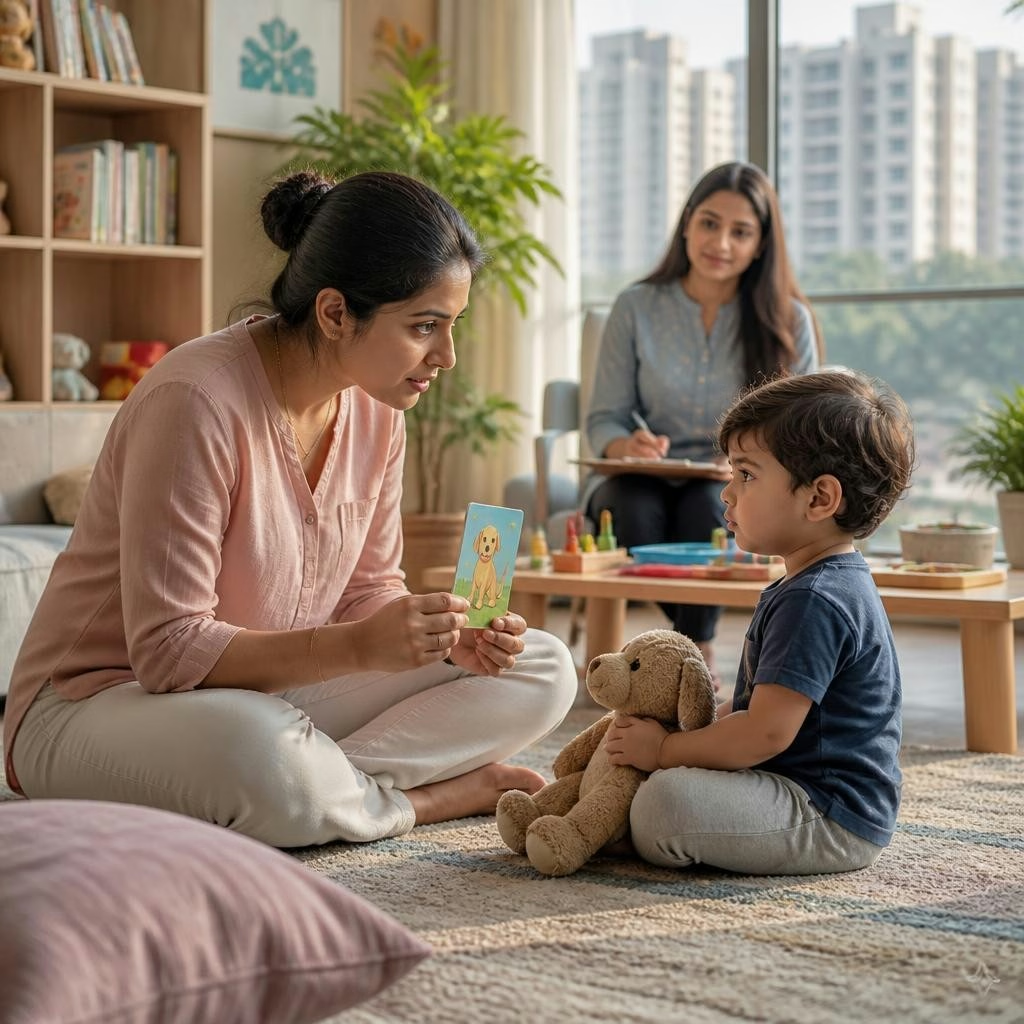
Families who started therapy earlier often report steady, visible progress in speech clarity, confidence and everyday communication. For example, one parent described notable improvement after a few months of speech sessions, and many others praise the structured, child‑friendly approach and clear home guidance that continued progress between sessions. In Gurgaon, centres that combine speech therapy with occupational therapy, ABA and special education can offer coordinated support when needs overlap.
Simple next steps and home tips for Gurgaon parents
If you’re worried: 1) talk with your paediatrician and ask for a hearing check; 2) book a speech‑language evaluation to get concrete guidance; 3) use everyday moments for language—narrate routines, read together daily, give simple choices, and wait for the child to respond; and 4) follow the home activities your therapist recommends so gains generalize into daily life. If you’d like local support, Rainbow Child Development Centre in Gurugram offers speech therapy, occupational therapy, ABA and special education under one roof and can arrange assessments and individualized plans at the centre. Early action gives your child the best chance to build strong communication skills.
Customer review


Article by
Rainbow Child Development Center | Occupational Therapy in Gurugram | Speech Therapy | ABA Therapy | Special Educator
Rainbow Child Development Centre in Gurgaon, Haryana, provides specialized care for children through occupational therapy, speech and hearing therapy, ABA, special education, and child psychiatry. As a leading occupational therapy centre in Gurgaon, we enhance motor skills, sensory processing, and independence. We also offer expert speech therapy in Gurgaon to improve communication and language. Renowned for effective autism treatment in Gurgaon, we deliver personalized programs, making us a trusted autism centre in Gurgaon. Our skilled special educators in Gurgaon provide tailored learning plans, positioning us among the top special schools in Gurgaon, special education schools in Gurgaon, and centers for comprehensive therapy in Gurgaon.