Feeding and Swallowing Difficulties in Children: When Gurugram Parents Should Seek Therapy
A practical guide for Gurugram parents to spot feeding and swallowing problems in children, know when to seek professional help, and understand how specialised feeding and dysphagia therapy typically works step by step.
Why this matters
Feeding and swallowing are everyday activities that most families take for granted — until a child struggles. Problems with eating can affect nutrition, growth, comfort, and family mealtimes. This article explains common signs to watch for, when to get help in Gurugram, and what a specialised feeding or dysphagia therapy program typically involves so you can take calm, practical next steps for your child.
Common signs parents notice
Parents usually spot problems first. Watch for repeated coughing or gagging during meals, choking or coughing that happens with solids or liquids, a wet or gurgly voice after swallowing, persistent drooling, food pocketing in the cheeks, long mealtimes (much slower than peers), strong food refusal or selective eating, frequent spitting up, or poor weight gain. Any of these can be a clue that your child is having trouble handling textures or coordinating swallowing safely.
Red flags that suggest professional assessment is needed
Some concerns are best evaluated sooner rather than later. Seek a professional assessment if your child: has repeated choking episodes; frequently coughs or breathes noisily during meals; shows weight loss or falls off expected growth charts; avoids most foods or fluids and mealtimes become battles; or has known developmental delays that affect mouth movement, coordination, or sensory responses. A specialist can identify whether the issue is oral motor, sensory, behavioral, or a swallowing safety concern.
When feeding problems are an emergency
If a child is actively choking and cannot breathe, becomes pale or blue, or cannot regain normal breathing after a choking episode, get immediate emergency care. Also seek urgent attention for repeated near-choking events, breathing changes during or after eating, or signs of aspiration-related chest infection (for example, new persistent cough or fever after feeding). If you’re unsure whether a situation is an emergency, err on the side of prompt medical help.
What an initial assessment looks like
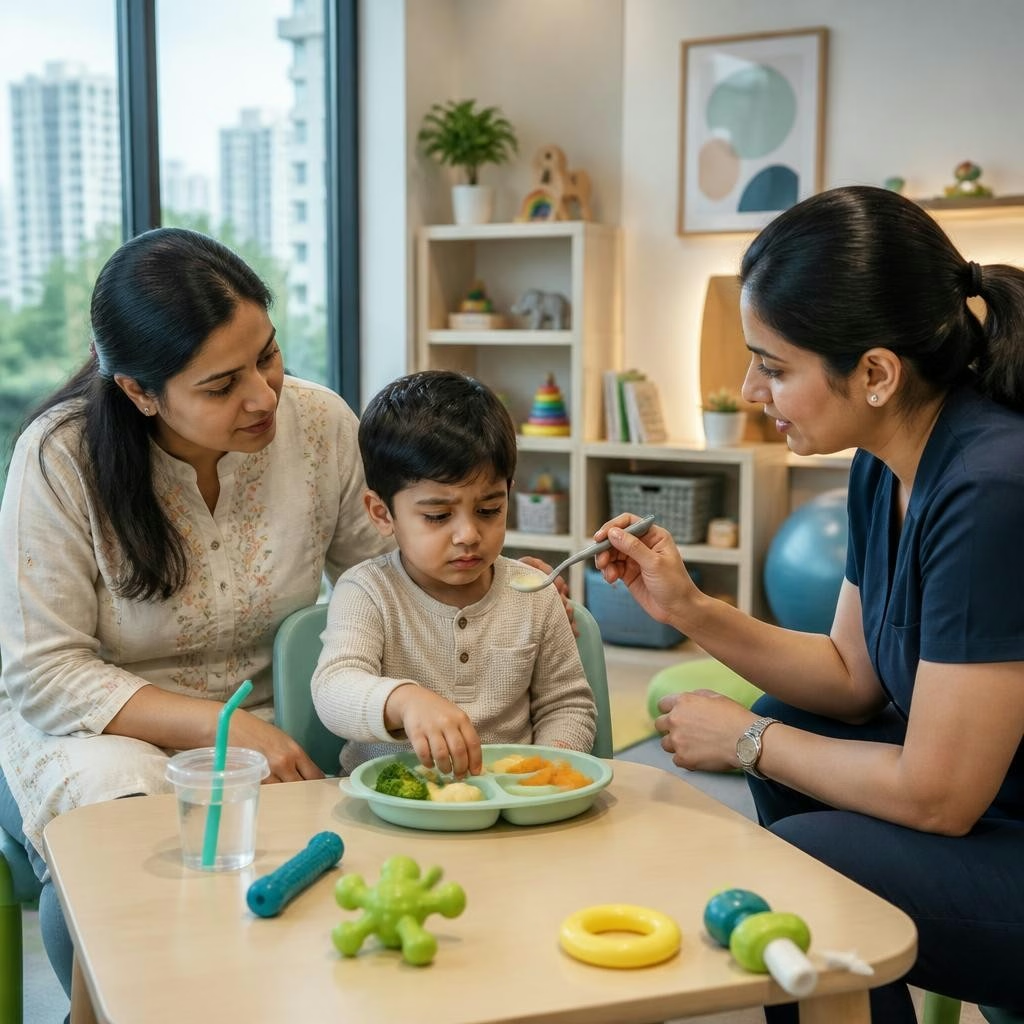
A feeding-focused assessment at a specialist centre typically starts with a detailed history: feeding milestones, current eating patterns, medical background, and behaviours at mealtimes. Therapists observe the child during feeding to note posture, oral movements, chewing and swallowing, and responses to different textures. Speech-language pathologists and occupational therapists commonly lead these assessments; they may work with special educators or paediatricians for a fuller picture. At Rainbow Child Development Centre in Gurugram you can expect a child-friendly evaluation that looks at both safety and functional skills.
How specialised feeding and dysphagia therapy usually proceeds — step by step
Therapy is personalised, but most programs follow a clear sequence: 1) intake and goal-setting with parents, 2) targeted oral-motor and sensory exercises to improve mouth strength and sensation, 3) positioning and mealtime setup to support safer swallowing, 4) careful texture progression and guided practice with foods and liquids, 5) behavioural and routine strategies to reduce mealtime anxiety and refusal, and 6) regular review and adjustment of goals. Therapists also teach parents simple, practical techniques to use at home so progress continues between sessions.
Who’s on the therapy team and your role as a parent
Effective feeding support is usually multidisciplinary: speech-language therapists focus on swallowing and oral motor skills; occupational therapists address sensory processing, posture, and coordination; special educators and counsellors help with mealtime routines and behavioural strategies. Parents are essential partners — therapists will explain goals, demonstrate techniques, and give home programs. Many families appreciate clear step-by-step guidance and regular updates from the team, which helps the child generalise skills into everyday meals.
Practical tips to try safely at home
While arranging an assessment, you can make mealtimes safer and less stressful: 1) keep the child upright and well-supported during eating, 2) offer small, manageable bites and sips, 3) serve one food at a time to reduce overwhelm, 4) keep the environment calm and predictable, turning off screens and minimizing distractions, 5) avoid forcing food — use gentle encouragement and short practice sessions, and 6) record episodes (what was offered, texture, reaction) to share with the therapist. These small changes can provide useful information and help keep meals calmer until professional help begins.
How progress is measured and what to expect
Therapy progress is usually gradual and breaks down into small, measurable wins: safer swallows, reduced coughing during meals, greater acceptance of new textures, shorter mealtimes, and increased caregiver confidence. Frequency and timeline vary by the child’s age, underlying cause, and consistency of home practice. Regular reviews let the team adjust strategies and celebrate incremental improvements, which are often meaningful for both child and family.
Finding help in Gurugram and next steps
If you’re in Gurugram and concerned about your child’s feeding or swallowing, consider booking an initial feeding assessment. Rainbow Child Development Centre offers Dysphagia Treatment, Feeding and Swallowing Therapy, Oral Placement Therapy, in‑home services, and family counselling as part of a multidisciplinary approach. The centre’s environment and staff are often praised by parents for clear explanations and practical guidance, which many families find reassuring when starting therapy. For a first step, document a few typical mealtime episodes and reach out to discuss an assessment at the centre (H.No 56, Basement House, Gurugram).
Customer review


Article by
Rainbow Child Development Center | Occupational Therapy in Gurugram | Speech Therapy | ABA Therapy | Special Educator
Rainbow Child Development Centre in Gurgaon, Haryana, provides specialized care for children through occupational therapy, speech and hearing therapy, ABA, special education, and child psychiatry. As a leading occupational therapy centre in Gurgaon, we enhance motor skills, sensory processing, and independence. We also offer expert speech therapy in Gurgaon to improve communication and language. Renowned for effective autism treatment in Gurgaon, we deliver personalized programs, making us a trusted autism centre in Gurgaon. Our skilled special educators in Gurgaon provide tailored learning plans, positioning us among the top special schools in Gurgaon, special education schools in Gurgaon, and centers for comprehensive therapy in Gurgaon.