Handwriting Problems in School‑Age Children: How Occupational Therapy in Gurugram Can Help
A practical guide for parents who notice messy, slow, or painful handwriting in their child — what causes these issues, what an occupational therapy assessment in Gurugram looks like, and simple steps you can take at home and with therapists to improve speed, legibility, and classroom confidence.

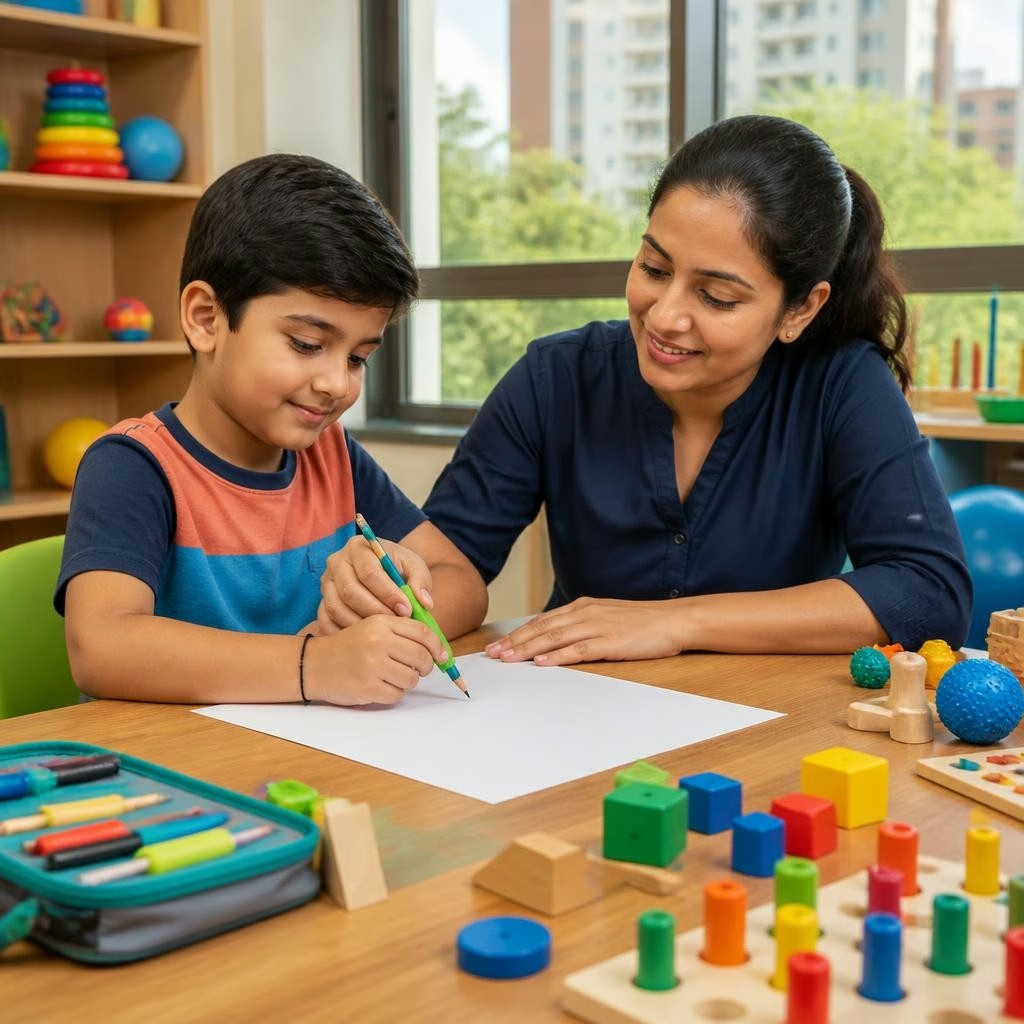
Why handwriting still matters
Handwriting is more than neat notes — it combines fine motor control, visual processing, posture and attention. For many school‑age children, struggles with handwriting show up as frustration, slower schoolwork, or avoiding written tasks. If your child is bright but their worksheets look messy or they fall behind when copying from the board, occupational therapy (OT) can address the underlying skills so writing becomes easier and more automatic.
Common signs to watch for
Look beyond the final page. Common red flags include an awkward pencil grip, inconsistent letter sizes, letters that slant or float above the line, very slow copying, cramped or painful hand fatigue after short tasks, frequent erasing, or poor spacing between words. Some children also avoid writing or rush to finish with poor legibility. Noting when the problem started and examples of schoolwork helps an OT assessment.
What causes handwriting difficulties?
Handwriting problems can come from several sources that often overlap: weak hand or finger strength, poor fine motor coordination, limited visual‑motor integration (matching what the eyes see to hand movements), difficulties with sensory processing or posture, and sometimes attention or planning challenges. A thorough OT evaluation looks for the combination that best explains your child’s writing pattern.
How an occupational therapy assessment works
At an OT centre in Gurugram that offers handwriting assessment and intervention, the first step is an evaluation. This typically includes observing pencil grasp and posture, measuring hand strength and coordination, seeing how the child copies and writes spontaneously, and checking visual‑perceptual skills. Therapists also talk with parents and teachers to understand classroom demands. That information is used to build a personalised plan with clear, practical goals.
Intervention approaches you can expect
Therapists use a mix of playful practice and targeted exercises. Common strategies include activities to improve grip and finger strength, multisensory tracing and letter formation drills, fine motor games to increase dexterity, posture and seating adjustments for better control, and graded practice for speed and legibility. Sensory integration techniques may be used when tactile or proprioceptive issues affect writing. Interventions are adapted to the child’s interests so practice stays engaging.
Working with school and teachers
Because handwriting needs to function in the classroom, OT teams often collaborate with teachers. Practical classroom supports might include providing extra time for written tasks, allowing typed work where appropriate, using lined or raised‑line paper, or breaking long copying jobs into shorter segments. Many OT programmes also offer school readiness and teacher‑focused recommendations so gains in therapy transfer to everyday schoolwork.
Simple home activities parents can try
You don’t need special equipment to support progress. Short, daily play activities help: using tweezers to pick up small objects, threading beads, cutting with scissors, playing with clay or putty, and practising letter formation in sand, rice, or with finger paints. Encourage drawing and games that require controlled hand movements. Keep sessions brief and fun — consistent, 5–10 minute practice is more effective than occasional long drills. Your child’s therapist can suggest activities tailored to your child’s needs.
What progress looks like and how long it takes
Every child progresses at a different pace. Improvements might show first as better endurance (less fatigue), then clearer letter shapes, improved spacing, and finally increased speed and confidence. Therapists measure progress through repeated observations and samples of schoolwork rather than a single milestone. Parents and other caregivers who share consistent practice strategies typically see steadier improvement. Several families have noted clearer, more confident writing after working with therapists in Gurugram.
Why choose a local OT centre in Gurugram
When selecting a centre, look for one that offers a structured handwriting assessment, clear home‑practice plans, and good communication with families and schools. Local parents praise centres where therapists are patient, experienced and child‑focused and where the environment feels safe and positive. These qualities help children engage in therapy and families stay involved in the process.
How to get started — practical next steps
If you’re concerned, gather a few samples of recent schoolwork (copying tasks, worksheets, timed writing if available) and note specific concerns (pain, avoidance, timing). Book an initial OT assessment that includes handwriting evaluation and ask about personalised goals and home practice. If in‑centre visits are difficult, check whether in‑home services are available. Good assessment leads to a clear plan: short, fun daily practice, school supports, and periodic reviews so you can see measurable change over time.
Customer review


Article by
Rainbow Child Development Center | Occupational Therapy in Gurugram | Speech Therapy | ABA Therapy | Special Educator
Rainbow Child Development Centre in Gurgaon, Haryana, provides specialized care for children through occupational therapy, speech and hearing therapy, ABA, special education, and child psychiatry. As a leading occupational therapy centre in Gurgaon, we enhance motor skills, sensory processing, and independence. We also offer expert speech therapy in Gurgaon to improve communication and language. Renowned for effective autism treatment in Gurgaon, we deliver personalized programs, making us a trusted autism centre in Gurgaon. Our skilled special educators in Gurgaon provide tailored learning plans, positioning us among the top special schools in Gurgaon, special education schools in Gurgaon, and centers for comprehensive therapy in Gurgaon.