Home Activities to Boost Your Child’s Speech Therapy Progress: A Gurgaon Parent Guide
Practical Hindi–English routines, games, and simple talking strategies parents in Gurgaon can use at home to support speech therapy—while keeping playtime relaxed and following your therapist’s guidance.

Why home practice helps
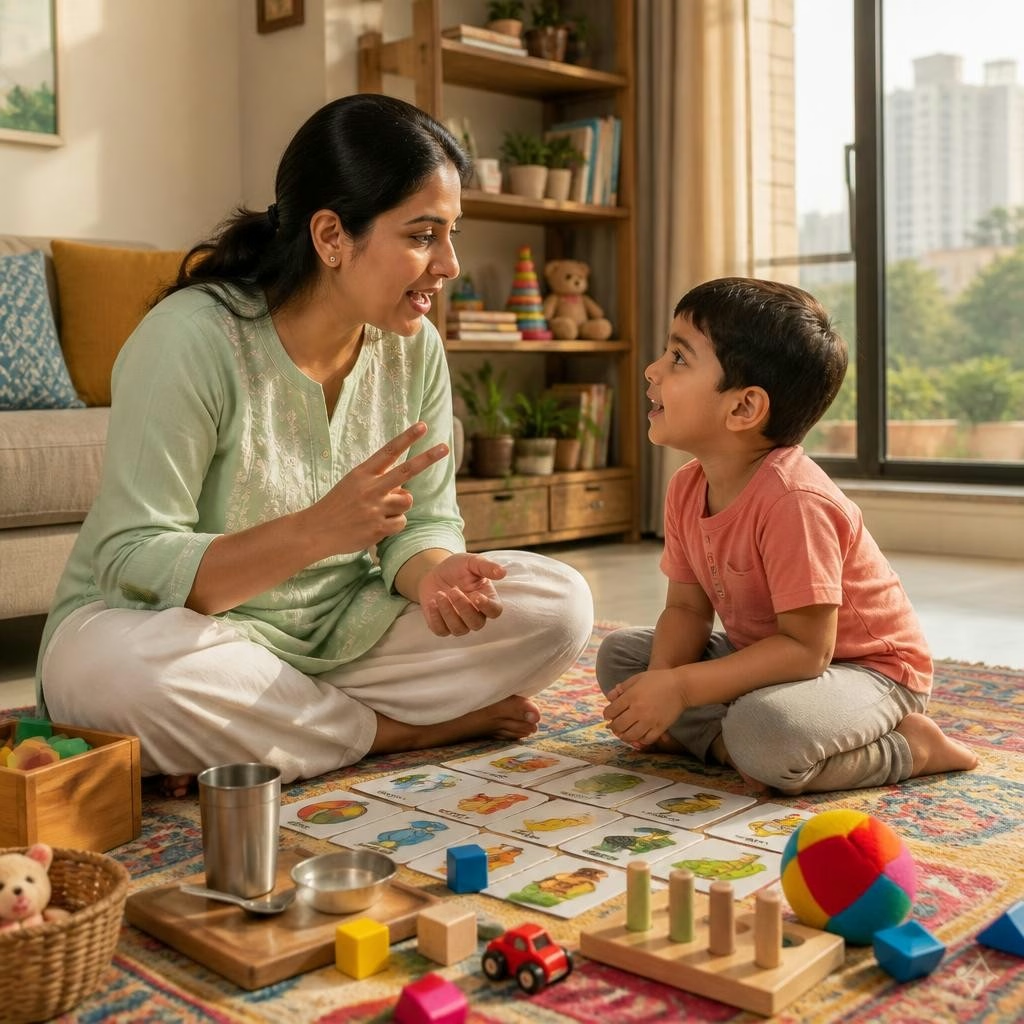
Therapy time is important, but most learning happens at home. Regular, short activities reinforce the skills your child is working on in sessions—speech sounds, vocabulary, taking turns, or following instructions. Many parents at local centres report that clear guidance from therapists and consistent home practice lead to noticeable gains in communication and confidence.
Keep playtime playful — avoid pressure
The goal is practice without stress. Turn goals into games, follow your child’s lead, and stop when they get tired or frustrated. Use lots of praise and celebrate small attempts. If a child resists, switch to a favourite toy or a familiar routine; a 2–5 minute successful activity is better than a long session that ends in tears.
Daily routine moments to use — simple examples
Everyday routines are rich with language opportunities: mealtimes, bathing, dressing, and walks. Narrate what you do in short phrases and mix Hindi and English naturally (Hinglish): e.g., at mealtimes say “Eat rice—khao,” “More roti?” or “Open your tiffin, dikhana.” While dressing: “Shoes on—झूते पहनो (jhoote pehno).” During walks: “See the dog—kutta! Dog says ‘bow-wow’.” Keep phrases short and repeat them often so your child can imitate.
Five quick games to encourage talking
1) Choice Game: Offer two choices and wait for a response. “Juice or milk? / Juice ya milk?” 2) Ball Toss: Roll the ball back and name the action: “Throw! Roll!” Ask for the word before you pass. 3) I-Spy (simplified): “I spy something red—laal cheez?” 4) Puppet Play: Use a soft toy to ask simple questions and model answers. 5) Snack-time Request: Place a preferred snack slightly out of reach and prompt “Please” or a one-word request. These games can be done in 2–5 minutes, several times a day.
How to expand words into sentences
When your child says a word, expand it into a short model. If they say “ball,” respond “Big ball” or “Roll the ball.” If they say “mumma,” expand to “Mumma here” or “Where is Mumma?” Use consistent word order and repeat expansions 2–3 times. Avoid direct quizzing; model naturally in context so the child hears functional language patterns.
Use visuals and simple supports
Visuals make expectations clear—picture choice cards for snacks, a small routine board for steps (brush, wash, dress), or a ‘first–then’ card (First toilet, then play). These tools reduce frustration and give your child cues to communicate. You can make quick cards with photos or drawings and keep them where the routine happens.
Include sensory and oral-motor play (safely)
Speech and feeding skills are linked to oral and sensory control. Gentle play—blowing bubbles, blowing cotton across a table, using straws for thickened drinks only if approved, or chewing crunchy textures if the therapist recommends—can help breath control and lip/tongue strength. Always check with your child’s therapist before introducing new feeding textures or activities to ensure safety and appropriate progression.
Short, frequent practice beats long sessions
Aim for many short bursts (2–10 minutes) spread through the day rather than one long block. Set small, achievable targets: two new words this week, three successful requests a day, or one expanded sentence during storytime. Keep a simple log or use a phone reminder so practice is consistent without becoming a chore.
Make it a family routine — involve siblings and caregivers
Share the therapist’s strategies with grandparents, siblings, and tuitions so everyone uses the same words and routines. Turn siblings into role models—encourage them to ask simple questions and wait for answers. Consistency across caregivers helps the child generalize skills beyond the therapy room.
When to check back with your therapist
If activities cause regular frustration, or if you’re unsure how to change a task when your child progresses, consult the therapist for a tweak. Therapists at multidisciplinary centres often give specific home programs and tips to fit family routines—ask for demonstrations and a written plan. If progress stalls for several weeks, or if you notice safety issues with feeding or breathing, contact your therapist promptly.
Article by
Rainbow Child Development Center | Occupational Therapy in Gurugram | Speech Therapy | ABA Therapy | Special Educator
Rainbow Child Development Centre in Gurgaon, Haryana, provides specialized care for children through occupational therapy, speech and hearing therapy, ABA, special education, and child psychiatry. As a leading occupational therapy centre in Gurgaon, we enhance motor skills, sensory processing, and independence. We also offer expert speech therapy in Gurgaon to improve communication and language. Renowned for effective autism treatment in Gurgaon, we deliver personalized programs, making us a trusted autism centre in Gurgaon. Our skilled special educators in Gurgaon provide tailored learning plans, positioning us among the top special schools in Gurgaon, special education schools in Gurgaon, and centers for comprehensive therapy in Gurgaon.