In‑Home Therapy vs Centre‑Based Therapy in Gurgaon: Which Is Better for Your Child?
A practical comparison of in‑home and centre‑based speech, occupational and ABA therapy in Gurgaon, with guidance on when Rainbow Child Development Centre typically recommends one model or a blend to meet a child's goals.
Why this choice matters
Choosing between in‑home and centre‑based therapy affects progress, family routines and how skills transfer to everyday life. Both models can help with speech, motor skills, sensory needs and behaviour — but the setting changes what’s easiest to practise, who’s involved, and how quickly your child generalises new skills to real situations.
Core goals most therapies share
Whether it’s speech therapy, occupational therapy or ABA, common aims include improving communication, building daily‑living skills, supporting attention and reducing challenging behaviours. Decisions about setting should be driven by the child’s functional goals (for example, independent feeding, clearer speech, or social interaction), not just convenience.
What centre‑based therapy looks like at Rainbow CDC
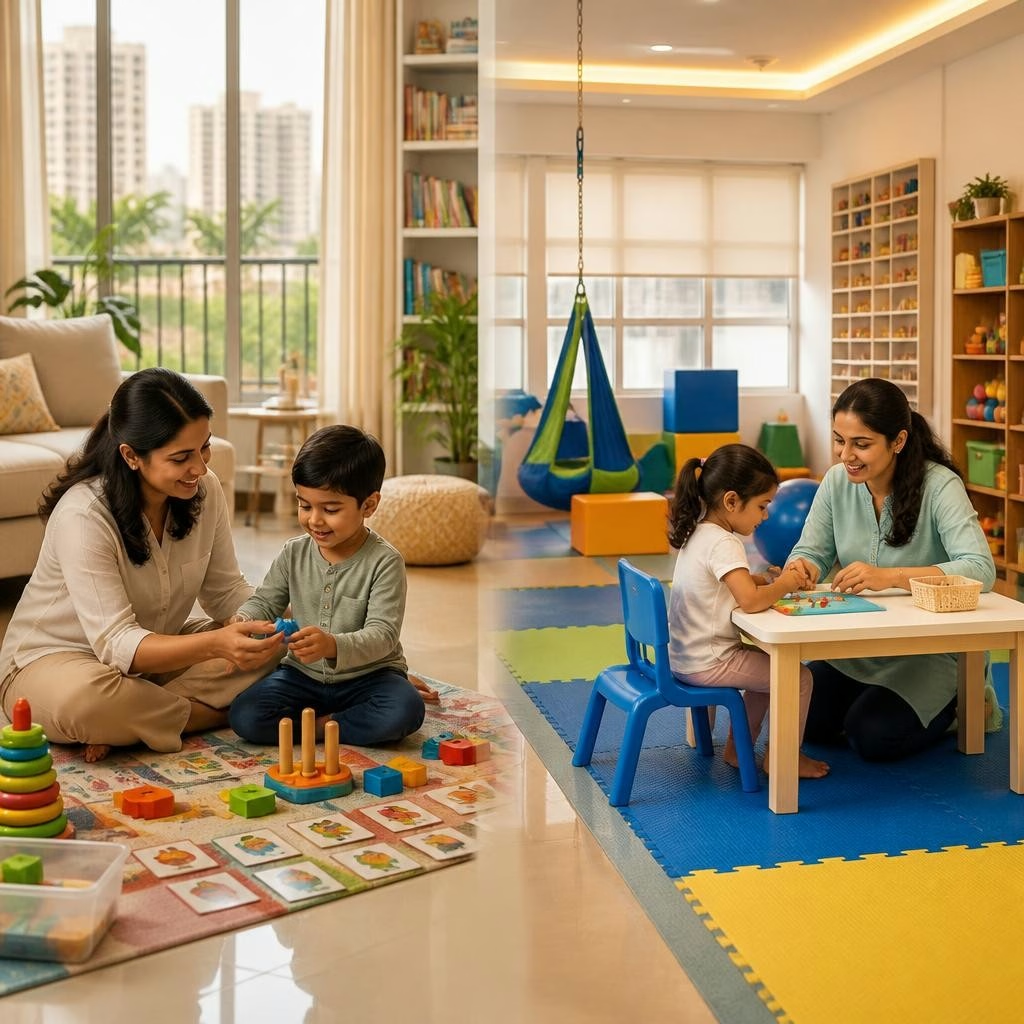
At the centre, therapy happens in a structured, child‑friendly environment with specialised equipment and peers nearby. Sessions are led by trained therapists using planned activities and regular assessments. Parents at the centre receive clear feedback, home‑practice ideas and progress updates so therapy continues beyond session time.
What in‑home therapy looks like
In‑home sessions bring a therapist into your child’s natural environment to work on goals where they matter most — mealtimes, play routines, or sibling interaction. Therapists adapt strategies to familiar furniture, toys and family routines, and they coach caregivers on real‑time ways to support learning throughout the day.
Advantages of centre‑based therapy
Centre therapy offers concentrated, distraction‑managed practice, access to multiple specialists and equipment, and opportunities for peer interaction. For many children, the consistent routine and therapists’ ability to collaborate in the same space speeds up skill acquisition and allows straightforward tracking of progress over time.
Advantages of in‑home therapy
In‑home therapy shines when the main goals are functional skills in the family context: feeding, dressing, mealtime behaviours, and everyday communication. It reduces travel stress, enables therapists to train caregivers in the moment, and helps skills generalise quickly because practice happens in the places the child actually uses them.
When Rainbow CDC might recommend centre‑based therapy
The centre model is often recommended when a child benefits from concentrated, multi‑disciplinary input — for example, when assessments show needs across speech, OT and ABA that require coordinated sessions, when specialised equipment or group practice is important, or when the child responds well to a structured clinic routine.
When Rainbow CDC might recommend in‑home therapy
In‑home sessions are useful when mobility, anxiety in new places, or specific daily routines are the priority. Rainbow CDC’s in‑home option is particularly helpful when parents need hands‑on coaching to manage behaviours at mealtimes, incorporate communication strategies into day‑to‑day life, or when travelling to the centre regularly is difficult.
The hybrid approach: mixing centre and home
Many families do best with a mix: core skill building at the centre plus periodic in‑home visits to generalise skills and train caregivers. For example, a child may attend regular centre speech or OT sessions and receive biweekly home visits to reinforce routines, practise feeding strategies, or translate gains into family life. This blend leverages the strengths of both settings.
Practical tips for families in Gurgaon and questions to ask
Decide with a short trial: try a few sessions in each setting and compare how your child engages and how easily gains transfer home. Ask providers: How will progress be measured? What home‑practice will you recommend? How do therapists coach caregivers? What safety and scheduling options exist for in‑home visits? Consider logistics common to Gurgaon — travel time, peak traffic hours, and your family’s daily routine — when planning frequency. Finally, look for the signs reviewers often mention: clear explanations from therapists, regular parent guidance, and visible small improvements over time — those are useful markers that therapy is working regardless of setting.
Article by
Rainbow Child Development Center | Occupational Therapy in Gurugram | Speech Therapy | ABA Therapy | Special Educator
Rainbow Child Development Centre in Gurgaon, Haryana, provides specialized care for children through occupational therapy, speech and hearing therapy, ABA, special education, and child psychiatry. As a leading occupational therapy centre in Gurgaon, we enhance motor skills, sensory processing, and independence. We also offer expert speech therapy in Gurgaon to improve communication and language. Renowned for effective autism treatment in Gurgaon, we deliver personalized programs, making us a trusted autism centre in Gurgaon. Our skilled special educators in Gurgaon provide tailored learning plans, positioning us among the top special schools in Gurgaon, special education schools in Gurgaon, and centers for comprehensive therapy in Gurgaon.