Phonological vs Articulation Disorders: Why Your Child’s Pronunciation Errors Matter (A Guide for Gurgaon Parents)
Learn the difference between phonological and articulation disorders, signs to watch for in Gurgaon children, and how targeted speech therapy and home strategies can improve clarity and reduce persistent “baby talk.”
Why pronunciation matters
Pronunciation is more than just how a child sounds — it affects their ability to be understood, join conversations, make friends, and feel confident at school. Small mistakes are normal as children learn language, but persistent or patterned errors can interfere with learning and social interaction. This article breaks down two common types of speech difficulties — articulation and phonological disorders — so you can notice the difference and take practical next steps.
What is an articulation disorder?
An articulation disorder is about how a child physically makes individual sounds. A child with an articulation issue may have trouble producing one or two specific sounds (for example, making an “s” sound correctly) because of tongue, lip, or jaw placement or coordination. These errors are usually consistent: the child knows the sound they want but can’t form it clearly yet.
What is a phonological disorder?
A phonological disorder is language-based: the child uses systematic patterns that simplify speech. Instead of struggling with a single sound’s movement, they regularly replace or omit groups of sounds — for example, dropping final consonants (saying “ba” for “ball”) or substituting all “k”/“g” sounds with “t”/“d.” These patterns affect many words and can make a child harder to understand overall.
Simple ways to tell them apart
Look for patterns. If a child consistently has trouble with one or two sounds but can say other sounds correctly, it’s likely articulation. If the child makes the same type of change across many sounds and words (like dropping endings or swapping entire sound classes), that suggests a phonological issue. Articulation errors tend to be about production mechanics; phonological errors are about how the child organizes sound rules in language.
Signs parents in Gurgaon should notice
Here are practical, observable signs that warrant a closer look: family and friends often can’t understand the child; the child avoids talking or answers with gestures; teachers note that the child’s speech affects classroom participation; errors are getting in the way of learning to read or follow instructions; or the child’s speech still sounds immature compared with peers. If errors are persistent or causing frustration, consider an assessment.
What happens in a speech and language assessment
A professional assessment looks beyond whether a child makes sounds correctly — it evaluates speech clarity, sound patterns, oral-motor strength and movement, and language understanding. At Rainbow Child Development Centre, assessments are child-friendly and include listening to the child talk, discussing developmental history with caregivers, and setting clear therapy goals. The assessment helps determine whether a child would benefit more from articulation-focused activities, phonological approaches, or a combination.
How targeted therapy differs
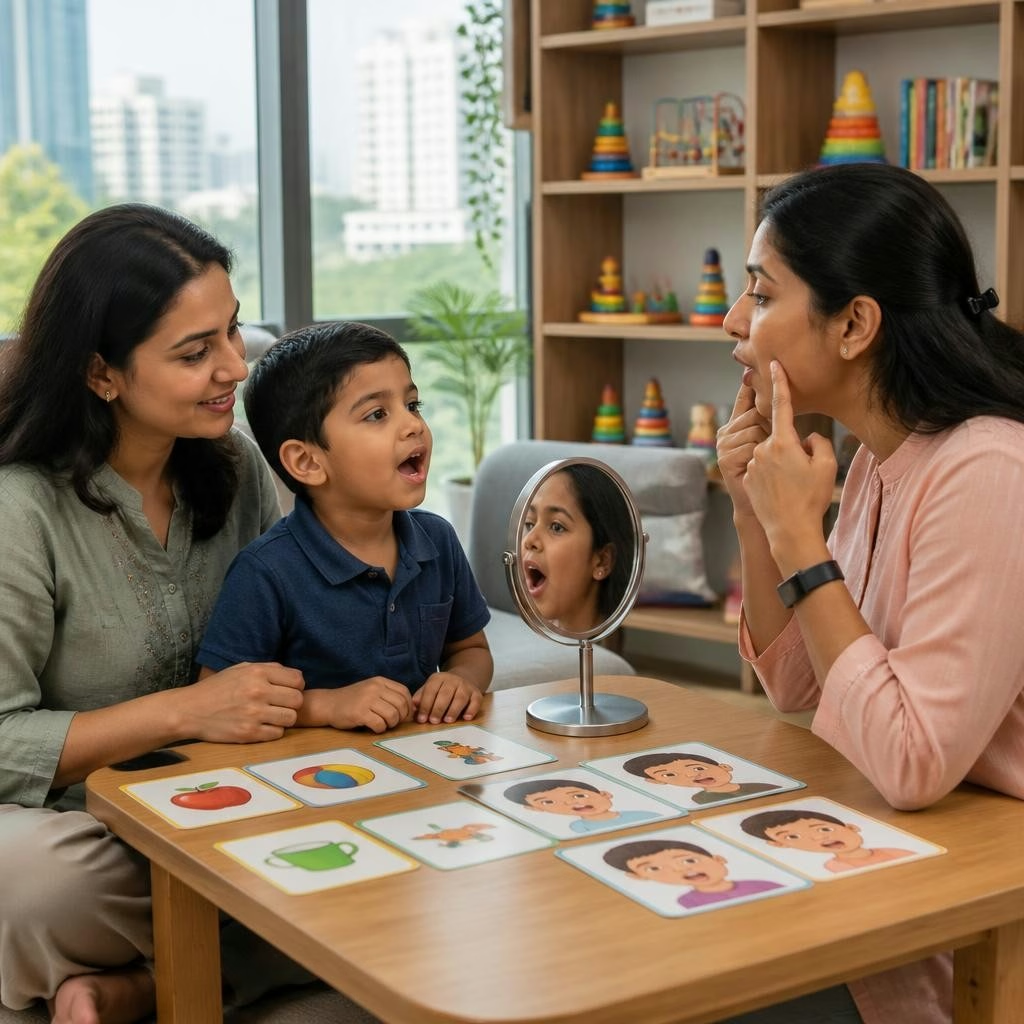
Articulation therapy focuses on teaching the correct movements and placement for specific sounds, often using modeling, repetition, and visual cues. Phonological therapy works on changing the child’s sound rules — using minimal pairs, contrast activities, and game-based practice to show how different sounds change meaning. Rainbow CDC lists services for both Articulation Disorder Therapy and Phonological Disorder Therapy, and therapists typically choose techniques that match a child’s assessment profile.
Home strategies that really help
Parents can support progress by practicing clear, natural speech models (not overcorrecting), reading aloud together, using play to encourage target sounds, and following short home programs given by the therapist. Avoid excessive “baby talk” when the child is practicing new sounds; instead, model correct words in a fun, low-pressure way. Keep sessions short and frequent, celebrate small wins, and ask your therapist for specific activities you can do between sessions.
Why early, combined support is useful
Early intervention helps children build clearer speech habits before patterns become entrenched. Many parents who bring children for speech support report improvements in clarity and confidence, and appreciate a multidisciplinary approach when communication overlaps with motor, sensory, or learning needs. Rainbow Child Development Centre offers speech therapy alongside occupational therapy, special education, and parental guidance — an approach that can be helpful when speech issues affect broader development.
Next steps for Gurgaon families
If you’re concerned about your child’s pronunciation, start with a speech and language assessment to identify whether the issue is articulation, phonological, or both. Bring examples of words or recordings that show typical errors and share developmental history with the therapist. If you’d like in-person assessment or therapy, Rainbow Child Development Centre is located at H.No 56, Basement House, Gurugram, and offers child-friendly speech and language services. Early, targeted support plus consistent home practice gives most children the best chance to speak more clearly and confidently.
Article by
Rainbow Child Development Center | Occupational Therapy in Gurugram | Speech Therapy | ABA Therapy | Special Educator
Rainbow Child Development Centre in Gurgaon, Haryana, provides specialized care for children through occupational therapy, speech and hearing therapy, ABA, special education, and child psychiatry. As a leading occupational therapy centre in Gurgaon, we enhance motor skills, sensory processing, and independence. We also offer expert speech therapy in Gurgaon to improve communication and language. Renowned for effective autism treatment in Gurgaon, we deliver personalized programs, making us a trusted autism centre in Gurgaon. Our skilled special educators in Gurgaon provide tailored learning plans, positioning us among the top special schools in Gurgaon, special education schools in Gurgaon, and centers for comprehensive therapy in Gurgaon.