School Readiness Checklist for Gurgaon Preschools: Skills Beyond ABCs and 123s
A practical checklist of motor, social, communication and self-help skills Gurgaon children should develop before preschool, plus clear signs when a school‑readiness program or early intervention centre can help bridge gaps.
Why school readiness is more than academics
Starting preschool is a big step for young children and for parents. Schools look for kids who can follow simple routines, interact with peers, and manage basic self-care—skills that make learning smoother and more enjoyable. While ABCs and counting are important, readiness also includes motor coordination, listening and following instructions, social confidence, and the ability to regulate emotions. Focusing on these practical areas helps children settle into the classroom and gives teachers space to build academic skills.
How to use this checklist
Read through the short, practical items below and think about which ones your child can already do, which need practice, and which feel challenging. If several items in a category are hard for your child, consider extra practice at home or consulting a school‑readiness program or early intervention service. Small, regular activities—five to ten minutes a day—can make steady progress.
Motor skills: gross motor checklist
Gross motor abilities help children move confidently in the playground and during classroom activities. Look for: running without tripping often, jumping with both feet, climbing a low ladder or playground steps, kicking and catching a large ball, and easily getting on and off small chairs. If a child struggles with balance or coordination, occupational therapy and guided play activities can build strength and confidence.
Motor skills: fine motor & pre‑writing checklist
Fine motor skills support drawing, cutting and handling classroom tools. Check whether your child can: hold a crayon with a functional grasp, draw simple shapes (circle, line), cut along a straight line with safety scissors, string large beads, and manipulate buttons or zipper pulls. These skills are useful for handwriting readiness and classroom independence; targeted exercises and play-based practice help develop them.
Communication: receptive and expressive skills
Communication readiness includes both understanding and using language. A child who is ready usually follows two‑step instructions, names familiar objects and people, uses short sentences to express needs, and takes part in simple back‑and‑forth conversations. They also point or show what they want when needed. If you notice unclear speech, limited vocabulary, or difficulty following directions, speech therapy and language-focused activities can make a big difference. Parents at local centres often report clearer communication and better classroom participation after regular guidance and home practice.
Social, emotional and behaviour skills
Preschoolers benefit from basic social and emotional abilities: playing alongside or with other children, taking simple turns, accepting ‘no’ occasionally, and staying with a teacher for short guided activities. Look for emerging independence in managing frustration—using words or a calm strategy rather than tantrums—and the ability to join group songs or games. If behaviours or attention are consistently interfering with learning, behaviour‑focused intervention or parent coaching can help establish routines and positive responses.
Self‑help and daily living skills
Self‑help makes the school day easier for both child and teacher. Important items include: feeding with minimal spills, drinking from an open cup, washing and drying hands with supervision, using the toilet independently (or signalling clearly), putting on a simple jacket or shoes, and carrying a small backpack. Practice and predictable routines at home accelerate independence and reduce separation stress on the first days of school.
Cognitive and early learning skills
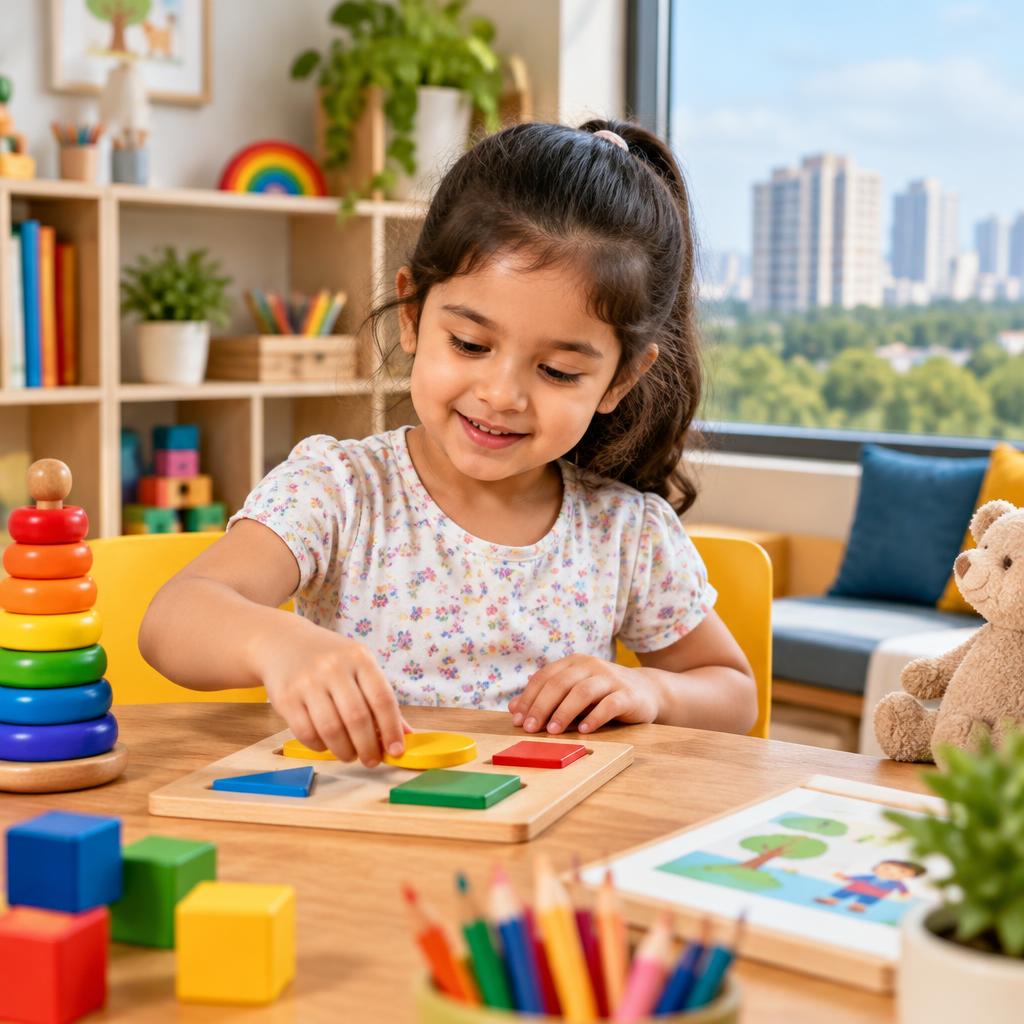
Early learning skills are the foundation for classroom learning: knowing familiar shapes and colours, matching similar objects, completing simple puzzles, recognising basic patterns, and showing curiosity about books and pictures. Attention span matters too—being able to focus on a short group activity for a few minutes. These cognitive skills are built through play, story time and everyday routines rather than formal drilling.
Sensory processing, attention and regulation
Some children are easily overwhelmed by noise, crowded spaces, or busy classrooms. Sensory needs can show up as covering ears, being unusually fidgety, or seeking constant movement. Check whether your child can sit for short circle time, tolerate noises common in a preschool, and shift between active and calm activities. If sensory or attention challenges interfere with learning, sensory integration strategies, occupational therapy and structured breaks can help a child participate more comfortably.
When to consider a school‑readiness program or early intervention
If a child shows persistent delays in multiple areas—speech that is hard to understand, difficulty following simple instructions, severe motor coordination issues, or emotional outbursts that don’t respond to routine strategies—it’s a good time to seek professional help. A coordinated school‑readiness program or multidisciplinary centre can assess strengths and create a tailored plan. Many parents value centres that offer speech therapy, occupational therapy, special education and parent guidance under one roof, because coordinated goals and regular home activities speed progress and help children enter preschool ready to learn.
Practical next steps for parents in Gurugram
Start with simple daily routines: short story time, play that strengthens hands (e.g., playdough), turn‑taking games, and small self‑care tasks. Observe which skills need more practice and keep a short weekly log of improvements. When you want more support, look for local programs that offer a school readiness curriculum plus speech and occupational therapy options—centres that also guide parents on home practice can be especially helpful. Parents who’ve used local services often highlight clear guidance from therapists and visible improvements in communication, attention and participation after regular sessions. If you’re unsure where to start, a brief assessment at a child development centre can point to targeted, achievable goals and activities to try before school begins.
Customer review


Article by
Rainbow Child Development Center | Occupational Therapy in Gurugram | Speech Therapy | ABA Therapy | Special Educator
Rainbow Child Development Centre in Gurgaon, Haryana, provides specialized care for children through occupational therapy, speech and hearing therapy, ABA, special education, and child psychiatry. As a leading occupational therapy centre in Gurgaon, we enhance motor skills, sensory processing, and independence. We also offer expert speech therapy in Gurgaon to improve communication and language. Renowned for effective autism treatment in Gurgaon, we deliver personalized programs, making us a trusted autism centre in Gurgaon. Our skilled special educators in Gurgaon provide tailored learning plans, positioning us among the top special schools in Gurgaon, special education schools in Gurgaon, and centers for comprehensive therapy in Gurgaon.