Supporting Hearing‑Impaired Children in Gurgaon: How Speech & Language Therapy Helps
A practical guide to how speech therapy supports children with hearing loss (with or without hearing aids), typical therapy goals, and everyday techniques Gurgaon parents can use to reinforce listening and speaking skills at home.
Why speech therapy matters for children with hearing loss
Hearing loss affects the way children hear sounds, learn words and connect with others. Even with hearing aids or other devices, many children need guided practice to build clear speech, understand language, and take part in conversations. Speech and language therapy focuses on the specific listening and communication skills a child needs so they can join play, learning and everyday routines more confidently.
Start with a careful assessment
A good therapy plan begins with assessment: speech and language ability, oral motor skills, feeding/swallowing where relevant, and the child’s social communication. At Rainbow Child Development Centre that typically means a speech-and-language evaluation alongside child-focused assessments so therapists can identify strengths and priorities and set realistic short‑term and long‑term goals.
Common goals speech therapists set
Therapists set goals tailored to a child’s age and hearing profile. Typical targets include improving sound awareness and discrimination, developing clearer articulation, expanding receptive (understanding) and expressive (speaking) vocabulary, increasing turn‑taking and conversational skills, improving oral motor control for speech and feeding, and building pre‑literacy skills for school readiness.
Therapy approaches you’ll see in sessions
Work is usually playful and structured. Techniques used at the centre include targeted articulation practice for speech sounds, phonological approaches for sound patterns, oral placement therapy for children who need help with tongue and lip movement, feeding and swallowing therapy when needed, sensory integration strategies to support attention, and group or play‑based sessions to boost social communication. Sessions are adapted to each child’s pace and learning style.
Working with hearing aids and everyday listening
Speech therapists work with children whether they use hearing aids or not. Therapy focuses on maximizing auditory access (making the best use of whatever hearing the child has) and combining listening practice with visual and tactile support when needed. Therapists commonly recommend that parents coordinate with their audiologist for device checks and battery or fitting issues, while the therapy team concentrates on listening exercises, speech clarity and language growth.
Simple, effective home strategies for Gurgaon parents
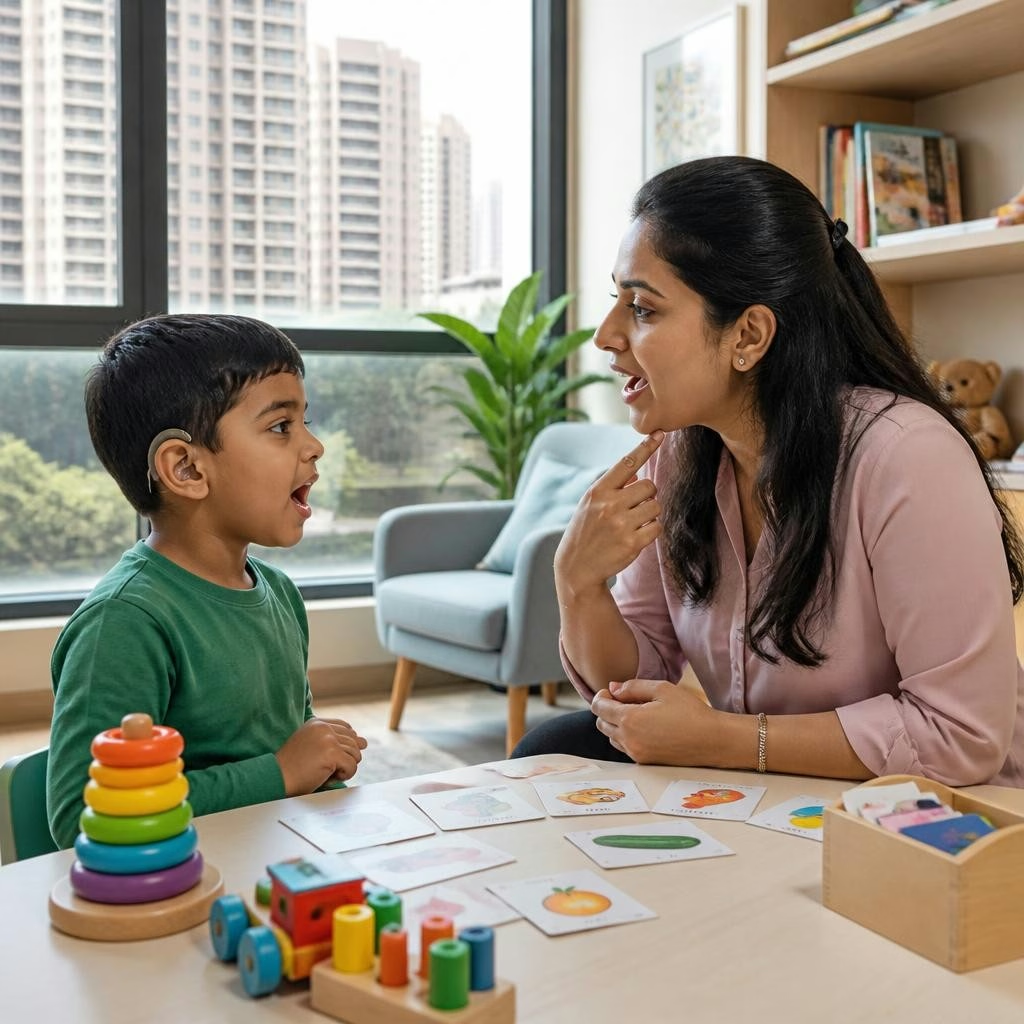
Parents make the biggest difference through consistent practice at home. Useful tips include: create short daily listening routines (singing, clapping games, listening to simple stories), get face‑to‑face for talk time so your child can see mouth movements, use short phrases and repeat key words, expand your child’s sentences (model a slightly longer phrase), read picture books together and talk about pictures, follow the therapist’s home activities and keep practice playful and brief. Encouraging device wear and following any feeding or oral motor exercises recommended by therapists helps carry progress into everyday life.
What to expect by age
For infants and toddlers the focus is early intervention: sound awareness, turn‑taking and parent coaching. Preschoolers often work on speech clarity, vocabulary growth and play‑based social skills. School‑age children may need support with conversational skills, reading and classroom listening, and handwriting or fine‑motor tasks that affect school performance. Rainbow’s School Readiness Program and related supports can help bridge therapy and classroom needs.
Why a multidisciplinary team helps
Children with hearing loss often benefit from a multi‑disciplinary approach. Speech therapy paired with occupational therapy, special education, behaviour support or psychological counselling addresses attention, sensory needs, learning strategies and classroom readiness. Rainbow offers many of these services under one roof and can coordinate goals so home and school carry consistent strategies.
What parents say about the process
Many parents highlight clear, regular communication and practical guidance from the therapy team. For example, one parent noted that the centre’s speech team explained the issues clearly, shared step‑by‑step guidance for home practice, and kept families updated on progress—elements that parents find reassuring when supporting a child’s hearing and speech journey.
Next steps: getting started in Gurugram
If you’re noticing delayed speech, unclear speech, trouble following instructions, or concern about feeding and oral control, consider scheduling a speech and language assessment. Rainbow Child Development Centre in Gurugram provides assessments, individualized therapy plans, parental counselling and in‑home services when appropriate. Ask about an initial evaluation and the recommended home activities so you can start reinforcing listening and speaking skills right away.
Customer review


Article by
Rainbow Child Development Center | Occupational Therapy in Gurugram | Speech Therapy | ABA Therapy | Special Educator
Rainbow Child Development Centre in Gurgaon, Haryana, provides specialized care for children through occupational therapy, speech and hearing therapy, ABA, special education, and child psychiatry. As a leading occupational therapy centre in Gurgaon, we enhance motor skills, sensory processing, and independence. We also offer expert speech therapy in Gurgaon to improve communication and language. Renowned for effective autism treatment in Gurgaon, we deliver personalized programs, making us a trusted autism centre in Gurgaon. Our skilled special educators in Gurgaon provide tailored learning plans, positioning us among the top special schools in Gurgaon, special education schools in Gurgaon, and centers for comprehensive therapy in Gurgaon.