Corona Discharge Ozone: A Practical Guide for Indian Engineers and Plant Managers
An engineer-focused introduction to corona discharge ozone generators covering how the technology works, key design and integration considerations for STP/ETP/WWTP, basic maintenance, safety measures relevant to Indian industrial sites, and guidance for selecting an OEM.

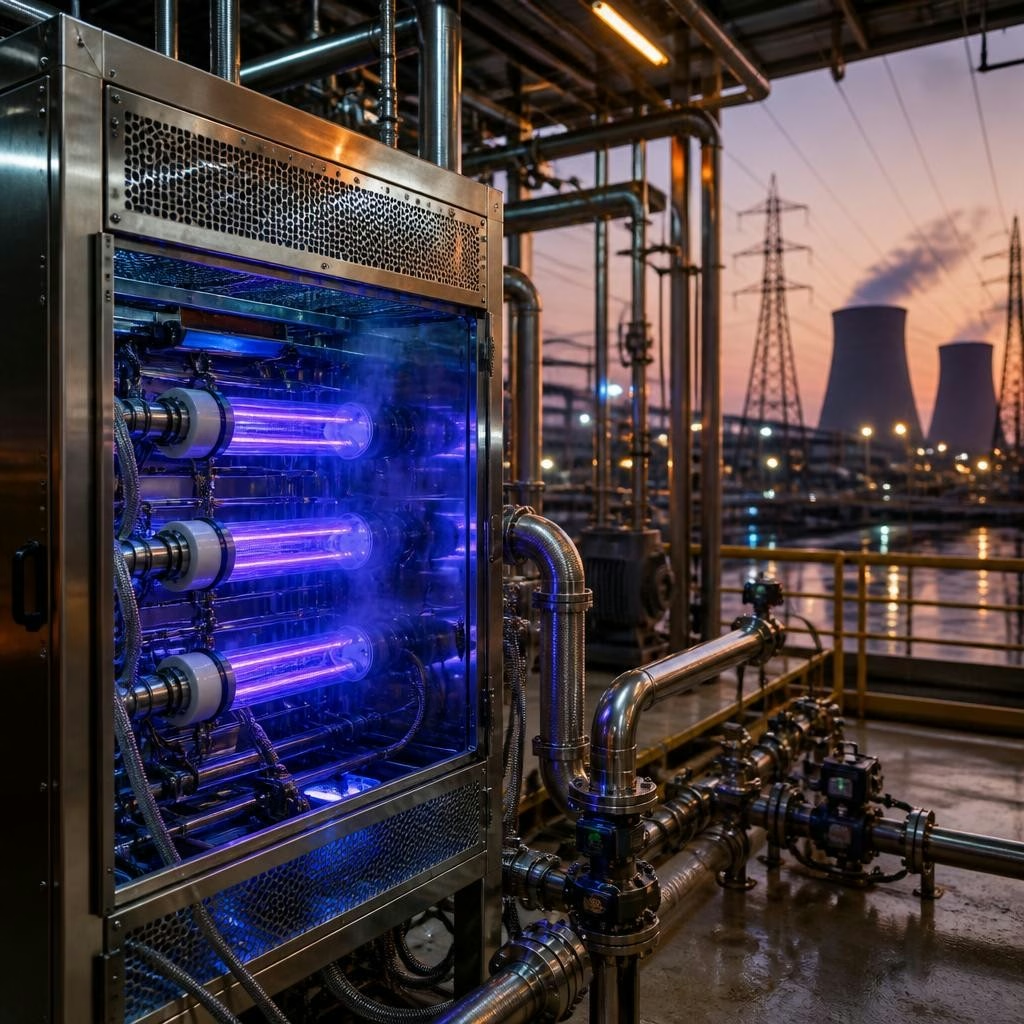
Why ozone and why corona discharge?
Ozone is a strong oxidant used widely for disinfection and oxidation of refractory organics in industrial water and wastewater treatment. For medium to large industrial applications, corona discharge is the most common and practical method to generate ozone on-site because it produces ozone at scales and concentrations suitable for treatment plants. As a manufacturer of ozone generators, Prasinos Tech Innovations lists corona discharge among its offered technologies, reflecting its relevance to STP, ETP and WWTP operations.
Basic principle of corona discharge ozone generation
Corona discharge ozone generators create a high-voltage electric field between electrodes separated by a dielectric barrier. When oxygen-containing feed gas passes through this field, a portion of O2 molecules is split into atomic oxygen, which then combines with O2 to form ozone (O3). Key physical factors that influence ozone production include the applied voltage and frequency, the geometry and material of the dielectric barrier, feed-gas composition, temperature, and humidity.
Feed gas, concentration and cooling considerations
Engineers must choose between air and oxygen as feed gas depending on required ozone concentration, costs and system complexity—oxygen gives higher concentration but at higher O2 supply cost. Because ozone production efficiency decreases with higher temperature, effective cooling is important; many industrial units use air or water cooling, and water-cooled ozone generators are a common design option for higher duty cycles. Proper control of feed-gas moisture is critical because humidity reduces ozone yield and can accelerate dielectric wear.
Design choices that affect performance
Design choices that materially affect delivered ozone and operating costs include dielectric material and thickness, electrode layout, gap spacing, and power supply design (voltage and waveform). Equally important are system-level elements: ozone concentration required at the contactor, contact time and mixing method, materials compatibility (piping and seals resistant to ozone), and an off-gas destruction or abatement plan. These considerations determine sizing, footprint and integration requirements for treatment plants.
Integration into STP/ETP/WWTP processes
When integrating a corona discharge ozone unit into an STP, ETP or WWTP, plan for pre-treatment to remove solids and fouling matter, specify appropriate contactors or mixers to ensure ozone mass transfer, and provide sufficient decay/contact time for target pollutants. For biological processes, ozone can be applied for pre-oxidation, tertiary disinfection, or sludge conditioning; each use case has different dose and contact requirements. Coordinate control and monitoring with plant automation to avoid overdosing and to sequence ozone injection with other chemical steps.
Operation and routine maintenance
Routine upkeep preserves performance: maintain feed-gas filtration and drying, inspect and clean or replace dielectric components according to the manufacturer's guidance, ensure cooling circuits are functioning and free from scale, and verify electrical connections and grounding. Periodic checks should include ozone output verification, leak inspections around ozone piping and contactors, and functional testing of ozone destruct units and alarms. Maintain clear logs of operational parameters to spot trends and to trigger preventive maintenance before failures occur.
Safety and regulatory practices for Indian sites
Ozone is toxic at elevated concentrations and a respiratory irritant; safety planning must include fixed and portable ozone monitors, adequate ventilation in generator rooms, clear signage, and trained operators. Use engineering controls to prevent worker exposure and to safely handle off-gas (destruction catalysts or contactors). Follow applicable Indian occupational health and environmental regulations, consult local safety guidance, and adopt site-specific procedures and personal protective equipment requirements. Never rely on smell alone to detect leaks—monitoring instruments are essential.
Choosing an OEM and next practical steps
Select an OEM based on relevant experience with corona discharge systems, availability of local service and spare parts, and demonstrated ability to support integration with STP/ETP/WWTP processes. Ask for performance data, site references, demonstration of water- or air-cooled options, and details on maintenance schedules. Prasinos Tech Innovations operates from Secunderabad and serves industrial customers across India, and customer feedback highlights strong technical support and practical demonstrations of treatment technologies. For a site-specific recommendation, begin with a mass-balance of the treatment stream, expected ozone demand, and desired outcomes, then consult the OEM for sizing, safety planning and a maintenance contract.
Article by
Prasinos Tech Innovations
Prasinos Tech Innovations Private Limited is an OEM at the forefront of sustainable environmental technologies. We specialize in the design and manufacturing of advanced systems including nanobubble generators, ozone generators, hydrodynamic cavitation units, and advanced oxidation processes (AOP) tailored for critical applications in sewage treatment plants (STP), effluent treatment plants (ETP), and water and wastewater treatment plants (WWTP). Our technologies are engineered to deliver high-efficiency, low-footprint solutions across diverse sectors such as aquaculture, agriculture, horticulture, and the bioenergy industry, including biogas and biodiesel production.