Corona Discharge Ozone vs UV vs Chlorine: Choosing Disinfection for Indian STPs
A practical comparison of corona discharge ozone, UV, and chlorine disinfection for sewage and wastewater treatment plants in India, covering footprint, safety, operating costs, by-products, and reuse implications to help engineers make informed choices.

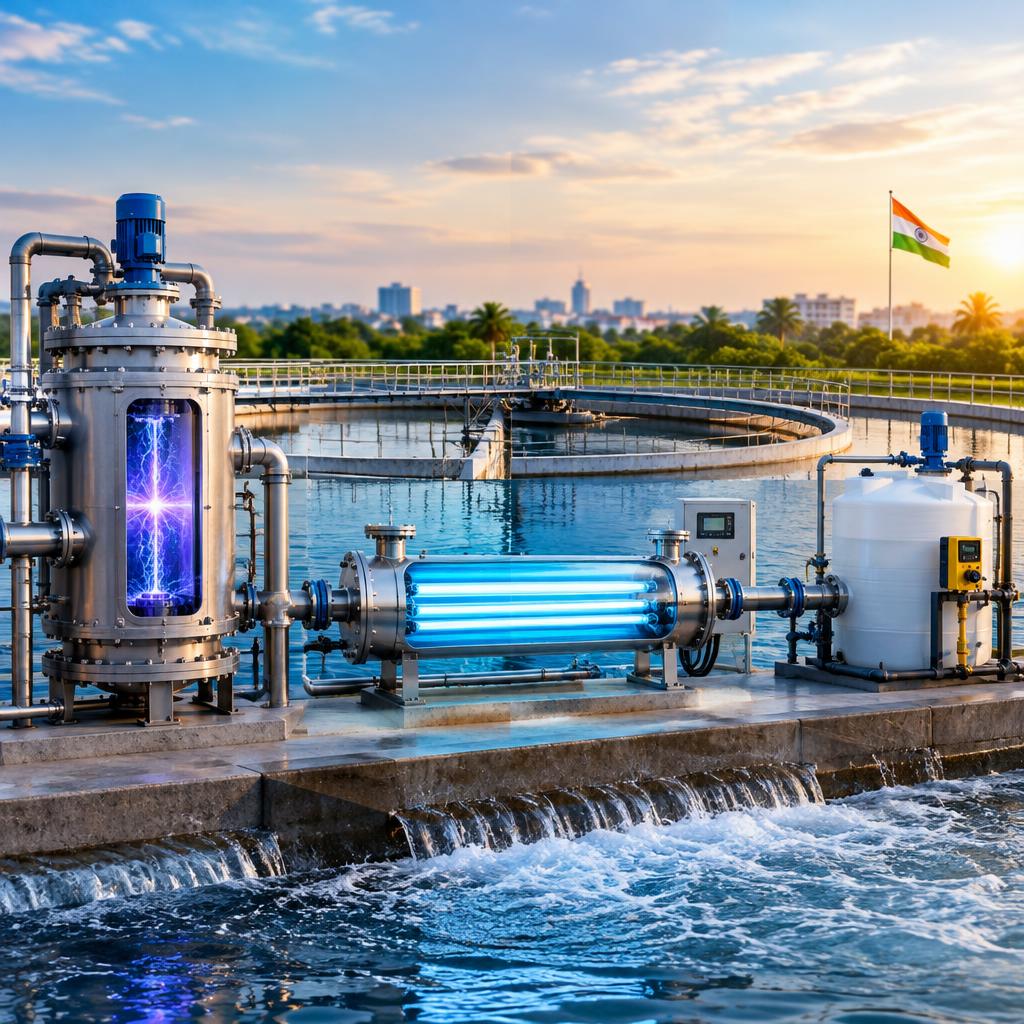
Why the choice of disinfection matters for Indian STPs
Disinfection is a critical final step in STP and WWTP design: it protects public health, supports regulatory compliance, and influences whether treated water is suitable for reuse. In India, engineers must balance operational realities—power reliability, operator skill, space constraints, and downstream reuse goals—when selecting a disinfectant. This article compares three common approaches—corona discharge ozone, ultraviolet (UV), and chlorine—so you can match technology to site priorities.
How corona discharge ozone works and where it excels
Corona discharge ozone generators produce ozone by applying a high-voltage discharge to oxygen or dry air. Ozone is a very strong oxidant that inactivates pathogens and breaks down many organic contaminants, helping with color, odor and certain micropollutants when properly applied. Ozonation is often paired with advanced oxidation processes (AOP) or downstream polishing steps to address by-products and to extend treatment scope. For plants with limited footprint but higher treatment performance targets—such as industrial ETPs or reuse-oriented STPs—ozone can be an attractive option, provided operators plan for safe handling, monitoring and appropriate off-gas destruction.
UV disinfection: strengths and limitations
UV disinfection inactivates microorganisms by damaging nucleic acids and is effective against bacteria, viruses and protozoa when the water is sufficiently clear. UV systems have a relatively compact footprint and do not add chemicals to the water, so they avoid many chemical disinfection by-products. However, UV provides no residual disinfectant in the distribution network, is sensitive to turbidity and fouling, and requires periodic lamp replacement and cleaning. UV is particularly suitable where the secondary effluent is well-polished and continuous operator maintenance is available.
Chlorine disinfection: practicality and trade-offs
Chlorination (typically using sodium hypochlorite or gaseous chlorine) is a widely used, low-capital option that delivers a persistent residual—an important advantage for distribution systems or sites where recontamination risk is high. Chlorine systems are familiar to operators and relatively straightforward to dose and control. The main trade-offs are chemical handling and the potential formation of halogenated disinfection by-products (DBPs) when organic matter is present. For reuse applications with strict limits on DBPs, engineers often need additional treatment or alternative disinfectants.
Comparing footprint, safety, cost, and by-products
Footprint: UV and well-designed corona discharge skid systems can be compact; selection depends on required contact times and ancillary equipment (off-gas destruction for ozone, clear-water prefiltration for UV). Safety: ozone is a toxic gas and needs leak detection, ventilation and off-gas control; chlorine requires safe storage and dosing controls; UV poses minimal chemical risk but requires electrical safety and lamp handling protocols. Operating cost drivers: ozone and UV consume electrical energy and require maintenance (lamps, electrodes, oxygen/air supply), while chlorine systems incur chemical purchase and safe storage costs. By-products: chlorine can form halogenated DBPs; ozone can form oxidation by-products (bromate risk where bromide is present) and often needs downstream treatment or quenching if residuals are a concern; UV produces no chemical residuals or DBPs but no residual disinfectant either.
Selecting by reuse goals and regulatory context
If the primary objective is safe reuse (irrigation, industrial cooling) and residual protection in distribution is required, chlorine or combined approaches (e.g., UV followed by low-dose chlorination) are common. For applications demanding high oxidation—removal of color, odor, or certain micropollutants—or where chemical usage should be minimized, ozone (often integrated with AOPs) can provide superior performance. When the treated effluent is already low in turbidity and operator capacity for maintenance is adequate, UV is a low-by-product option for pathogen inactivation. Always review local discharge and reuse standards to ensure the chosen approach meets limits for pathogens and chemical by-products.
Practical checklist for engineers specifying disinfection
1) Define reuse and regulatory targets up front (pathogen log reductions, allowable DBPs). 2) Assess final effluent quality—turbidity and organics determine UV and chlorine performance. 3) Evaluate site constraints: available space, power reliability, operator skill, and safety infrastructure. 4) Consider combined solutions: UV or ozone with a low-level residual or ozone followed by biological polishing/AOP for micropollutant control. 5) Budget for lifecycle costs: energy, consumables, monitoring and maintenance. 6) Plan safety measures: leak detection and off-gas destruction for ozone, secure chemical storage for chlorine, and routine lamp/electrical safety for UV.
Bringing technology to your site: integration and vendor support
Integration with pre- and post-treatment is essential—corona discharge ozone, UV, and chlorine each work best when matched to upstream clarification and polishing. Manufacturers that offer system integration (ozone generators, AOP modules, nanobubble or cavitation pre-treatment) can simplify commissioning and monitoring. As one customer observed, Prasinos Tech Innovations is known for an innovative, sustainability-focused approach to water and wastewater solutions; for projects in India, discussing site-specific pilots, demonstrations and integration with AOP or nanobubble enhancements can help validate performance before full-scale implementation.
Conclusion — balance performance, safety and reuse needs
There is no single 'best' disinfectant for all Indian STPs. Chlorine remains practical where residual protection and low capital cost are priorities. UV is a clean, compact option when effluent clarity is good and residuals are not required. Corona discharge ozone offers strong oxidation and advanced contaminant control but demands careful safety, monitoring and often downstream polishing. Use the checklist above, align technology to reuse objectives, and consult vendors that can demonstrate integrated solutions and site-level performance to find the right fit for your plant.
Customer review


Article by
Prasinos Tech Innovations
Prasinos Tech Innovations Private Limited is an OEM at the forefront of sustainable environmental technologies. We specialize in the design and manufacturing of advanced systems including nanobubble generators, ozone generators, hydrodynamic cavitation units, and advanced oxidation processes (AOP) tailored for critical applications in sewage treatment plants (STP), effluent treatment plants (ETP), and water and wastewater treatment plants (WWTP). Our technologies are engineered to deliver high-efficiency, low-footprint solutions across diverse sectors such as aquaculture, agriculture, horticulture, and the bioenergy industry, including biogas and biodiesel production.