Designing Compact STP/ETP Solutions for Indian Real Estate Projects
Practical guidance for architects, developers and PMC teams on planning low-footprint sewage and effluent treatment using nanobubbles, ozone and AOP, with layout ideas, space-saving measures and compliance considerations for Indian projects.
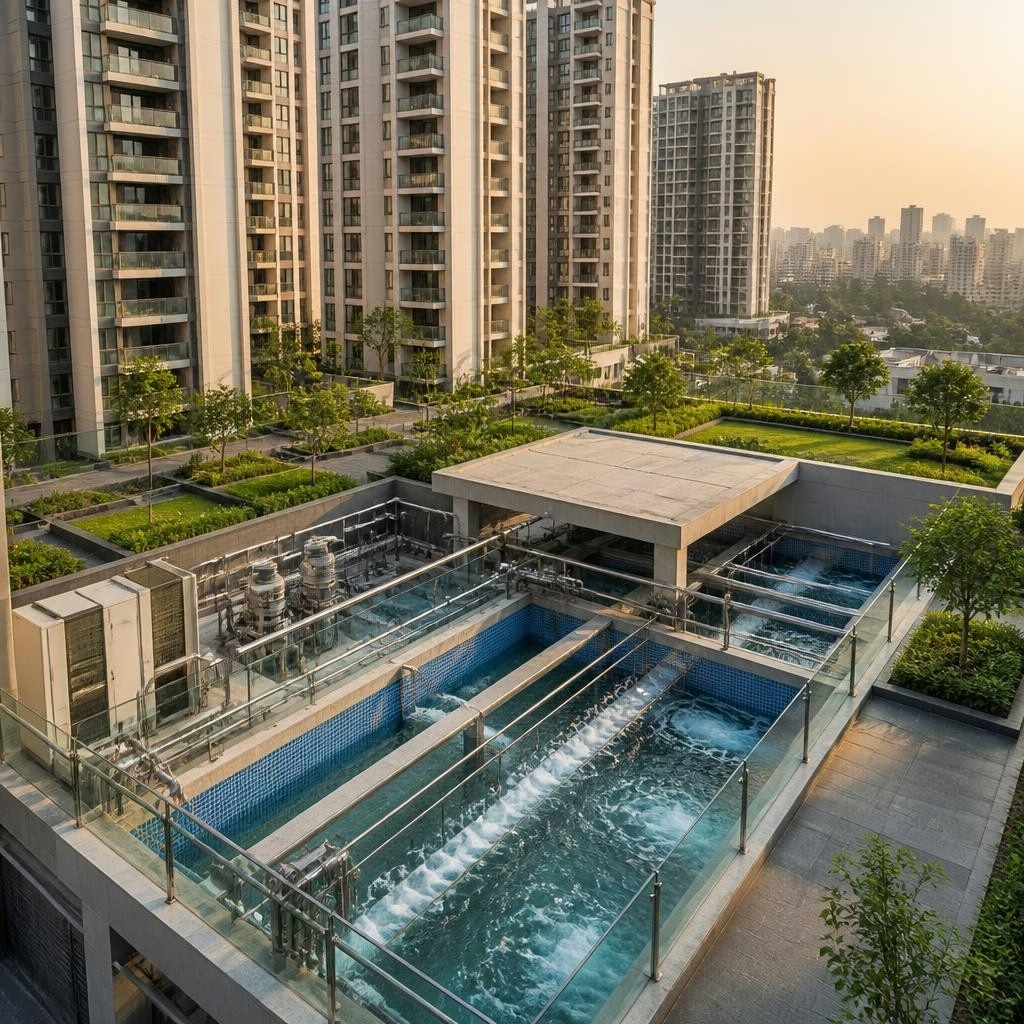
Why compact treatment matters in high‑density developments
High-density residential and mixed‑use projects in India increasingly need on‑site wastewater treatment that occupies minimal land, meets discharge or reuse standards, and keeps operating costs manageable. Limited podium, basement and podium‑garden space, combined with requirements for odour control and vehicle access, make compact process selection and careful layout essential during early design phases.
Core technologies that reduce footprint
A combination of modern processes can substantially shrink the plant footprint compared with conventional extended aeration systems. Nanobubble technology improves oxygen transfer and biological performance in smaller tanks; ozone generators and advanced oxidation processes (AOP) provide high‑efficiency polishing in compact reactors; hydrodynamic cavitation can enhance mixing and reduce detention time. Specifying these technologies as part of a staged treatment train lets you replace large secondary clarifiers or long aeration basins with denser, faster units.
Layout concepts for minimal space
Start treatment layout work during schematic design to reserve continuous space for tanks and maintenance access. Consider vertical stacking of process stages where possible (e.g., compact aerobic reactor above polishing skid), use modular skid‑mounted units for ozone/AOP, and locate electrical/control panels adjacent to the plant for consolidated cabling. Multi‑function tanks (e.g., combined equalization and biological contact) can save area but require careful process control. Wherever site gradients allow, gravity‑fed sequencing reduces pump station size and associated footprint.
Utility, safety and access planning
Design for desludging and truck access, clear ventilation paths, and segregation of chemical storage (for ozone off‑gas handling and AOP reagents) from occupied spaces. Provide dedicated access routes for service personnel and ensure lifting points or removable covers exist for submersible equipment. Plan electrical capacity and HVAC for skid‑mounted ozone generators and control cabinets; compact plants concentrate utilities, so early coordination with MEP teams avoids later retrofits.
Process integration: nanobubbles, ozone and AOP in real projects
Nanobubble aeration can reduce tank volume by improving dissolved oxygen distribution and accelerating biochemical reactions, often allowing smaller aeration zones. Ozone and AOP are effective compact polishing steps for trace organics, colour and disinfection, and can enable higher water reuse standards without large tertiary filters. When combining technologies, allow for safe sequencing (biological treatment followed by oxidation/polishing), ozone off‑gas management, and appropriate contact times within compact reactors or cartridges.
Regulatory and compliance checkpoints for Indian sites
Early engagement with the local municipal authority and the State Pollution Control Board is essential to confirm discharge limits, monitoring requirements and any reuse approvals. Follow relevant building codes for underground tanks, fire and chemical storage, and the National Building Code guidance on service spaces and ventilation where applicable. Maintain records and instrumentation for online monitoring to demonstrate compliance and ease statutory reporting during handover.
Commissioning, operation and lifecycle considerations
Compact systems rely on tighter control and regular preventive maintenance. Specify remote monitoring and alarms, simple operator interfaces, and a clear spare‑parts list. Account for routine tasks such as membrane or cartridge replacement (if used), electrode or ozone generator service, and periodic desludging. A well‑documented commissioning plan and operator training reduce start‑up risk and prolong equipment life.
Choosing a partner and next steps
Select vendors who can demonstrate successful compact installations, provide site trials or live demos, and offer technical support during design and commissioning. Customer feedback suggests that expertise, timely execution and hands‑on support are valuable selection criteria. Begin with a site‑specific feasibility study that maps available space, flow and load profiles, and reuse targets; use that baseline to compare modular nanobubble, ozone and AOP configurations and to prepare a coordinated MEP and access layout for approvals.
Customer review


Article by
Prasinos Tech Innovations
Prasinos Tech Innovations Private Limited is an OEM at the forefront of sustainable environmental technologies. We specialize in the design and manufacturing of advanced systems including nanobubble generators, ozone generators, hydrodynamic cavitation units, and advanced oxidation processes (AOP) tailored for critical applications in sewage treatment plants (STP), effluent treatment plants (ETP), and water and wastewater treatment plants (WWTP). Our technologies are engineered to deliver high-efficiency, low-footprint solutions across diverse sectors such as aquaculture, agriculture, horticulture, and the bioenergy industry, including biogas and biodiesel production.