From Wastewater to Resource: Rethinking the Role of Ozone in Modern STPs
An overview of how ozone-based technologies, combined with AOP, nanobubbles and cavitation, can support circular economy goals, water reuse, Net Zero Water ambitions and industrial sustainability in modern sewage treatment plants.
Why rethink ozone in sewage treatment?
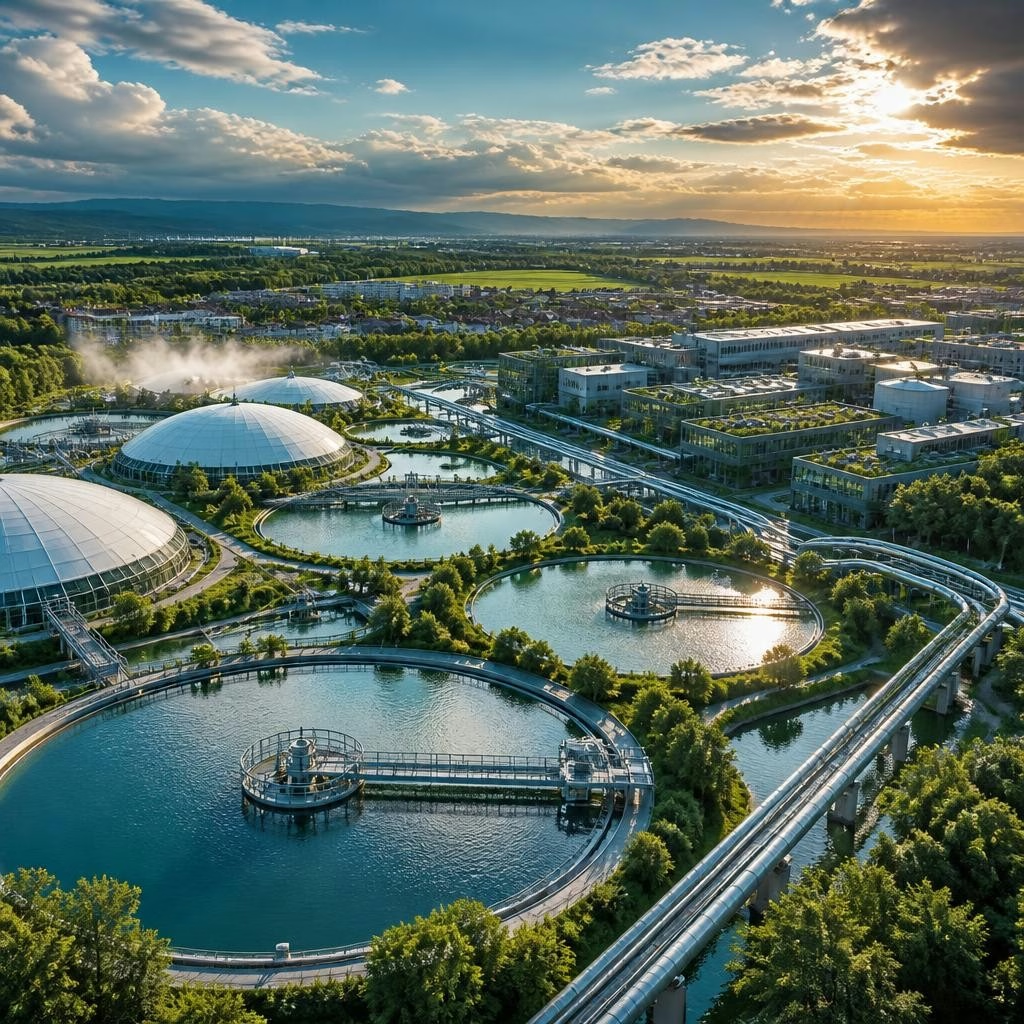
Cities and industries are increasingly treating wastewater not as a disposal problem but as a recoverable resource. Ozone—an established strong oxidant—has a renewed place in this mindset because it can help transform wastewater streams so they are safer to reuse, easier to polish, and less likely to generate persistent disinfection byproducts when applied as part of an integrated process. For plant operators pursuing circular-economy outcomes, ozone adds a flexible tool for upgrading effluent quality ahead of reuse or recovery steps.
What ozone does in a modern STP
In practical terms, ozone contributes to STP performance in two complementary ways: rapid oxidation of organic and color-causing molecules, and effective disinfection of pathogens that survive conventional biological treatment. Because ozone reacts quickly, it is well-suited for polishing and for treating specific contaminant loads that are difficult to remove biologically. In many facilities it is applied after biological treatment to reduce odor, remove color or reduce certain micropollutants prior to advanced filtration or reuse.
Pairing ozone with AOP and cavitation for tougher contaminants
Ozone is often more effective when paired with Advanced Oxidation Processes (AOPs) or cavitation technologies. AOP schemes—where ozone is combined with hydrogen peroxide, UV, or catalysts—generate highly reactive radicals that break down recalcitrant organics more completely than ozone alone. Hydrodynamic cavitation can enhance mass transfer and precondition contaminants so downstream oxidation is more efficient. Together, these combinations can reduce the need for repeated chemical dosing and make tertiary treatment more robust for industrial or challenging municipal streams.
Improving transfer and contact: the role of nanobubbles
Oxygen transfer and gas–liquid contact are central to any gas-based treatment. Nanobubble technology increases gas residence time and improves dispersion in water, supporting better contact between ozone (or oxygen) and contaminants without necessarily increasing gas flow. For STPs, integrating nanobubble generators with ozone systems can improve oxidation efficiency and lower the apparent chemical demand per unit of contaminant removed. Customers of integrated solutions have noted the practical benefits of seeing combined systems in operation before committing to larger installs.
How this supports circular economy and Net Zero Water goals
Higher-quality polishing via ozone and allied processes creates opportunities for water reuse within industries and municipalities—laundry reuse, cooling tower make-up, landscape irrigation, or process water in industrial plants. By minimizing the need for fresh water and by enabling safe recovery pathways, these treatments contribute to Net Zero Water strategies. When designed with energy efficiency in mind and combined with resource recovery steps (sludge reduction, nutrient recovery), ozone-based polishing becomes a practical component of broader sustainability and climate-resilience plans.
Operational considerations: safety, footprint and energy
Ozone systems require careful design and monitoring: correct dosing, contact time, off-gas handling and health-and-safety controls are essential. Energy use should be evaluated against the benefits of higher-quality effluent and potential reductions in downstream chemical use or disposal costs. Integrating compact, optimized hardware and control strategies—alongside complementary technologies such as cavitation and nanobubbles—helps reduce footprint and can improve lifecycle performance. Regular maintenance, skilled commissioning and performance validation are critical to meet regulatory and reuse targets reliably.
Next steps: designing an integrated polishing solution with local expertise
For STP owners and operators considering ozone-led polishing or reuse-ready upgrades, the most practical step is a site assessment that matches water quality objectives to the right combination of technologies—ozone generators, AOP configurations, hydrodynamic cavitation units and nanobubble systems. Prasinos Tech Innovations, based in Secunderabad and serving clients across India, develops and supplies many of these components and has been recognized by customers for technical knowledge, demonstrations of patented nanobubble technology and strong field support. If your goal is safer reuse, smaller environmental footprint, and stronger resilience to variable influent, request a feasibility discussion or pilot demonstration to evaluate integrated ozone solutions in your STP.
Article by
Prasinos Tech Innovations
Prasinos Tech Innovations Private Limited is an OEM at the forefront of sustainable environmental technologies. We specialize in the design and manufacturing of advanced systems including nanobubble generators, ozone generators, hydrodynamic cavitation units, and advanced oxidation processes (AOP) tailored for critical applications in sewage treatment plants (STP), effluent treatment plants (ETP), and water and wastewater treatment plants (WWTP). Our technologies are engineered to deliver high-efficiency, low-footprint solutions across diverse sectors such as aquaculture, agriculture, horticulture, and the bioenergy industry, including biogas and biodiesel production.