How Hotels and Resorts in India Can Upgrade STPs Without Civil Expansion
Practical guidance for hotel and resort owners on using compact nanobubble systems, ozone and AOP to improve underperforming STPs within existing tank volumes for safe gardening and flushing reuse, with minimal disruption.
The retrofit challenge for hotel STPs
Many hotels and resorts face the same dilemma: ageing or underperforming sewage treatment plants (STPs), limited on-site space for expansion, and a need to maintain guest comfort and aesthetics. Owners want higher-quality treated water for irrigation and toilet flushing, better compliance and lower operating costs, but large civil expansion is costly, time-consuming and disruptive. A targeted retrofit using compact, high-efficiency technologies can often restore or improve STP performance without excavating tanks or building new basins.
Why compact technologies are suited to hotels
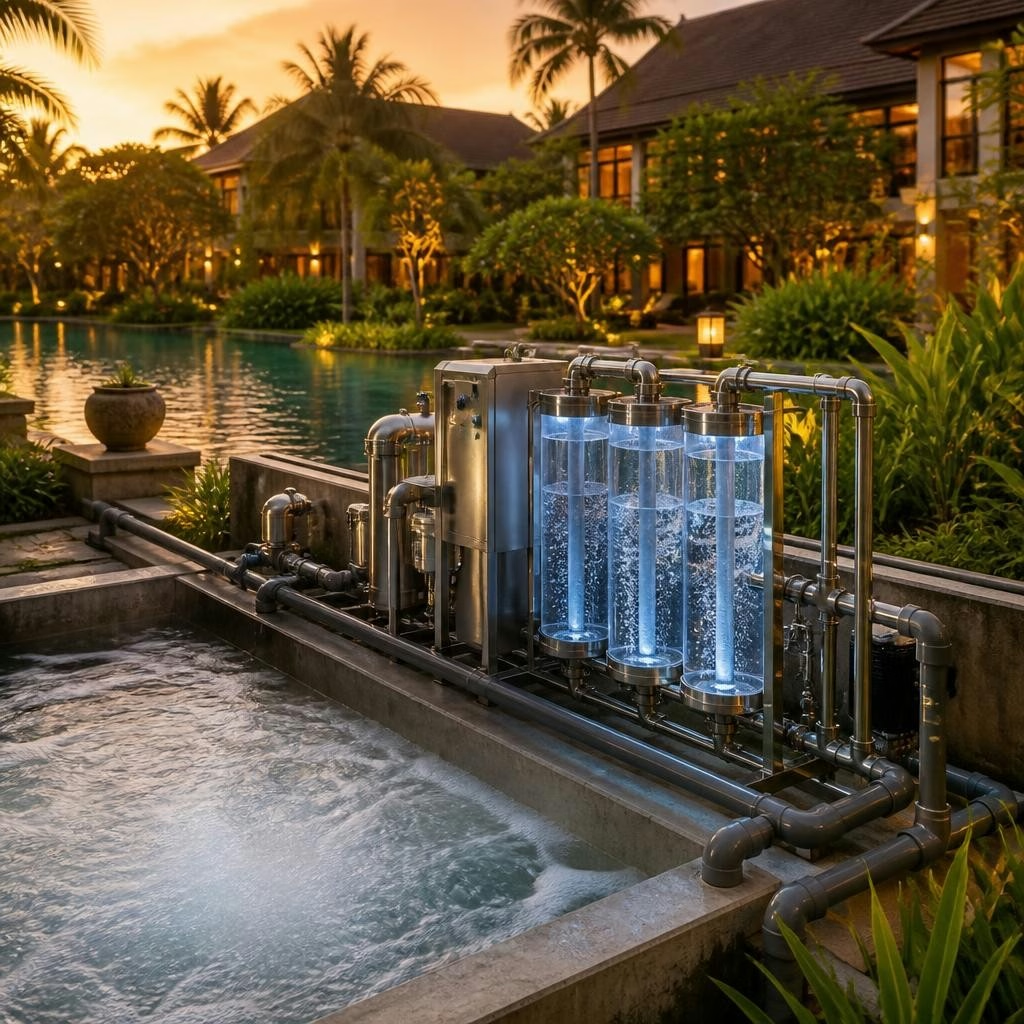
Compact technologies—such as nanobubble generators, ozone systems and advanced oxidation processes (AOP)—are designed to increase treatment effectiveness within existing tank volumes. They typically have a smaller footprint than additional concrete tanks and can be installed in sumps, pipework or auxiliary skids. For hospitality sites where landscaping, guest movement and uninterrupted services matter, these low-footprint upgrades reduce downtime and site disturbance compared with civil work.
How nanobubble systems improve biological treatment
Nanobubble technology enhances dissolved oxygen transfer and gas–liquid contact at micro scales, supporting aerobic microbial processes in existing aeration basins or reactors. Better oxygen availability can accelerate COD/BOD removal, reduce sludge production and stabilize biological processes—all without enlarging tank volume. For hotel STPs this can translate to steadier effluent quality for reuse and lower reliance on chemical additives.
Using ozone and AOP for disinfection and organics control
Ozone generators and AOP units are compact options for disinfection, oxidation of recalcitrant organics, and odor or color removal. Ozone can be dosed directly into a contact chamber or mixed line; when combined with hydrogen peroxide or UV in an AOP, it breaks down fine organics that biological systems struggle with. These treatments can be added downstream of existing biological units to lift effluent quality to levels suitable for non-potable reuse such as landscaping and toilet flushing.
Practical steps for a retrofit without civil expansion
A typical retrofit approach begins with a site assessment and effluent characterization to identify constraints and target parameters (e.g., COD/BOD, ammonia, turbidity, pathogens). Next comes pilot testing or a live demonstration with compact equipment to validate performance in the plant’s actual conditions. After selection of the appropriate combination—nanobubble injection, ozone contact/AOP module, or a small hydrodynamic cavitation unit—installation focuses on integrating equipment into existing piping, aeration systems or side-stream loops to avoid major structural changes.
Operation, safety and maintenance considerations
While these technologies reduce chemical usage and footprint, they require appropriate controls, operator training and routine maintenance. Nanobubble generators and ozone systems should be monitored for flow rates, oxygen transfer or ozone dose, and periodic checks carried out on compressors, blowers or ozone modules. Ozone handling requires safety measures and trained staff. A clear maintenance schedule and online monitoring help sustain performance and demonstrate compliance to regulators.
Benefits for hotels and resorts
When well integrated, compact upgrades can deliver multiple hotel-relevant benefits: improved treated-water quality suitable for irrigation and flushing reuse; reduced sludge handling and chemical costs; fewer odors and better landscape watering; and limited guest disruption during installation. For properties aiming to strengthen sustainability credentials, these solutions can also support water-conservation goals without the time and expense of tank expansions.
Next steps and what to expect from a technology partner
Choose a technology partner who begins with a site visit, offers a live demonstration or pilot, and provides clear integration plans for minimal disruption. Based in Secunderabad and serving clients across India, Prasinos Tech Innovations supports nanobubble, ozone and AOP retrofits and is noted by customers for helpful, knowledgeable service and on-site demonstrations. Hotel owners should request an assessment that includes expected performance gains, operational needs and a staged implementation plan to confirm that performance targets can be met without civil expansion.
Article by
Prasinos Tech Innovations
Prasinos Tech Innovations Private Limited is an OEM at the forefront of sustainable environmental technologies. We specialize in the design and manufacturing of advanced systems including nanobubble generators, ozone generators, hydrodynamic cavitation units, and advanced oxidation processes (AOP) tailored for critical applications in sewage treatment plants (STP), effluent treatment plants (ETP), and water and wastewater treatment plants (WWTP). Our technologies are engineered to deliver high-efficiency, low-footprint solutions across diverse sectors such as aquaculture, agriculture, horticulture, and the bioenergy industry, including biogas and biodiesel production.