How Nanobubble Aeration Stabilises Biological Treatment in Textile & Dyeing ETPs
Practical guidance for textile and dyeing plant managers on using nanobubble aeration and hydrodynamic cavitation, plus complementary AOP/ozone approaches, to improve DO stability, colour removal and COD control in Indian ETPs.
The challenge in textile and dyeing ETPs
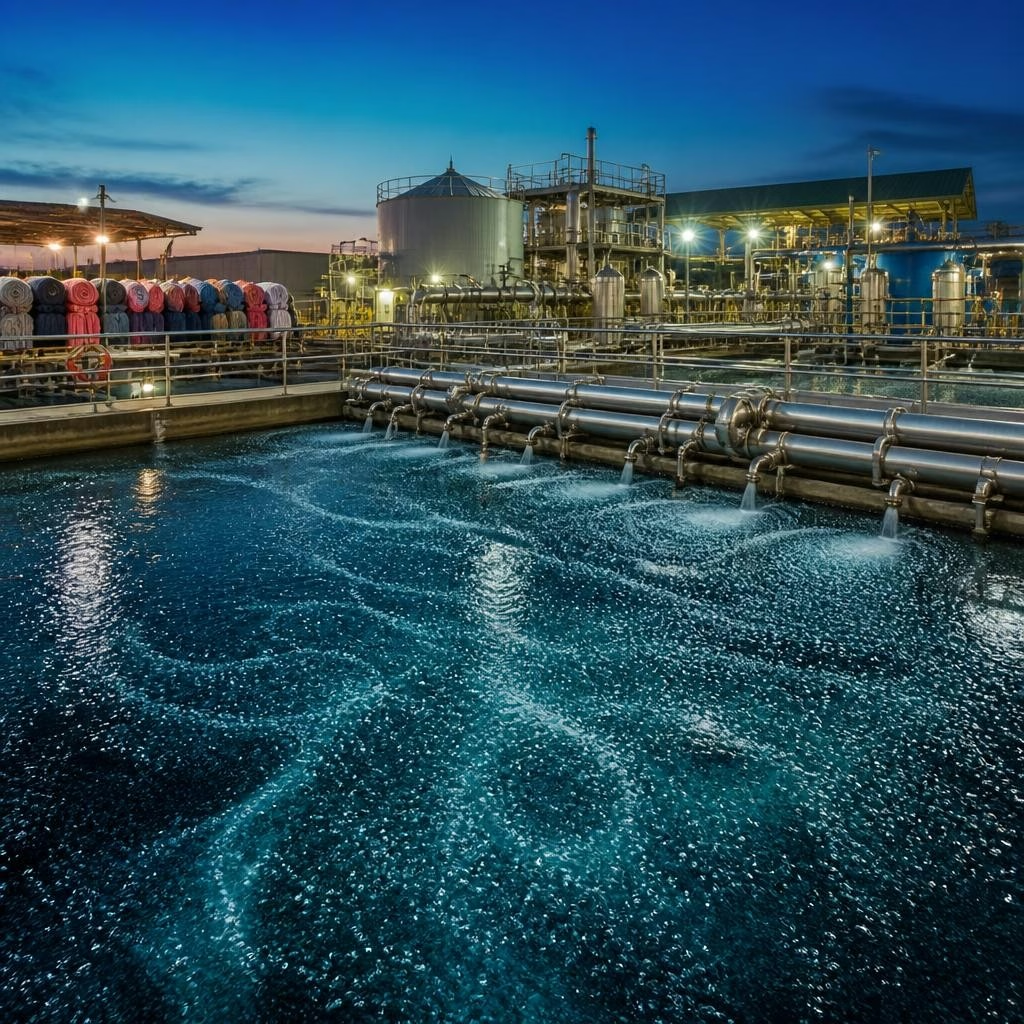
Textile and dyeing effluent treatment plants commonly face large, rapid swings in organic load and intense colour loads that stress biological systems. Variable influent composition can cause dissolved oxygen (DO) to drop quickly, upsetting microbial populations and reducing treatment efficiency. For plant managers in Indian textile clusters, maintaining DO stability while improving colour and COD removal is a persistent operational priority—especially where footprint, energy use and chemical costs must be controlled.
What nanobubbles and hydrodynamic cavitation do
Nanobubbles are extremely small gas bubbles with high surface area and long suspension times in water; they enhance oxygen transfer and interaction with contaminants. Hydrodynamic cavitation generates localized pressure changes and micro-bubbles that can disrupt recalcitrant compounds and increase mass transfer. Together, these technologies—offered as nanobubble generators and hydrodynamic cavitation units—provide physical ways to raise effective oxygen availability and promote oxidative reactions without relying solely on increased blower power or higher chemical dosing.
Stabilising DO and biological treatment with nanobubble aeration
Because nanobubbles persist longer and present much greater gas–liquid contact area than conventional bubbles, they help maintain more consistent DO in biological reactors. That steadier oxygen supply reduces stress on aerobic biomass during load spikes, supporting more stable BOD/COD removal and reducing the likelihood of filamentous bulking from oxygen starvation. For plants struggling with fluctuating loads, integrating nanobubble aeration into aeration tanks or equalization basins can smooth DO profiles and make downstream biological processes more resilient.
Improving colour removal and COD with combined approaches
Colour compounds in textile effluents are often partially resistant to biodegradation. Combining nanobubble-enhanced aeration or hydrodynamic cavitation with advanced oxidation processes (AOP) and targeted ozone application can increase breakdown of chromophoric molecules and improve overall COD reduction. Ozone generators and AOP units, when used judiciously after preliminary biodegradation or as part of a polishing stage, can oxidize dye fragments that biology cannot fully remove—leading to better discharge quality and potential reuse opportunities.
Practical retrofit and operational considerations
When planning upgrades, consider trialing nanobubble units on a pilot reactor or a portion of the flow to observe effects on DO stability, aeration energy use, and sludge production. Placement options include aeration basins, equalization tanks or recirculation loops; hydrodynamic cavitation modules are often installed upstream of biological stages or ahead of AOP dosing. Monitor DO, settleable solids, mixed liquor suspended solids (MLSS) trends and colour/COD before and after implementation to evaluate benefits. Choose solutions that are compact and energy-efficient to fit within site constraints common in textile clusters.
What practitioners and peers report
Field experience from demonstrations and installations suggests that properly sized nanobubble systems can deliver noticeable improvements in DO stability and biological performance. One customer who attended a live demonstration specifically praised the patented nanobubble technology and its practical impact. More broadly, local users highlight helpful technical support, timely execution and perceived value for money when these systems are applied alongside ozone or AOP equipment—factors that matter when selecting a vendor for piloting or scaling up.
Next steps for textile plant managers
If variable loads and colour are undermining your ETP performance, start with a diagnostic: record influent variability, DO trends, and colour/COD baselines for a representative period. Request a site-specific pilot or live demo of nanobubble and cavitation technology to assess integration needs and expected operational changes. When evaluating providers, look for clear pilot plans, on-site support for commissioning and measurable monitoring criteria. For teams in India, working with suppliers experienced in nanobubble generation, hydrodynamic cavitation and AOP/ozone systems helps ensure the technical fit and practical follow-through you’ll need to stabilise biological treatment and improve effluent quality.
Customer review


Article by
Prasinos Tech Innovations
Prasinos Tech Innovations Private Limited is an OEM at the forefront of sustainable environmental technologies. We specialize in the design and manufacturing of advanced systems including nanobubble generators, ozone generators, hydrodynamic cavitation units, and advanced oxidation processes (AOP) tailored for critical applications in sewage treatment plants (STP), effluent treatment plants (ETP), and water and wastewater treatment plants (WWTP). Our technologies are engineered to deliver high-efficiency, low-footprint solutions across diverse sectors such as aquaculture, agriculture, horticulture, and the bioenergy industry, including biogas and biodiesel production.