How Nanobubble Technology Improves STP Performance in Indian Cities
A practical overview of how nanobubble generators can boost BOD/COD reduction, raise oxygen transfer efficiency, and cut sludge and chemical use for municipal and industrial sewage treatment plants in India.
Introduction: Why Indian STPs need improved aeration
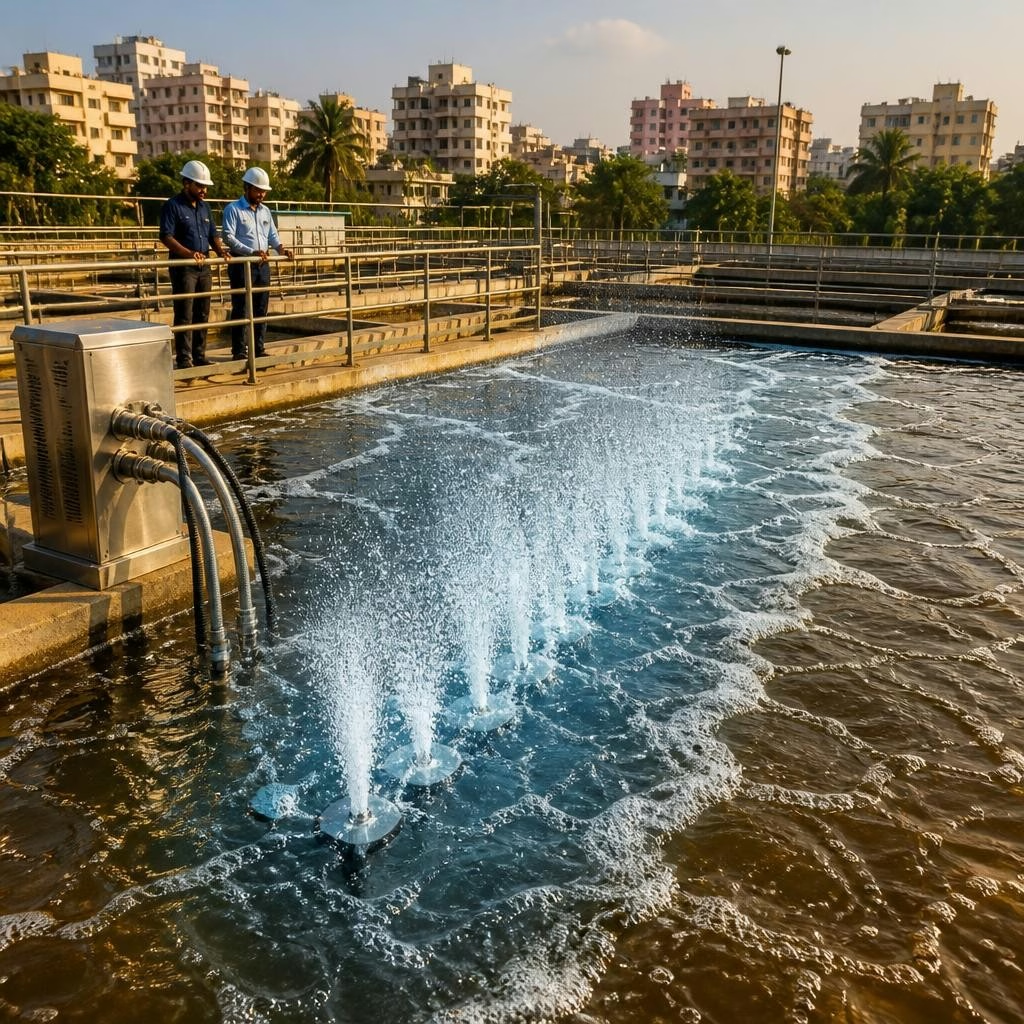
Many municipal and industrial sewage treatment plants (STPs) in Indian cities face fluctuating influent loads, land constraints, and growing regulatory pressure to meet discharge standards. Traditional aeration and chemical treatment approaches often struggle to balance performance, energy use, and operating costs. Nanobubble technology provides an alternative aeration and process-enhancement approach that can be retrofitted into existing plants or included in new designs to improve overall biological treatment performance while reducing some operational burdens.
Common performance challenges in municipal and industrial STPs
Urban STPs often contend with high organic loads (BOD/COD), variable flow rates, limited basin volume, and the need to meet tightening effluent norms. Industrial ETP streams can introduce toxic or inhibitory compounds that slow biological activity, requiring more intensive aeration or chemical dosing. Space limits and energy costs make it difficult to expand mechanical aeration or add large treatment trains. These constraints create demand for compact, energy-efficient solutions that enhance oxygen delivery and biological degradation without dramatically increasing footprint or chemical dependency.
What nanobubble generators do and how they work
Nanobubble generators create extremely small gas bubbles that remain suspended in water for much longer than conventional bubbles. This increases the gas–liquid contact time and improves dissolved oxygen transfer and mass transfer efficiency. In practice, nanobubble systems can supply oxygen more effectively to microbial communities in aeration basins and reactors, boost mixing at a microscale, and support biological oxidation processes while often requiring less mechanical energy and space than traditional aeration equipment.
How nanobubbles boost BOD and COD reduction
Improved oxygen availability directly supports the aerobic microorganisms responsible for breaking down organic matter, helping to accelerate BOD and COD removal in secondary treatment. By enhancing dissolved oxygen distribution throughout the tank, nanobubbles can reduce dead zones and promote more uniform biological activity. For industrial streams where biological treatment is feasible, integrating a nanobubble generator ahead of or within biological reactors can help maintain stable treatment rates even when influent loads vary.
Operational benefits: less sludge and reduced chemical use
Nanobubble-enhanced processes have been observed to reduce excess sludge formation and decrease reliance on chemical additives in many applications. Better oxygen transfer and improved contact at the microorganism level can result in more complete biodegradation and lower biological solids production. In turn, reduced sludge handling and lower chemical dosing can lower operating costs and simplify downstream processing. These outcomes depend on feed characteristics and system design, so site-specific evaluation is important.
Practical steps for implementing nanobubble systems in STPs
Start with a pilot or demonstration unit to quantify effects on DO, BOD/COD removal, sludge yield and energy consumption under local conditions. Typical implementation steps include mapping existing aeration or mixing points, selecting generator capacity to match flow and oxygen demand, integrating control and monitoring for dissolved oxygen and process indicators, and scheduling training and maintenance. Monitoring should track influent and effluent BOD/COD, dissolved oxygen profiles, sludge volume index or settled solids, and any changes in chemical usage to evaluate return on investment.
Choosing a supplier and why Prasinos Tech may be a fit
When evaluating vendors, look for proven nanobubble generators, openness to pilot testing, clear installation and service plans, and experience across STP and ETP projects. Prasinos Tech Innovations Pvt. Ltd. develops nanobubble generators and complementary technologies (including ozone generators, hydrodynamic cavitation units and AOP solutions) and emphasizes compact, energy-saving designs for wastewater applications. Customers have highlighted the company’s expertise, sustainable approach and helpful demonstrations when deciding on a solution. For STPs in Indian cities, beginning with a site assessment and a short-duration pilot will provide the most reliable indication of performance improvements and operational impacts.
Customer review


Article by
Prasinos Tech Innovations
Prasinos Tech Innovations Private Limited is an OEM at the forefront of sustainable environmental technologies. We specialize in the design and manufacturing of advanced systems including nanobubble generators, ozone generators, hydrodynamic cavitation units, and advanced oxidation processes (AOP) tailored for critical applications in sewage treatment plants (STP), effluent treatment plants (ETP), and water and wastewater treatment plants (WWTP). Our technologies are engineered to deliver high-efficiency, low-footprint solutions across diverse sectors such as aquaculture, agriculture, horticulture, and the bioenergy industry, including biogas and biodiesel production.