How Nanobubbles and Ozone Help Indian Farmers Reuse Treated STP Water for Irrigation Safely
A practical guide for municipalities, builders, and farmers on upgrading STP effluent with nanobubble and ozone technologies to reduce odour, improve water quality, and support safe agricultural reuse in Indian peri-urban and rural settings.
Why upgrading STP effluent matters for irrigation
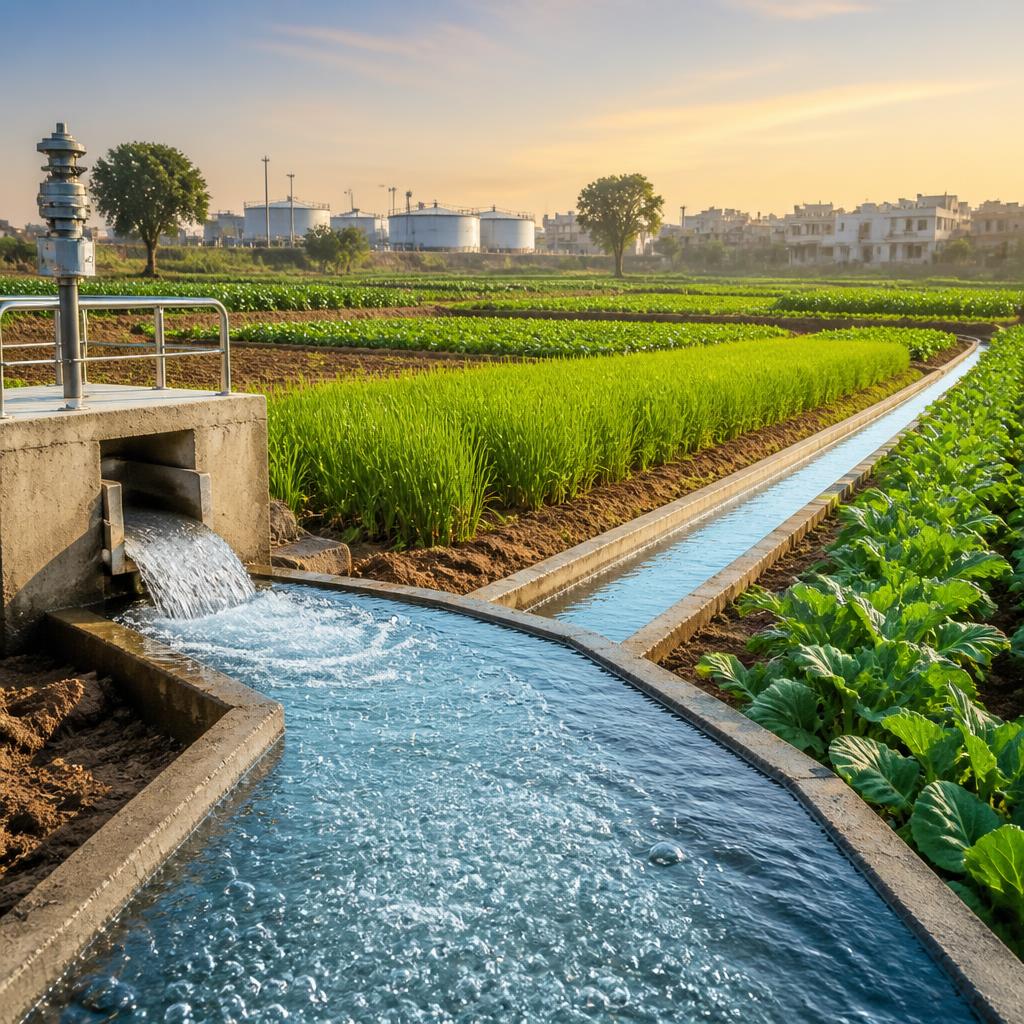
Water scarcity and growing demand for irrigation in peri-urban and rural India make treated sewage reuse an attractive option. Typical secondary-treated STP effluent can still contain residual organics, low dissolved oxygen, unpleasant odour, pathogens, and trace pollutants that affect crop health and public perception. Upgrading effluent quality before agricultural reuse reduces risks, improves crop outcomes, and helps close local water cycles while reducing freshwater withdrawals.
What nanobubble technology does for treated water
Nanobubbles are extremely small gas bubbles with high stability in water and a large surface-area-to-volume ratio. When introduced into STP effluent, they improve oxygen transfer and can enhance biological removal of organic matter, supporting better COD/BOD reduction. In practice, nanobubble injection can reduce sludge production, lower the need for chemical aeration, and help maintain aerobic conditions in polishing basins—outcomes that make effluent safer and more stable for irrigation.
How ozone improves disinfection and odour control
Ozone is a powerful oxidant that acts quickly on odorous compounds, many pathogens, and certain organic pollutants. Integrating ozone treatment after biological polishing can remove persistent odours and reduce microbial loads without leaving long-lived chemical residues. Practical implementations use ozone generators—including water-cooled and corona-discharge units—to provide controlled oxidation and help meet safety and acceptability requirements for agricultural reuse.
Why combining nanobubbles, ozone and AOPs is effective
A combined approach leverages complementary mechanisms: nanobubbles strengthen biological treatment by increasing dissolved oxygen and mass transfer, while ozone and advanced oxidation processes (AOPs) break down recalcitrant organics and inactivate pathogens. Hydrodynamic cavitation and AOP modules can be added where trace micropollutants or persistent organics are a concern. This treatment train is well suited for sites that require both improved biological performance and targeted oxidation/polishing.
A practical upgrade pathway for municipalities and builders
Start with a site assessment and effluent testing to identify gaps in biological removal, oxygen levels, odour sources, and target contaminants. A common pathway is: optimize biological treatment; add nanobubble aeration to polishing tanks; follow with ozone or an AOP stage for disinfection and odour control; and finish with monitoring and modest post-treatment storage before irrigation. Pilot trials or live demonstrations help validate performance on local wastewater characteristics before full-scale installation.
Operational and farmer-safety considerations
Operational planning should include routine monitoring (microbial indicators, organic load trends, and basic field checks) and maintenance of gas-generation equipment. Farmers should be advised on irrigation timing (e.g., avoid contact irrigation on leafy vegetables shortly before harvest) and on crop selection and handling practices consistent with local regulations. Coordination with municipal authorities and extension services ensures reuse is matched to safe agricultural practices and public-health guidelines.
Benefits for Indian peri-urban and rural reuse projects
Upgrading STP effluent with nanobubble, ozone, and complementary AOP or cavitation units can reduce odour complaints, improve biological treatment efficiency, lower chemical consumption, and produce more reliable irrigation water—delivering both environmental and economic advantages. Customers and partners have praised the technical expertise and sustainability focus of solution providers who combine these technologies, and many report that site demonstrations and pilot projects have been particularly helpful when planning reuse in agriculture.
Customer review


Article by
Prasinos Tech Innovations
Prasinos Tech Innovations Private Limited is an OEM at the forefront of sustainable environmental technologies. We specialize in the design and manufacturing of advanced systems including nanobubble generators, ozone generators, hydrodynamic cavitation units, and advanced oxidation processes (AOP) tailored for critical applications in sewage treatment plants (STP), effluent treatment plants (ETP), and water and wastewater treatment plants (WWTP). Our technologies are engineered to deliver high-efficiency, low-footprint solutions across diverse sectors such as aquaculture, agriculture, horticulture, and the bioenergy industry, including biogas and biodiesel production.