Improving Biogas Yield from STP Sludge and Food Waste with Hydrodynamic Cavitation and Nanobubbles
A practical guide for biogas project developers and STP owners on using hydrodynamic cavitation and nanobubble pre-treatment to enhance solids breakdown, improve biodegradability, and support higher methane production for plants treating sewage and organic waste in India.
Overview: why pre-treatment matters for biogas from STP sludge and food waste
Sewage sludge and mixed food waste often contain complex, slowly degradable solids—cellulose, fats, proteins and resilient microbial cells—that limit the hydrolysis stage in anaerobic digestion. Effective pre-treatment breaks these structures, increases soluble organic fractions and helps the downstream bacterial community convert more of the feedstock into methane. This article explains how hydrodynamic cavitation and nanobubble technologies, offered by Prasinos Tech Innovations Pvt. Ltd., can be applied as pre-treatment steps to improve solids breakdown and biogas performance for plants in India.
Common limitations of untreated sludge and mixed organics
Operators frequently face slow solids solubilization, accumulation of inert solids, poor mixing and variable feedstock quality when co-digesting STP sludge with food waste. These issues increase hydraulic retention time (HRT), reduce volumetric methane production and complicate solids handling and pumping. Practical pre-treatment aims to reduce particle size, increase soluble chemical oxygen demand (sCOD), and make organics more accessible to hydrolytic and methanogenic microbes without destabilizing the anaerobic environment.
What hydrodynamic cavitation does and where it helps
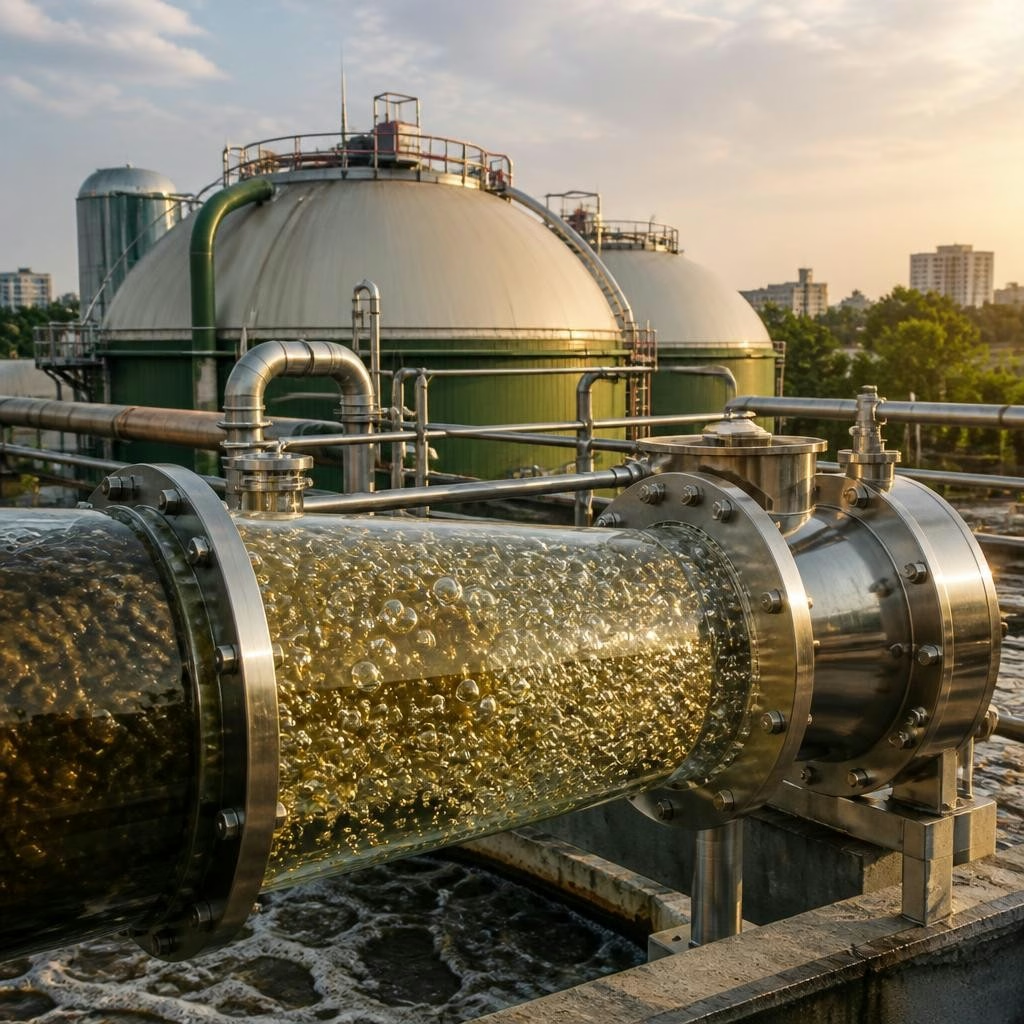
Hydrodynamic cavitation creates intense local shear and pressure changes by forcing liquid through designed constrictions. That mechanical energy disrupts cell walls, emulsifies fats, and reduces particle size—leading to higher solubilization of organic matter. As a pre-treatment step, cavitation can accelerate hydrolysis and lower the energy needed for downstream digestion equipment. Prasinos Tech lists hydrodynamic cavitation units among its offerings suitable for integration ahead of digesters or into solids-processing lines.
How nanobubbles support pre-treatment (and what to avoid)
Nanobubbles improve mass transfer and can assist in flotation, dispersion and enhanced contact between water and solids during pre-treatment. In an aerobic or facultative pre-treatment stage, nanobubbles can enhance biological hydrolysis and removal of floating contaminants; when used together with mechanical cavitation they may increase the fraction of soluble organics delivered to the anaerobic stage. Important caution: introducing dissolved oxygen directly into an anaerobic digester can inhibit methanogens. Nanobubble systems are therefore best applied in a controlled pre-treatment step or for sludge conditioning, with proper de-aeration or retention prior to anaerobic feed.
A practical pre-treatment workflow for STP sludge and food waste
A typical, implementable sequence is: (1) coarse screening and removal of large debris, (2) shredding or maceration for particle-size reduction, (3) hydrodynamic cavitation to disrupt cells and solubilize organics, (4) controlled nanobubble treatment or conditioning to improve dispersion and flotation of fines, (5) solids separation or equalization, and (6) feed to the anaerobic digester once conditions are appropriately de-aerated. This workflow is adaptable for continuous and batch biogas systems and is compatible with co-digestion strategies used by STP owners and biogas plant developers.
Operational and monitoring considerations
When adding pre-treatment you should monitor key parameters: total and volatile solids (TS/VS), soluble COD/BOD, volatile fatty acids (VFA), alkalinity, pH, and biogas composition. Track energy inputs for cavitation and nanobubble systems versus gains in biogas to confirm positive energy balance. Maintain equipment cleanliness to avoid fouling, ensure safe handling of any oxidizing agents if used (AOP/ozone), and train staff in system controls and de-aeration procedures to protect anaerobic cultures. Pilot testing on a small, controlled scale before full integration is strongly recommended to tune process settings for local feedstock characteristics.
Why work with Prasinos Tech Innovations for pre-treatment
Prasinos Tech manufactures hydrodynamic cavitation units and nanobubble generators and positions these technologies for STP, ETP and biogas applications. Their team is frequently noted by customers for technical knowledge, helpful support and on-site demonstrations—attributes that are valuable when designing a tailored pre-treatment solution. Based in Secunderabad and serving clients across India, Prasinos can support pilot demonstrations, equipment selection and integration planning to align pre-treatment with your plant’s existing digestion strategy.
Article by
Prasinos Tech Innovations
Prasinos Tech Innovations Private Limited is an OEM at the forefront of sustainable environmental technologies. We specialize in the design and manufacturing of advanced systems including nanobubble generators, ozone generators, hydrodynamic cavitation units, and advanced oxidation processes (AOP) tailored for critical applications in sewage treatment plants (STP), effluent treatment plants (ETP), and water and wastewater treatment plants (WWTP). Our technologies are engineered to deliver high-efficiency, low-footprint solutions across diverse sectors such as aquaculture, agriculture, horticulture, and the bioenergy industry, including biogas and biodiesel production.