Improving Drinking Water Quality in Indian Townships with Nanobubbles and Ozone
How small and medium townships, gated communities, and institutions can combine nanobubble generation and ozonation to improve drinking water taste and safety while reducing chemical use, with practical steps for implementation.
Why townships and institutions are looking beyond conventional treatment
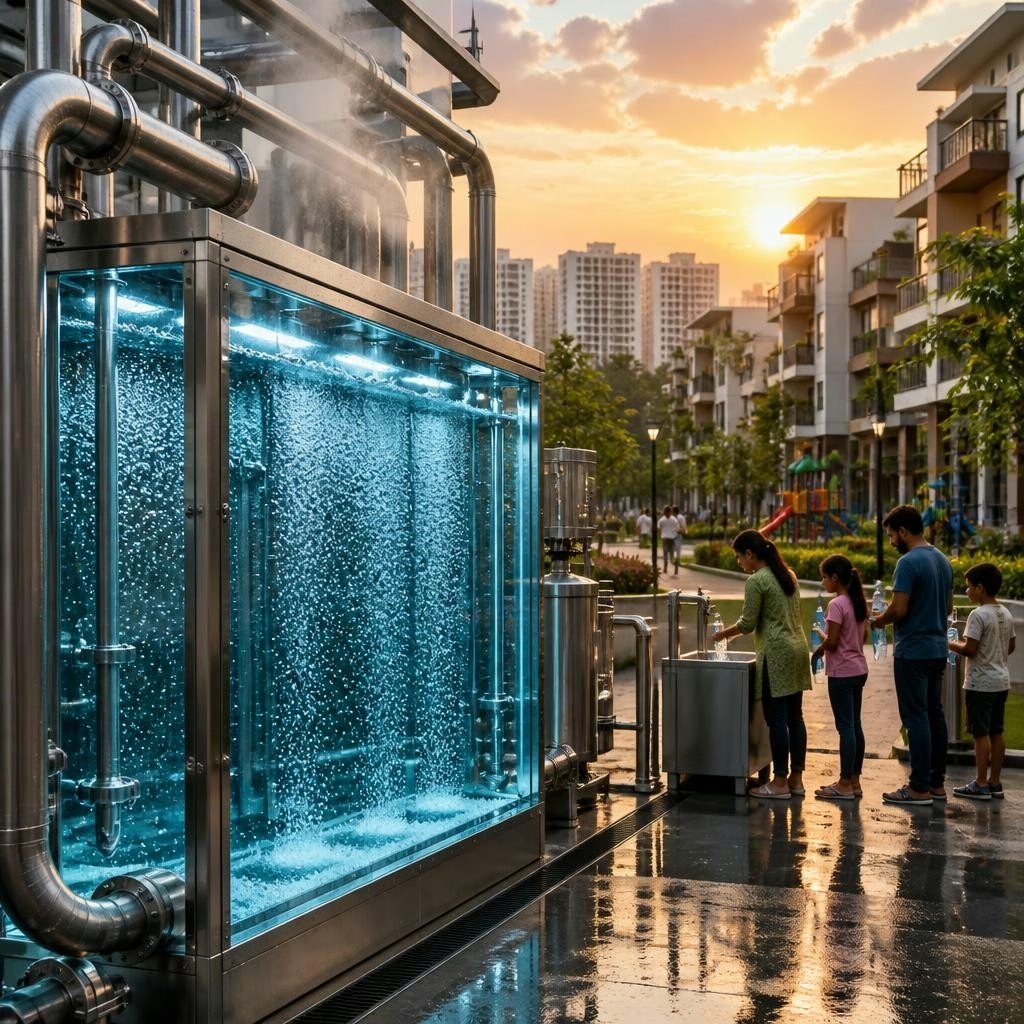
Many small and medium townships, gated communities, and institutional campuses in India face recurring drinking-water concerns such as unpleasant taste or odour, seasonal fluctuations in source-water quality, and the desire to reduce reliance on chemical dosing. These communities need compact, energy-efficient solutions that fit existing distribution systems and deliver consistent water quality for residents and staff.
What nanobubble technology brings to drinking-water systems
Nanobubble generators produce extremely small gas bubbles that remain suspended in water for long periods and increase gas–liquid contact efficiency. In practice this can improve oxygen transfer, help aggregate fine particles, and support oxidation processes that reduce the concentrations of certain organic compounds that can affect taste and odour. For systems that already struggle with biological or organic loading, adding controlled nanobubbling can reduce the need for some conventional chemical treatments and help stabilise water quality.
How ozonation complements nanobubbles
Ozone is a strong oxidant commonly used in water treatment to address taste and odour issues, reduce colour, and oxidise many organic contaminants. When applied carefully, ozonation can lower the levels of compounds that form unpleasant tastes or odours and provide an additional barrier against microbial and organic contaminants. Ozone does not leave a long-lasting disinfectant residual, so it is usually paired with downstream processes or a light residual disinfectant to protect distribution networks.
Synergy: combining nanobubbles with ozonation
When nanobubble generation and ozonation are integrated, the two technologies can be complementary. Nanobubbles enhance gas transfer and contact time in water, improving the distribution and reaction efficiency of dissolved ozone and oxygen. This often allows more effective oxidation at lower ozone doses compared with ozone alone, which can translate to reduced chemical usage and lower formation of certain by-products. Together they address taste and odour while supporting broader water-quality stability in distribution systems.
Practical design and pre-treatment considerations
Successful implementation begins with a site-specific assessment of source water, daily demand patterns, and existing treatment steps. Typical considerations include pre-filtration to remove turbidity and suspended solids that can consume ozone, appropriate ozone contact or reaction time, nanobubble injection points (for example after filtration or in a contact tank), and a plan for residual disinfectant if required by the distribution system. Monitoring for dissolved oxygen, ozone concentration, and basic water-quality parameters helps validate performance and tune the system.
Operation, maintenance and community factors
Compact nanobubble and ozone systems are generally engineered for low footprint and straightforward operation, but they do require trained operators, periodic maintenance (for blowers, generators and injectors), and safety practices specific to ozone handling. Community acceptance improves when technology providers offer on-site demonstrations, commissioning support, and clear maintenance schedules. Independent monitoring during a pilot phase helps build confidence in reported improvements to taste, odour and chemical consumption.
Benefits and next steps for decision-makers
For township managers, builders of gated communities, and institutional facility teams, combining nanobubbles with ozonation can: improve sensory quality (taste and odour), reduce certain chemical doses, stabilise water quality across distribution, and lower sludge or backwash loads in upstream processes. Practical next steps are: obtain a site assessment, run a small pilot or live demo, review monitoring data, and develop an operation and maintenance plan. Prasinos Tech Innovations Pvt. Ltd., based in Secunderabad and operating across India, specialises in nanobubble and ozone systems and commonly provides demonstrations and commissioning support that customers cite as helpful when evaluating these solutions.
Article by
Prasinos Tech Innovations
Prasinos Tech Innovations Private Limited is an OEM at the forefront of sustainable environmental technologies. We specialize in the design and manufacturing of advanced systems including nanobubble generators, ozone generators, hydrodynamic cavitation units, and advanced oxidation processes (AOP) tailored for critical applications in sewage treatment plants (STP), effluent treatment plants (ETP), and water and wastewater treatment plants (WWTP). Our technologies are engineered to deliver high-efficiency, low-footprint solutions across diverse sectors such as aquaculture, agriculture, horticulture, and the bioenergy industry, including biogas and biodiesel production.