Improving Shrimp and Fish Survival in High‑Density Indian Ponds with Nanobubbles
Practical guidance for aquaculture farmers on using nanobubble systems to maintain dissolved oxygen and water quality during hot weather and power interruptions, including layout tips, operating schedules, backup options, and monitoring advice.

Understanding the problem: heat, density and oxygen stress
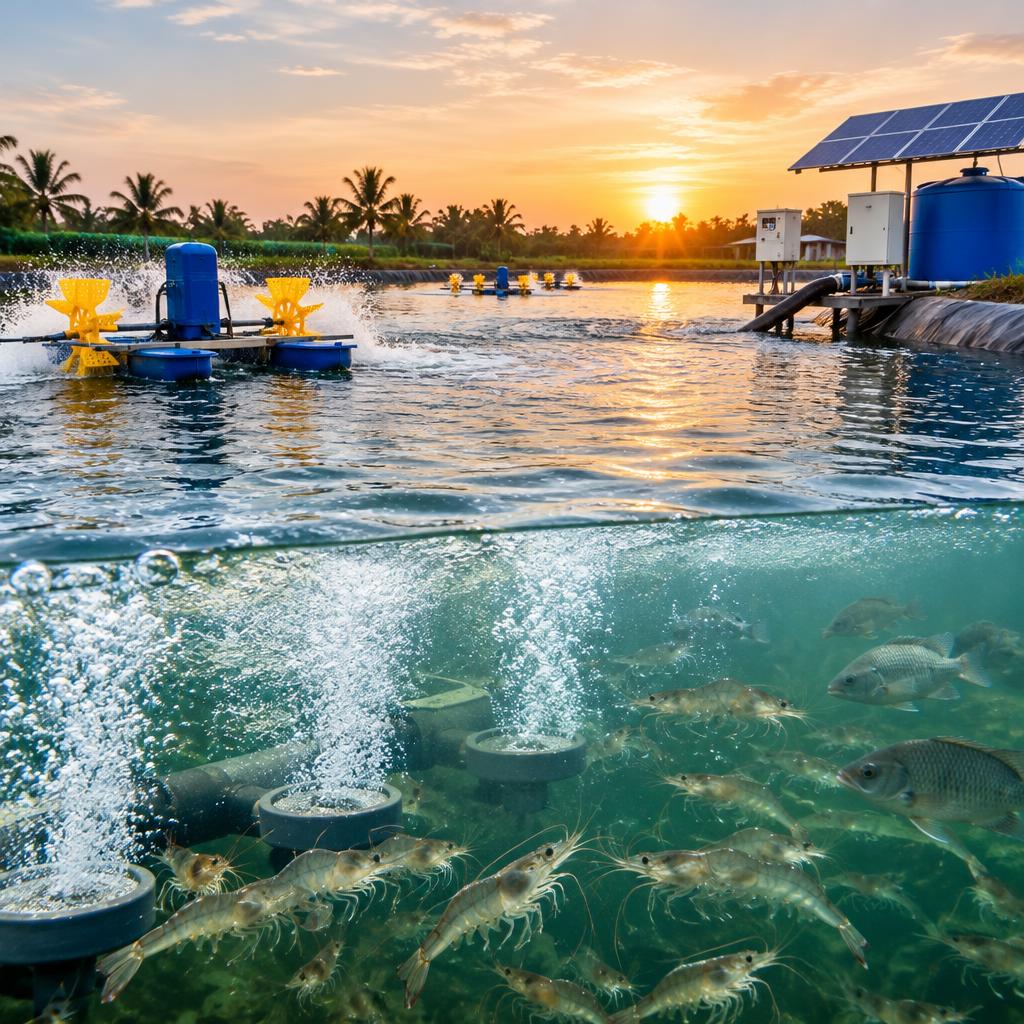
High stocking densities and high ambient temperatures can quickly create oxygen stress in shrimp and fish ponds. Warm water holds less oxygen while metabolic demand from animals and microbes rises, and organic loading from feeding accelerates oxygen consumption. During power cuts, mechanical aeration often stops, producing rapid declines in dissolved oxygen that can lead to mass mortalities. Any practical response must therefore focus on keeping dissolved oxygen stable and limiting the accumulation of harmful metabolites until normal aeration resumes.
Why nanobubbles help in high‑density ponds
Nanobubble generators produce extremely small gas bubbles that remain suspended in water for extended periods and increase gas transfer efficiency. Compared with surface aeration alone, nanobubbles can improve oxygen availability throughout the water column and support aerobic microbial activity that helps maintain water quality. For farmers facing summer stress or intermittent power, nanobubble systems are useful because they can sustain dissolved oxygen more evenly and reduce reliance on chemical interventions.
Practical system layout recommendations
Design a layout that distributes nanobubble injection across the pond rather than concentrating it at a single point. Position generators or injection manifolds so treated water reaches feeding zones and deeper areas where stratification can occur. Use multiple smaller units or multiple injection points to provide redundancy: if one unit goes offline, others continue supporting oxygen levels. Where a pond is divided into sections, equip each section independently so problems are contained and easier to manage.
Operating schedules for summer and high‑load periods
During hot weather and periods of heavy feeding, operate nanobubble systems for longer, with continuous or near‑continuous injection preferred to maintain stable oxygen. At night — when respiration rates for many species remain high and photosynthetic oxygen production ceases — prioritize maintaining nanobubble operation. If continuous operation is not possible, run more frequent cycles with minimal off‑time so dissolved oxygen does not fall below critical levels. Increase treatment intensity during peak stress days and taper back as conditions improve.
Backup strategies to survive power cuts
Prepare for outages by establishing a backup plan that keeps at least essential aeration running. Typical approaches include a properly sized generator, battery‑inverter systems, or portable battery‑operated aerators that can be moved between ponds. Prioritize powering units in the most vulnerable sections first and use portable equipment to maintain basic circulation and oxygen delivery until full systems restart. Maintain simple protocols so staff can switch to backup power quickly and safely when an outage begins.
Monitoring and routine maintenance to avoid surprises
Regular monitoring is essential: check dissolved oxygen and temperature frequently during hot spells, and observe animals for early signs of stress. Monitor indicators of water quality such as ammonia and clarity to detect accumulating problems. Maintain nanobubble generators and associated pumps with routine cleaning and spare parts on hand; inspect lines and manifolds for blockages. Establish simple alarm thresholds so staff are alerted when conditions drift toward danger and corrective action can be taken promptly.
Working with a nanobubble specialist for site‑specific plans
A site‑specific assessment is valuable because pond size, depth, stocking density, and feeding practices all influence system design and backup requirements. Prasinos Tech Innovations Pvt. Ltd. develops nanobubble generators and has worked with aquaculture users; customers have noted demonstrations of their patented technology and the helpful, knowledgeable approach of their team. For farmers facing summer mortality and unreliable grid power, a short pilot or demo at the farm can clarify placement, operating schedules, and the backup configuration that will work best in local conditions.
Customer review


Article by
Prasinos Tech Innovations
Prasinos Tech Innovations Private Limited is an OEM at the forefront of sustainable environmental technologies. We specialize in the design and manufacturing of advanced systems including nanobubble generators, ozone generators, hydrodynamic cavitation units, and advanced oxidation processes (AOP) tailored for critical applications in sewage treatment plants (STP), effluent treatment plants (ETP), and water and wastewater treatment plants (WWTP). Our technologies are engineered to deliver high-efficiency, low-footprint solutions across diverse sectors such as aquaculture, agriculture, horticulture, and the bioenergy industry, including biogas and biodiesel production.