Nanobubble Technology for Coastal Aquaculture Ponds: A Practical Sizing and Layout Guide
A practical guide for fish and shrimp farmers in coastal India on assessing pond volume and stocking, choosing nanobubble generator capacity, arranging diffusers, planning power and schedules, and working with providers for reliable performance.

Why nanobubbles matter for coastal aquaculture
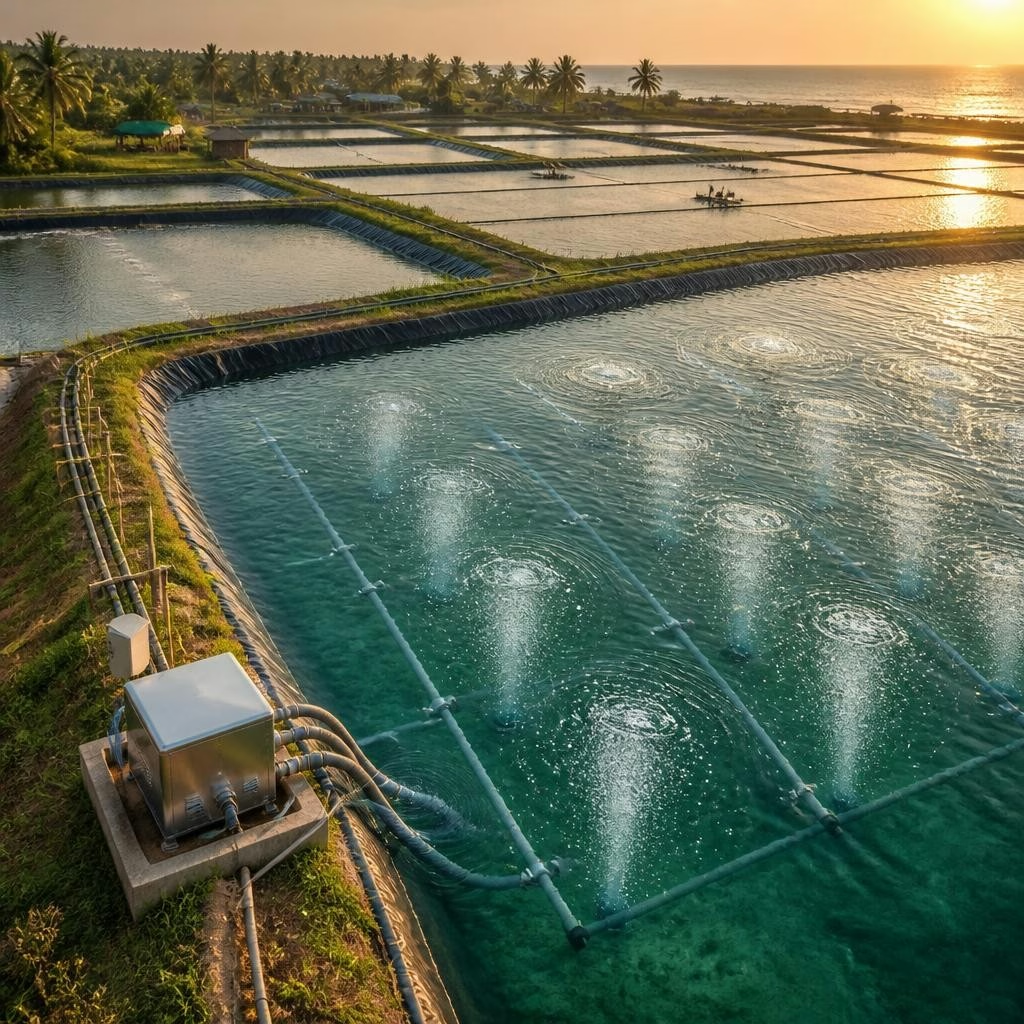
Nanobubble technology introduces extremely small, long-lasting gas bubbles into pond water to support dissolved oxygen levels, improve water circulation, and aid particulate oxidation. For coastal shrimp and fish ponds—where salinity, temperature swings and organic load from feed can stress stock—nanobubbles can help stabilize conditions that are important to survival and growth. Prasinos Tech Innovations develops OEM nanobubble systems specifically aimed at aquaculture use, and customers report seeing practical demonstrations of the technology in operation.
Start by measuring your pond: the essential inputs
Choose a generator size based on simple, verifiable pond data. At minimum collect pond surface area (m2), average depth (m) and therefore estimated volume (m3 = area × depth), current stocking density, typical daily feed input, and any seasonal variations (monsoon, high temperature periods, tidal influence). Also note inlet/outlet positions, bottom profile (uniform or sloped) and whether multiple connected ponds share water. These basic inputs let an OEM—or your technical advisor—translate biological oxygen demand and circulation needs into a recommended nanobubble capacity.
Sizing principles without overcomplication
Rather than relying on a single number, sizing uses two linked ideas: the volume of water you want to influence and the intensity of oxygen or circulation support required. Low-intensity aeration aims to maintain baseline dissolved oxygen between events; higher-intensity support is used during feeding, post-stocking or in heat stress. Provide your pond volume and typical operational scenarios to the system supplier so they can recommend a unit rated to treat that volume under your highest-demand condition. Prasinos Tech's team can demonstrate unit performance on representative ponds to validate sizing before purchase.
Practical diffuser layout and placement tips
Good layout promotes even oxygen distribution and circulation. For single or few diffusers, place them off-center to create a circulation path rather than pushing water directly to a bank. For larger ponds, a grid or staggered pattern with diffusers spaced to encourage cross-flow helps avoid dead zones. Place diffusers clear of heavy feeding zones or bottom sludge accumulation; if the pond has inlet and outlet structures, orient diffusers to support flow from inlet toward outlet. Work with the supplier to trial diffuser spacing: in many cases a live test will reveal the simplest effective arrangement for your pond geometry.
Operating schedules: continuous vs targeted use
Operating strategy depends on goals and power availability. Continuous low-level operation can keep dissolved oxygen stable overnight and reduce large swings, while targeted boosting during feeding, aeration events or heat stress conserves energy. Monitor dissolved oxygen, temperature and behaviour of stock to determine timing—many farms run higher output during night and during the hottest months. Record outcomes when you change schedules so you can compare survival, feed response and water clarity. Adaptive schedules informed by routine monitoring are more reliable than fixed timetables.
Power, corrosion protection and site infrastructure
Before installing, confirm the generator's electrical requirements (single- or three-phase, voltage, and rated power) and ensure cabling, distribution panels and protective devices match those needs. Coastal sites are exposed to saline air and higher corrosion risk, so plan for corrosion-resistant conduits, appropriate earthing and surge protection. Where grid reliability is a concern, evaluate backup options (generator sets, battery or solar hybrid solutions) with the supplier so the system can operate during outages. Ask the OEM for the unit's operating power draw and recommended electrical protections to size cables and breakers correctly.
Monitoring, maintenance and working with your supplier
Routine monitoring (dissolved oxygen, temperature, salinity and visual checks for circulation) is essential to tune system settings and schedule maintenance. Keep diffuser ports and connectors clean of biofouling and loose sediment, and follow the OEM's recommended inspection intervals. Many customers value on-site demonstrations and ongoing support when commissioning a system; providers who show a live demo and explain layout choices can help reduce trial-and-error. If you plan a phased rollout across multiple ponds, start with a pilot installation, collect performance data, and then scale the layout and operating plan based on measured results.
Customer review


Article by
Prasinos Tech Innovations
Prasinos Tech Innovations Private Limited is an OEM at the forefront of sustainable environmental technologies. We specialize in the design and manufacturing of advanced systems including nanobubble generators, ozone generators, hydrodynamic cavitation units, and advanced oxidation processes (AOP) tailored for critical applications in sewage treatment plants (STP), effluent treatment plants (ETP), and water and wastewater treatment plants (WWTP). Our technologies are engineered to deliver high-efficiency, low-footprint solutions across diverse sectors such as aquaculture, agriculture, horticulture, and the bioenergy industry, including biogas and biodiesel production.