Nanobubble Technology for Drip Irrigation in Indian Agriculture: Benefits and Practical Integration
A practical guide on how nanobubble-enriched irrigation water can improve root health, nutrient uptake, and yields for Indian field crops, with clear steps for integrating a nanobubble generator into existing drip systems.
Why consider nanobubbles for drip irrigation?
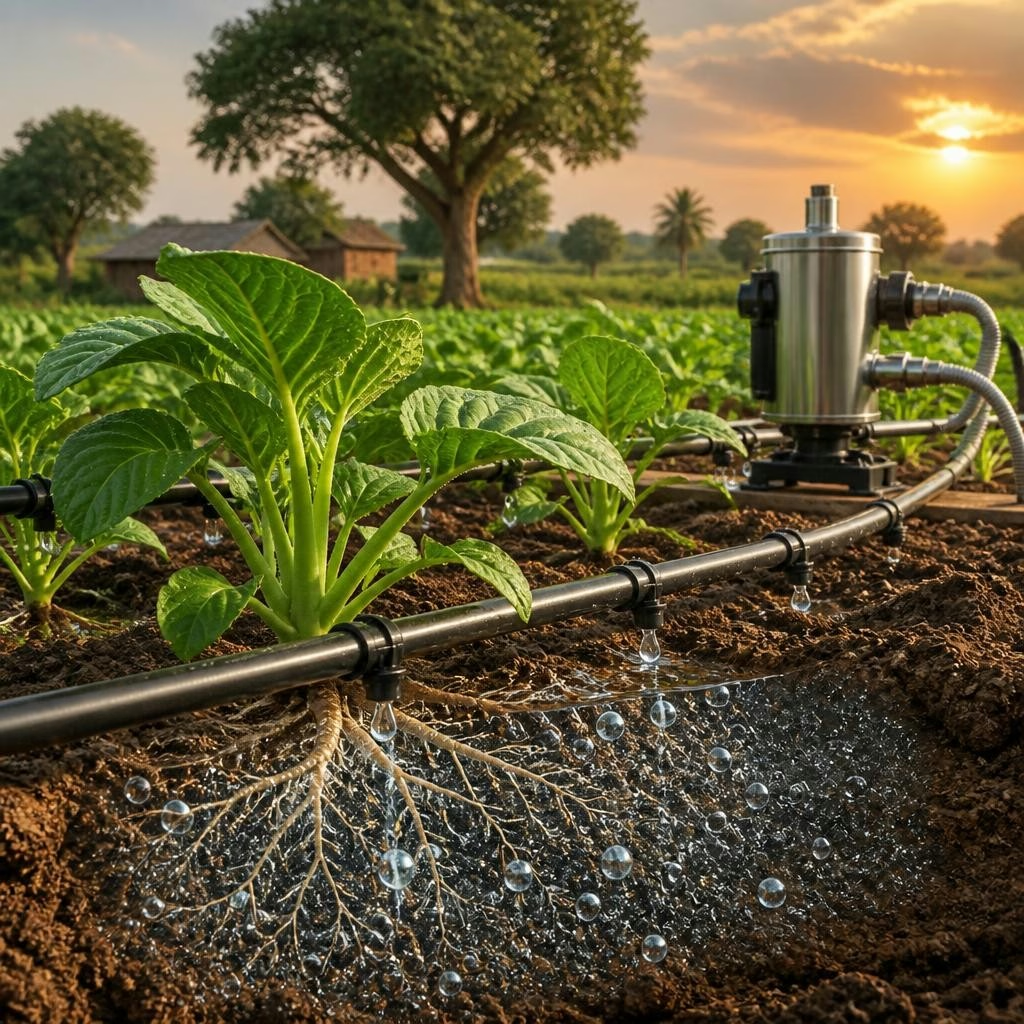
Nanobubble technology produces extremely small gas-filled bubbles that remain suspended in water for longer than conventional bubbles. In the context of drip irrigation, these bubbles can increase dissolved oxygen in irrigation water and change gas exchange dynamics at the root zone. For farmers facing low-oxygen soils, water reuse challenges, or recurring clogging and root-disease issues, nanobubble-enriched water is a potential tool to improve plant-available oxygen and overall root environment without changing core irrigation infrastructure.
How nanobubbles support root health and nutrient uptake
More oxygen in root-zone water can support healthier root respiration and encourage more active nutrient uptake. Improved oxygen levels may help roots recover from waterlogging stress, promote finer root development, and support a beneficial balance of soil microorganisms. Practically, growers often report better early vigor and more uniform stands when oxygen availability at the root zone improves. These effects can translate into more efficient fertilizer use and, in some cases, improved yields—although results depend on crop, soil, and overall management.
Relevance for Indian field crops and local water challenges
In India, many farmers use drip systems to save water and deliver nutrients precisely. Nanobubble generators can complement drip irrigation where irrigation water quality varies, where treated or recycled water is used, or where soils tend to become anaerobic. Crops that are commonly drip-irrigated—such as vegetables, orchards, and some field crops—may benefit from improved root-zone oxygenation. Because Prasinos Tech Innovations develops nanobubble generators and works in agricultural applications across India, growers can access technology designed for local conditions.
Step-by-step: integrating a nanobubble generator with an existing drip system
1) Assess water flow and quality: note average irrigation flow, seasonal peaks, and existing filtration. 2) Choose appropriate generator sizing and placement: install the nanobubble unit downstream of primary filtration and before the irrigation mainline so treated water enters the drip network. 3) Confirm pump and pressure compatibility: ensure the generator is compatible with your pump type and pressure regime; some units require a certain flow or hydraulic configuration to produce nanobubbles effectively. 4) Provide a stable power source and simple control interface for timed operation tied to irrigation events. 5) Start with a pilot section: treat a portion of the farm first to observe plant response before scaling up. Work with the equipment supplier to match the generator model to your system.
Operation, maintenance and on-field monitoring
Routine maintenance typically focuses on keeping upstream filters clean and ensuring the generator’s hydraulic and electrical connections are free of debris. Periodic checks of generator performance and basic water quality parameters (such as turbidity and visible sediment) help maintain consistent bubble generation. Monitor drip emitters for clogging and check plants regularly for changes in vigor or root health. Keep records of irrigation schedules, any chemical or fertilizer changes, and observed crop responses so you can correlate field performance with the nanobubble intervention.
How to evaluate success on your farm
Measure practical, farm-relevant indicators: plant vigor and uniformity, root health during inspection, yield per plot, water use per unit yield, and any changes in disease incidence or fertilizer responsiveness. A straightforward way to test the technology is a split-field trial: apply nanobubble-treated water on one block and your standard irrigation on another, under otherwise identical management. Track results across at least one full crop cycle to account for variability. Improvements in emitter performance or reduced need for chemical treatments are additional useful measures.
Finding local support and what to expect from a supplier
Choose a supplier experienced with agricultural deployments and local serviceability. Prasinos Tech Innovations, based in Secunderabad and serving India, designs nanobubble generators for agricultural use and provides demonstrations and field support. Customers have highlighted the company’s patented nanobubble offerings and on-site demonstrations as helpful when deciding how to integrate the technology. Before purchase, request a site assessment, a recommended pilot plan, and a clear maintenance checklist so you can scale with confidence if results meet your farm’s needs.
Customer review


Article by
Prasinos Tech Innovations
Prasinos Tech Innovations Private Limited is an OEM at the forefront of sustainable environmental technologies. We specialize in the design and manufacturing of advanced systems including nanobubble generators, ozone generators, hydrodynamic cavitation units, and advanced oxidation processes (AOP) tailored for critical applications in sewage treatment plants (STP), effluent treatment plants (ETP), and water and wastewater treatment plants (WWTP). Our technologies are engineered to deliver high-efficiency, low-footprint solutions across diverse sectors such as aquaculture, agriculture, horticulture, and the bioenergy industry, including biogas and biodiesel production.