Nanobubbles vs Conventional Aeration: What Indian STPs and ETPs Need to Know
A practical comparison of nanobubble aeration and traditional diffused/mechanical aeration for Indian sewage and effluent plants, focusing on energy use, oxygen transfer, footprint, retrofit options, and next steps for plant owners.
Why this comparison matters for Indian STPs and ETPs
Municipal and industrial wastewater plants in India face growing pressure to improve treatment efficiency while lowering operating costs and footprint. Managers evaluating upgrades must weigh conventional aeration approaches against newer options such as nanobubble systems. This article outlines the functional differences, practical benefits and limitations, and what to look for when considering a retrofit or pilot—grounded in the technologies offered by an OEM serving the Indian market.
How conventional aeration (diffused and mechanical) works
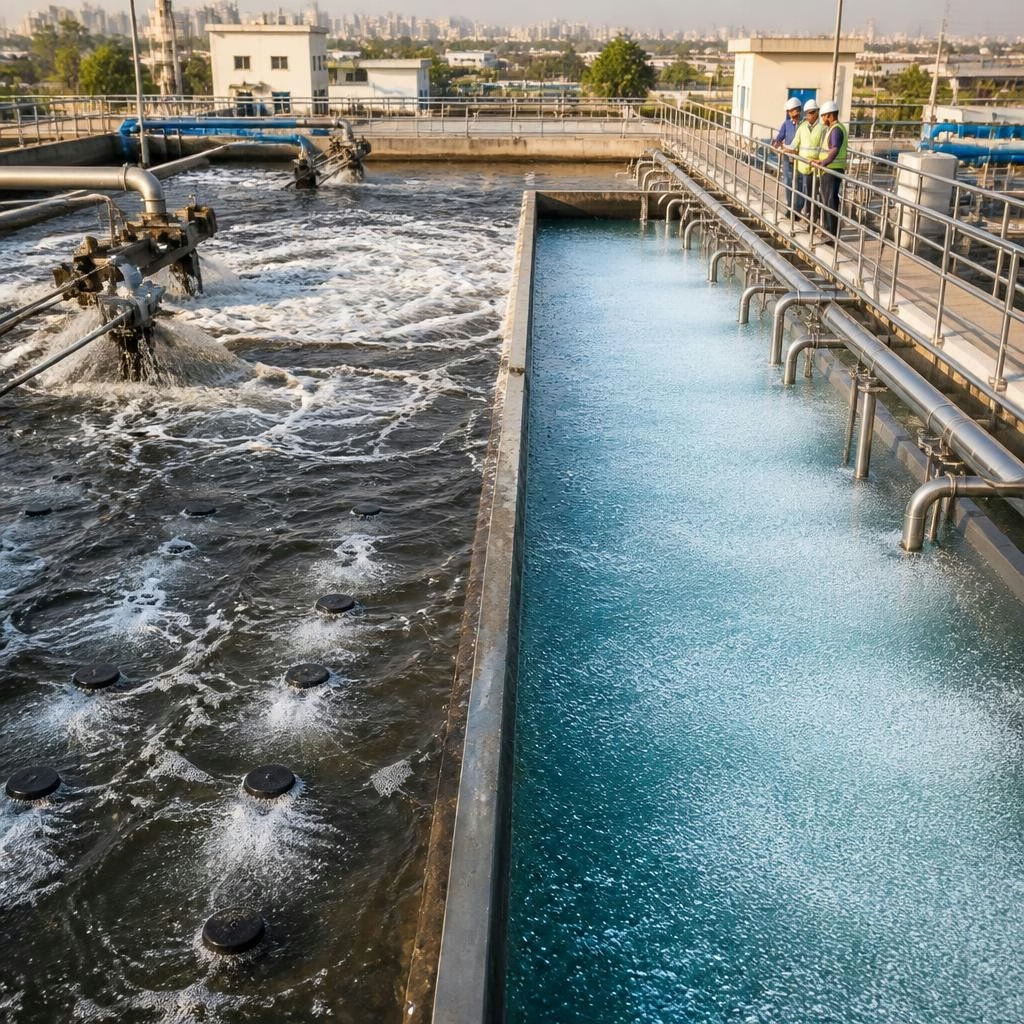
Conventional aeration typically uses either submerged diffused air (fine or coarse bubble diffusers) or mechanical surface aerators to deliver oxygen to biological treatment zones. Diffused systems rely on pressurized blowers and submerged diffusers to create bubbles that transfer oxygen as they rise; mechanical aerators agitate the surface to entrain air. Both approaches are proven and widely used, but they can require substantial blower or motor power and significant tank or equipment footprint to meet oxygen demand under peak loads.
What nanobubble aeration is and how it differs
Nanobubble technology produces extremely small gas bubbles that remain suspended in water for longer periods and present a much larger interfacial area per unit gas volume. That characteristic can increase the effective oxygen transfer to the liquid phase and improve contact with microorganisms. In practice, nanobubble systems are applied as generators or injectors that can complement or replace portions of conventional aeration, and many suppliers position them to reduce chemical dosing and sludge production in STP/ETP processes.
Energy use and oxygen transfer efficiency: practical considerations
Because nanobubbles can enhance oxygen transfer efficiency, they often enable reduced blower or compressor runtime for the same dissolved oxygen targets; however, actual energy savings depend on plant hydraulics, load patterns, retention time and how the nanobubble system is integrated. Plant owners should evaluate whole-system energy use (including any pumps or compressors for the generator) and compare lifecycle operating costs rather than relying solely on instantaneous power figures. Customer feedback for specialized providers highlights improved process efficiency and perceived value-for-money when systems are correctly matched to plant conditions.
Footprint and retrofit options for Indian plants
Nanobubble generators are typically compact compared with arrays of mechanical aerators or large blower systems, which can make them attractive for plants constrained by space. Several manufacturers offer generator modules specifically intended for STP, ETP and WTTP retrofit applications, enabling phased integration without major civil works. A customer account noted that the OEM demonstrated its patented nanobubble system in a live on-site demo, underscoring that in-place trials are a practical way to confirm performance before committing to a full retrofit.
Operational impacts, maintenance and performance signals to monitor
Operational effects often reported with nanobubble additions include improved dissolved oxygen stability, reduced chemical consumption and lower sludge accumulation—outcomes that, if realized, simplify downstream handling and disposal. Maintenance profiles differ from mechanical aerators: expect checks on pumps, injectors and any air/gas handling equipment, and discuss fouling or scaling management with the supplier. When evaluating vendors, ask for references, expected maintenance tasks, spare-parts lists and a recommended monitoring plan (dissolved oxygen, MLSS, SVI, COD/BOD trends) so you can quantify benefits objectively.
How to decide: pilots, metrics and next steps
Choosing between conventional upgrades and nanobubble integration starts with clear goals (energy reduction, compliance margin, sludge minimization, space constraints). Request a site assessment and a scoped pilot or demo that measures key metrics over a representative period. Compare total lifecycle costs—capital, energy, maintenance and chemical savings—and require clear performance guarantees where possible. For organizations in India seeking vendor support, consider OEMs that provide STP/ETP-targeted nanobubble generators and local demonstrations; an on-site demo can make the technology’s operating behavior and benefits clear before broader deployment.
Customer review


Article by
Prasinos Tech Innovations
Prasinos Tech Innovations Private Limited is an OEM at the forefront of sustainable environmental technologies. We specialize in the design and manufacturing of advanced systems including nanobubble generators, ozone generators, hydrodynamic cavitation units, and advanced oxidation processes (AOP) tailored for critical applications in sewage treatment plants (STP), effluent treatment plants (ETP), and water and wastewater treatment plants (WWTP). Our technologies are engineered to deliver high-efficiency, low-footprint solutions across diverse sectors such as aquaculture, agriculture, horticulture, and the bioenergy industry, including biogas and biodiesel production.