Ozone Safety and Compliance for Indian Industrial Plants: Practical Guidance for EHS Officers and Plant Managers
A practical guide for EHS officers and plant managers on safely operating high‑concentration ozone systems in STPs, ETPs and process plants—covering risk assessment, ventilation, leak detection, interlocks, regulatory expectations, and strategies to preserve uptime.
Why ozone is used — and why safety matters
Ozone is a powerful oxidant widely used in sewage treatment plants (STPs), effluent treatment plants (ETPs) and other process applications for disinfection, odor control and advanced oxidation. Its effectiveness stems from high reactivity, but that same reactivity can create health and operational risks when ozone escapes the intended treatment zone. For plant safety and regulatory compliance, managers must treat high‑concentration ozone systems as engineered hazards that require layered controls, monitoring and written procedures.
Start with a risk assessment and documented procedures
Before installation or commissioning, perform a site‑specific risk assessment that identifies ozone generation points, occupied work areas, maintenance tasks and potential leak or accumulation scenarios. Use the assessment to develop written procedures for normal operation, start/stop, maintenance, and emergencies. Include clear responsibilities, permit‑to‑work rules for confined spaces and a schedule for periodic review. These documents form the backbone of compliance and employee training.
Regulatory expectations in an Indian industrial context
Indian plants should align with national and state environmental and occupational authorities and any applicable local permits. Regulators expect documented risk controls, monitoring records, trained personnel and prompt incident reporting where required by local authorities. Engage early with the relevant pollution control board or inspectorate when installing high‑concentration ozone systems to confirm permit and discharge expectations and to ensure your compliance documentation meets local requirements.
Engineering controls: ventilation, enclosure and ozone destruction
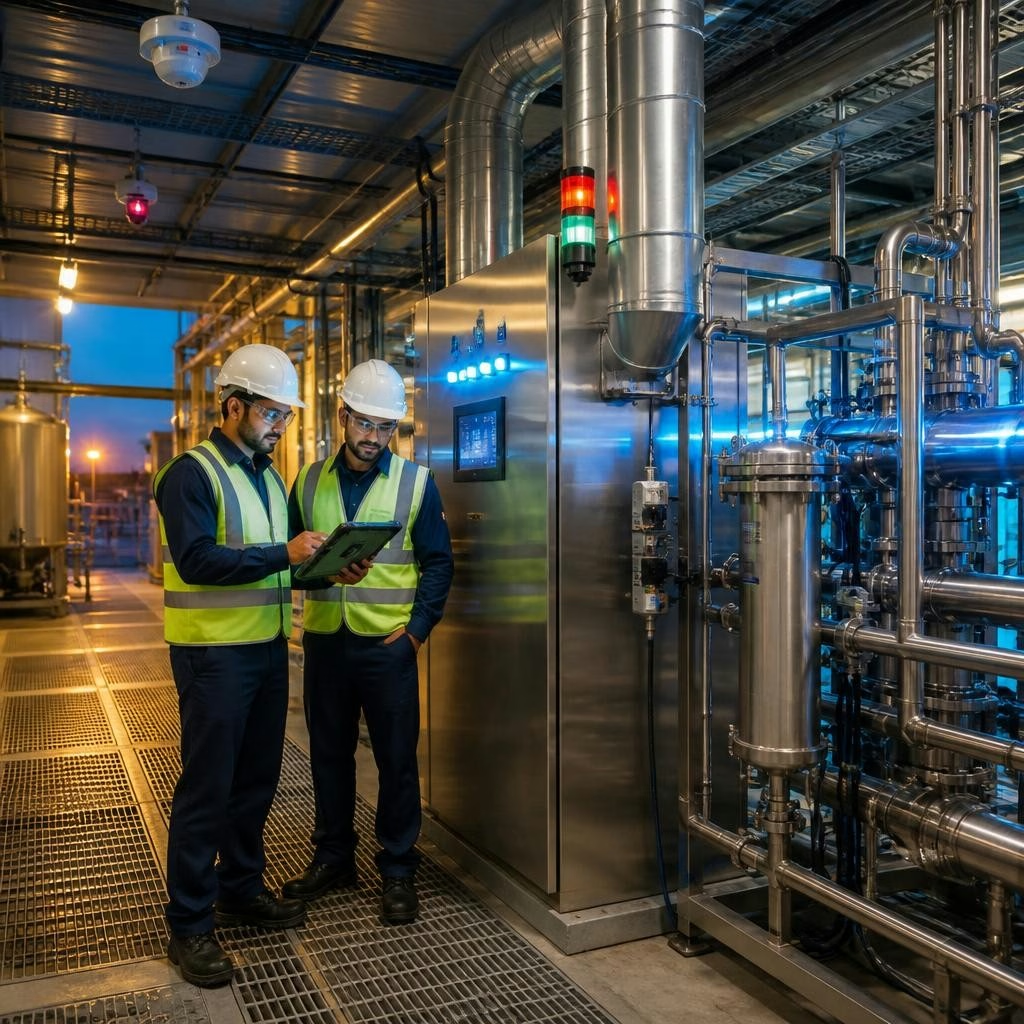
Primary protection begins with engineering: locate ozone generators in dedicated, well‑ventilated enclosures restricted to trained staff. Design the HVAC and exhaust to prevent ozone build‑up in adjacent occupied spaces and route exhaust to a safe discharge point. Where appropriate, specify ozone destruct units or catalytic converters on vent streams to neutralize released ozone. Consider equipment choices—for example, water‑cooled ozone generators reduce on‑site heat loads and can change HVAC requirements—so coordinate generator type with ventilation design.
Detection, alarms and leak management
Continuous ozone monitoring is essential where personnel might be exposed. Install fixed ozone sensors with audible and visual alarms at likely leak points and at breathing‑zone heights in work areas. Ensure sensors are calibrated and maintained on a documented schedule, and provide portable monitors for maintenance teams. Define alarm setpoints, automated responses and escalation paths in your procedures so alarms trigger rapid, pre‑planned actions rather than ad hoc responses.
Interlocks, control logic and fail‑safe design
Design control systems so ozone generation cannot occur unless safeguards are satisfied. Typical interlocks include generator shutdown on high ozone readings, HVAC failure, door opening to restricted enclosures, or loss of cooling. Integrate these interlocks with the plant PLC/SCADA for centralized alarms and trending, and implement lockout‑tagout procedures for maintenance. Redundancy—such as dual ozone destruct units or backup ventilation fans—helps maintain uptime while keeping safety intact.
Training, PPE and emergency response
Provide role‑based training for operators, maintenance staff and contractors that covers hazards, controls, monitoring, alarm response and emergency procedures. Supply appropriate personal protective equipment (PPE) for tasks with potential exposure and document its use. Develop an emergency response plan with clear evacuation routes, first‑aider instructions and coordination with local emergency services. Regular drills and refreshers keep response times short and reduce operational disruption during an incident. Many customers note that knowledgeable vendors and support teams make a real difference in safe operations, so involve equipment OEMs in training and commissioning.
Balancing safety with uptime: commissioning, maintenance and vendor partnership
Maintaining uptime while preserving safety requires disciplined commissioning, preventive maintenance and a pragmatic vendor relationship. Commission systems with staged tests of detectors, interlocks and destruct units; keep spare critical parts and calibration supplies on site; and use scheduled maintenance windows to inspect seals, piping and fittings. Work with your OEM for recommended maintenance intervals and spare‑parts lists, and ensure service contracts include response times acceptable for your process needs. This layered approach reduces unplanned downtime and keeps ozone systems operating safely and reliably.
Customer review


Article by
Prasinos Tech Innovations
Prasinos Tech Innovations Private Limited is an OEM at the forefront of sustainable environmental technologies. We specialize in the design and manufacturing of advanced systems including nanobubble generators, ozone generators, hydrodynamic cavitation units, and advanced oxidation processes (AOP) tailored for critical applications in sewage treatment plants (STP), effluent treatment plants (ETP), and water and wastewater treatment plants (WWTP). Our technologies are engineered to deliver high-efficiency, low-footprint solutions across diverse sectors such as aquaculture, agriculture, horticulture, and the bioenergy industry, including biogas and biodiesel production.