Retrofitting Ageing STPs in Indian Housing Societies with Nanobubble Aeration
This article explains how compact nanobubble generators can be added to existing sewage treatment plants in apartment complexes to reduce odour and foaming, stabilise biological processes, improve BOD/COD removal and help meet pollution control norms with minimal civil work.

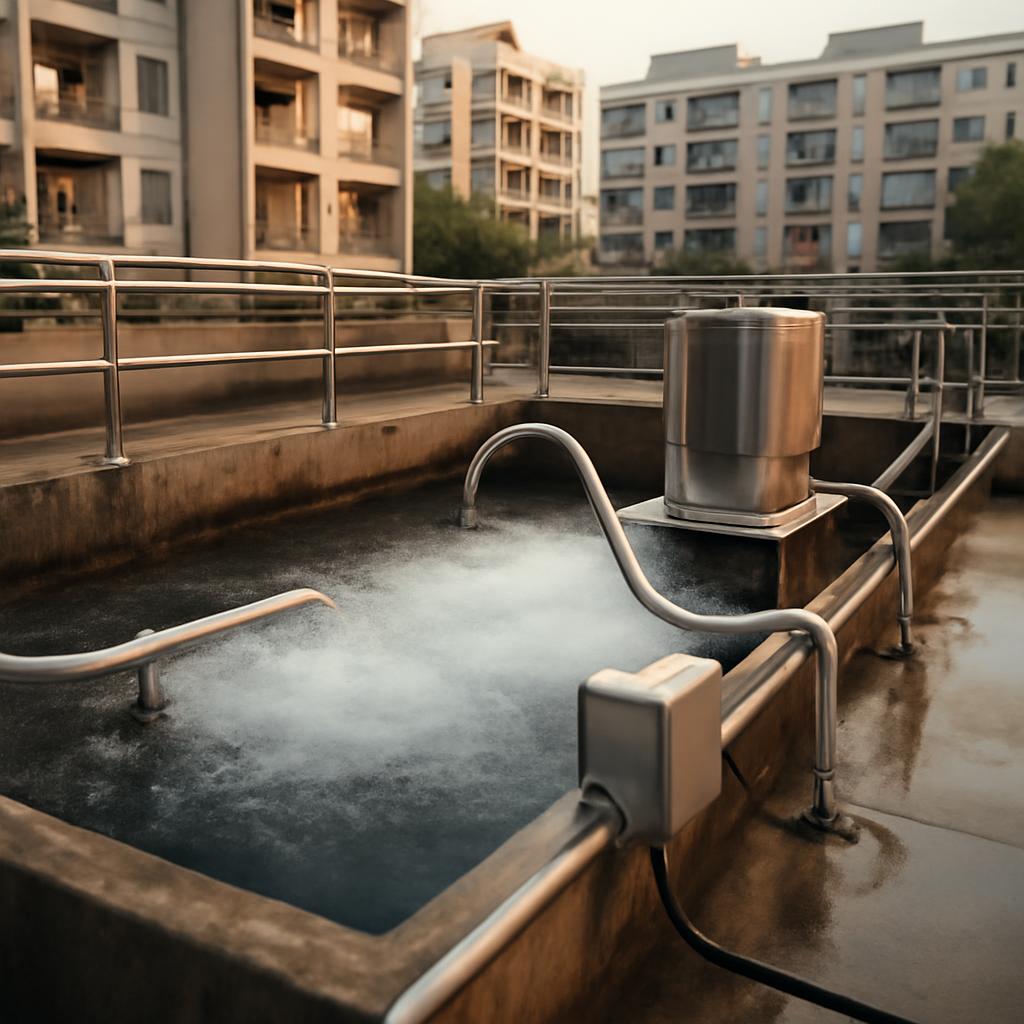
The challenge facing ageing STPs in residential societies
Many apartment complexes in India operate older STPs that were designed for different load conditions and have limited ability to adapt to changing wastewater characteristics. Common problems include persistent odour, surface foaming, poor dissolved oxygen (DO) levels, fluctuating biological activity and difficulty meeting local pollution control board (PCB) standards. These issues create nuisance for residents, increase operational costs and sometimes lead to non-compliance fines.
What is nanobubble aeration and why it suits retrofits
Nanobubble aeration uses high-density microscopic bubbles that remain suspended in water longer than conventional bubbles, increasing the effective oxygen transfer and contact area. Nanobubble generators are compact, low-footprint units that can be added into existing tanks or process streams. Because they improve oxygen availability without requiring large blowers or major structural changes, they are particularly well suited for retrofit projects where civil work must be minimised.
How nanobubbles stabilise biology and improve treatment performance
By increasing dissolved oxygen uniformly throughout the tank, nanobubbles help maintain a stable aerobic biomass. That stability supports more consistent BOD and COD reduction, reduces the tendency for anaerobic zones (a common source of odour) and generally lowers sludge production. In practical terms, this can translate into better treatment performance and a reduced need for corrective chemical dosing—outcomes that are directly aligned with the benefits described for nanobubble solutions used in STP applications.
Retrofit-friendly installation: minimal civil work, compact footprint
A typical retrofit does not require rebuilding tanks. Nanobubble units are designed to be mounted near or inside existing aeration tanks, circulation channels or recirculation loops. Installation focuses on placing the generator and routing its feed and electrical connections, integrating with existing mixers or recirculation pumps as needed. Because the equipment is compact, many housing societies can avoid expensive civils and retain current tank geometry and piping.
A practical checklist for RWAs and facility managers
Before committing to a retrofit, consider these steps: (1) arrange a site survey to map tank volumes, inlet/outlet locations and existing aeration systems; (2) confirm treatment objectives (odour control, foam reduction, BOD/COD targets, reuse quality); (3) request a demo or pilot in a representative tank or flow stream where possible; (4) verify integration requirements for power and piping; and (5) define monitoring points and success metrics so performance can be tracked after commissioning. These actions help set realistic expectations and measure outcomes.
Operational and maintenance considerations
Nanobubble systems are generally low-maintenance compared with large aeration blowers, but they do require routine checks of feedlines, power connections and control settings. Operators should be trained on basic operation and simple troubleshooting. Ongoing monitoring of DO, sludge levels and influent/effluent BOD or COD is important to confirm that the retrofit is delivering the intended benefits. Customers of established nanobubble providers also report that knowledgeable support teams and timely commissioning are key to a smooth retrofit experience.
Next steps: evaluation, pilot and engagement
For RWAs and facility managers ready to explore a retrofit, begin with a site assessment and ask for a pilot or live demonstration to see the technology’s effect on odour, foaming and DO distribution. Prasinos Tech Innovations Pvt. Ltd., based in Secunderabad and serving across India, offers nanobubble solutions tailored for STP and wastewater applications and can conduct surveys and demonstrations to establish feasibility. Preparing a clear scope—objectives, monitoring metrics and a realistic timeline—will make it easier to evaluate performance and decide on wider implementation.
Customer review


Article by
Prasinos Tech Innovations
Prasinos Tech Innovations Private Limited is an OEM at the forefront of sustainable environmental technologies. We specialize in the design and manufacturing of advanced systems including nanobubble generators, ozone generators, hydrodynamic cavitation units, and advanced oxidation processes (AOP) tailored for critical applications in sewage treatment plants (STP), effluent treatment plants (ETP), and water and wastewater treatment plants (WWTP). Our technologies are engineered to deliver high-efficiency, low-footprint solutions across diverse sectors such as aquaculture, agriculture, horticulture, and the bioenergy industry, including biogas and biodiesel production.