Planning Central Kitchen Equipment for Multi‑Branch Restaurants Across the GCC
Practical guidance for restaurant groups expanding across the UAE, Qatar, Oman and Saudi Arabia on how to size mixers, ovens, chillers and packing lines for a central kitchen that reliably supports multiple outlets.

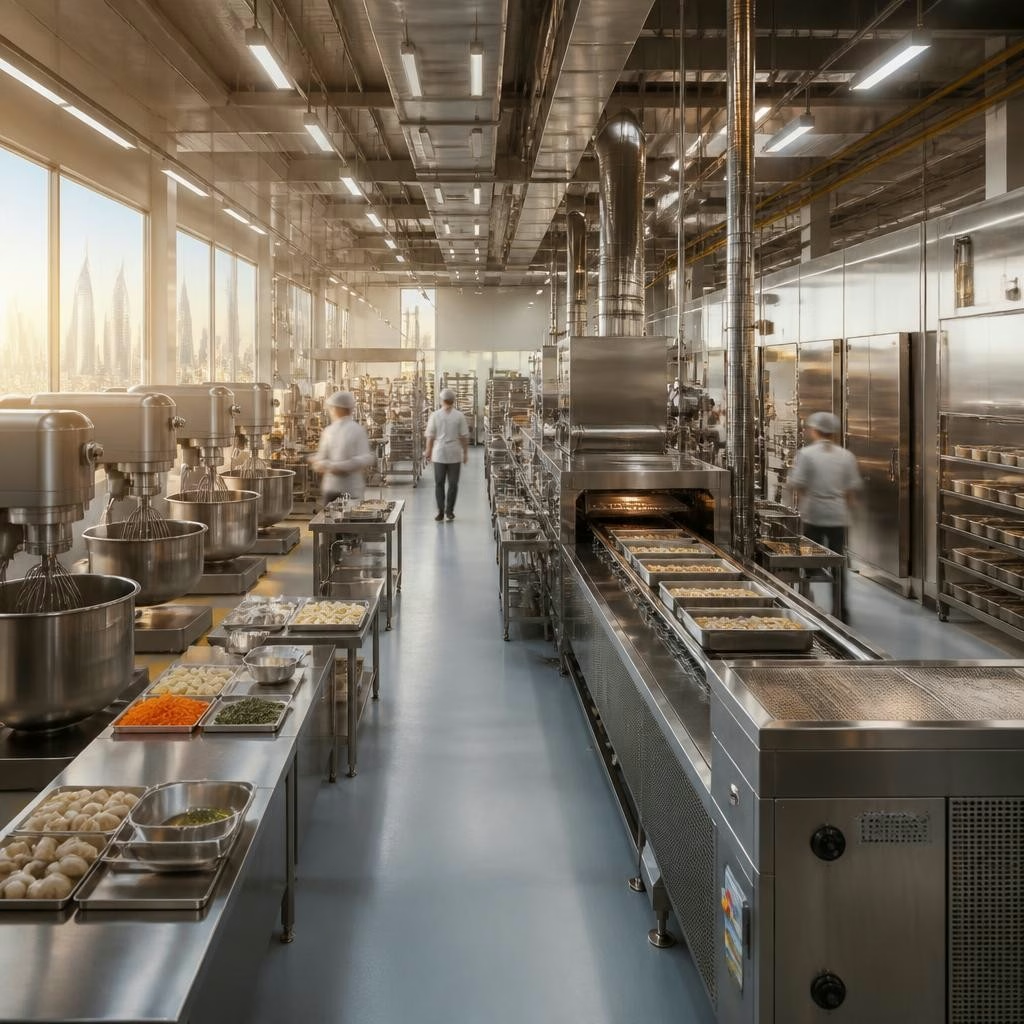
Why a central kitchen matters for multi‑branch operations
A well‑designed central kitchen lets restaurant groups standardize quality, reduce duplicate investment, and improve consistency across branches. Rather than treating each outlet as an independent production unit, a central kitchen handles large‑volume preparation of core components—sauces, doughs, prepped proteins, and portioned ingredients—so outlets can focus on final assembly and service. For brands expanding across the GCC, a central kitchen also supports compliance with local food safety rules and simplifies procurement and quality control.
Start with accurate demand and menu analysis
Begin by mapping the menu items that the central kitchen will produce and estimating daily and peak demand for each across all outlets. Collect realistic sales forecasts per outlet, factor in seasonality and promotional peaks, and convert those forecasts into production quantities (portions per day and per peak hour). This demand profile is the baseline for sizing mixers, ovens, chillers and packing lines: equipment should be chosen to meet peak hour throughput with an operational buffer for growth and unexpected spikes.
Sizing mixers and dough equipment
Specify mixers by expected batch size and the number of batches per shift rather than only by nominal capacity. Consider the bowl or hopper volume, motor power, duty cycle, and accessory options (dough hooks, planetary heads, vacuum capability). For multi‑shift production, choose equipment rated for continuous or heavy‑duty use and allow spare capacity so batches don't push equipment to its limits. Standardizing mixer models across locations simplifies spare parts and training.
Choosing ovens and cooking equipment for throughput and consistency
Select ovens and cooking equipment based on tray capacity, independent temperature zones, cycle time, and ease of loading. For bake‑heavy or cook‑heavy production, compare deck, convection and rack ovens on usable tray area and recovery time between loads. Pay attention to evenness of heat, programmable profiles for repeatable results, and maintenance access. Modular or stackable designs can save footprint while preserving capacity for peak loads.
Specifying chillers, freezers and cold storage
Cold storage sizing should reflect throughput, product dwell times, and regulatory hold times. Distinguish between blast chilling (for rapid cooldown and food safety), holding chillers for short‑term storage, and freezers for long‑term storage. Design storage volume around rolling inventory (daily production plus safety stock) and consider temperature zoning to separate raw materials, finished goods and packaging. Because GCC ambient temperatures can be high, ensure refrigeration systems are specified for local climatic conditions and include redundancy to avoid single‑point failures.
Planning packing lines and final processing
Packing line capacity must match the output from preparation and chilling stages. Define the target packaging speed (units per minute) based on portion sizes and expected shifts, and select conveyors, portioning systems and sealing equipment that support that throughput. For products requiring modified atmosphere packaging or vacuum sealing, ensure integration with cold chain and downstream transport plans. Flexible packing modules allow gradual automation as volumes grow.
Layout, workflow and hygiene considerations
A compact, logical layout reduces handling time and contamination risk. Separate raw and cooked flows, create clear chilled corridors from blast chillers to storage, and place packing lines close to final inspection and dispatch. Prioritise stainless steel surfaces and open access for cleaning to meet hygiene standards. Design circulation for easy movement of pallets and trolleys and allocate space for QC, labelling, and temporary buffer staging during dispatch windows.
Utilities, installation and GCC‑specific requirements
Check utility requirements early: kitchen equipment often needs 3‑phase power, adequate gas supply, drainage, compressed air and sufficient water pressure. Local electrical and mechanical standards vary across the UAE, Qatar, Oman and Saudi Arabia—confirm local codes and permitting timelines. Account for increased heat load and ventilation capacity in warmer climates, and ensure contractors size HVAC and exhaust systems for continuous commercial use.
Standardization, spare parts and after‑sales support
Standardizing equipment models across the operation reduces spare parts inventory and simplifies maintenance training. Build an N+1 redundancy mindset for critical items (refrigeration compressors, blast chillers, primary ovens) to avoid production stoppages. Reviews from SAS Kitchens customers emphasize the value of reliable after‑sales service and warranty support; when selecting suppliers, confirm response times for service calls, availability of parts, and planned maintenance options to protect daily operations and deliveries.
Next steps: validate design with a supplier and pilot before full roll‑out
Turn these estimates into a validated design with a manufacturer or systems integrator. A site visit, production trial or pilot run helps confirm cycle times, equipment recoveries and packaging throughput under real conditions. For groups expanding across the GCC, choose partners experienced with regional installations to avoid surprises in utilities, shipping or customs. SAS Kitchens, for example, provides stainless steel commercial equipment and installation services in the UAE and across the GCC; many customers report professional installation and on‑time project completion, which is a valuable asset when coordinating multi‑branch launches.
Customer review


Article by
SAS Kitchens - Commercial Kitchen Equipment
SAS Kitchens is a trusted provider of high-quality stainless steel commercial kitchen equipment in the UAE. We specialize in designing, manufacturing, and installing durable, high-performance kitchen solutions for restaurants, cafés, hotels, and food service businesses. With a focus on precision craftsmanship, functionality, and hygiene, our equipment is built to withstand the demands of professional kitchens. Our experienced team is committed to delivering reliable service, timely project execution, and tailored solutions that meet each client’s operational needs. At SAS Kitchens, customer satisfaction, product durability, and professional support are at the core of everything we do.