How to Plan a Compact Bakery Corner Inside Your Café or Restaurant in Dubai
Practical, step-by-step guidance for fitting a small bakery corner into a café or restaurant, covering equipment selection, layout, ventilation, power, storage and installation considerations tailored for Dubai and Sharjah venues.

Why add a bakery corner to your café or restaurant
A small in-house bakery can increase daily revenue, improve product freshness and create a signature offering that differentiates your venue. For multi‑concept spaces — coffee shops that sell pastries, casual restaurants adding breads and desserts — a compact bakery corner lets you control quality and shorten supply chains without requiring a full production facility.
Decide what you want to produce and how often
Begin by listing the items you plan to make on site (croissants, buns, flatbreads, tarts, cookies, or plated desserts). Frequency and batch size determine the equipment footprint: short runs and made‑to‑order pastries often need only a small deck or convection oven, a mixer or whipping machine and a modest proofing/holding setup, while higher-volume bakery items require larger ovens and production lines.
Choose the right compact equipment
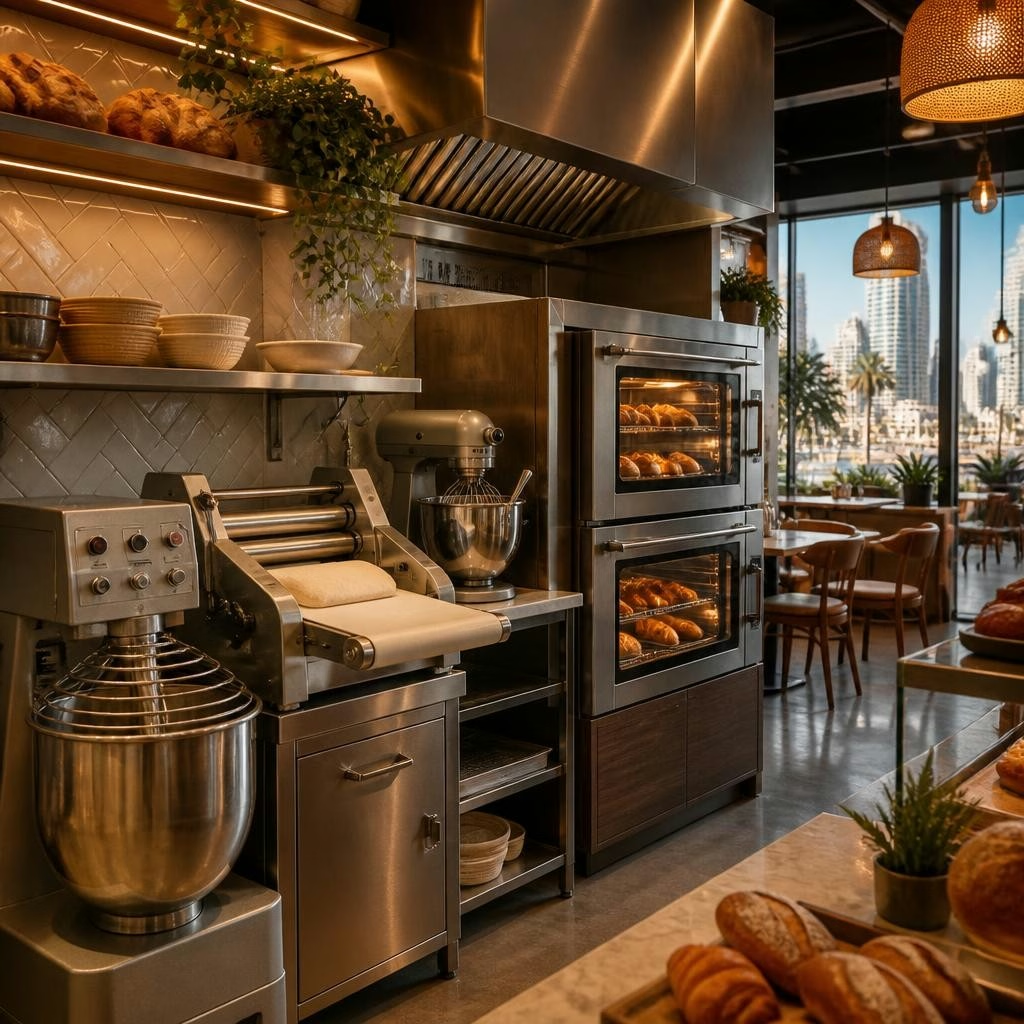
Select equipment designed for professional kitchens but sized for tight spaces. Key pieces include a commercial mixer for dough and batters, a small roller for laminating or dough sheeting, a compact oven or convection deck for baking, and a whipping machine for creams and mousses. United Catering Equipment lists compact options across these categories and can advise on models that balance performance with space efficiency. When searching, use the term commercial kitchen equipment dubai to find locally supported models and service options.
Plan an efficient workflow and layout
Design the corner as a sequence of zones: preparation (mixing and rolling), forming and resting (trays/proofing), baking/finishing, and plating/display. Keep the workflow linear to avoid cross traffic: ingredients should move from cold storage to prep to oven to service with minimal backtracking. Consider mobile trolleys and foldable worktables to create flexible space during peak service.
Ventilation, extraction and local requirements
Even a small baking area generates heat, steam and odors. Work with your landlord or an HVAC contractor to determine extraction needs that meet local building codes. Compact hoods and spot extraction can be adequate for low-volume baking, but they must vent correctly and maintain kitchen air balance. Early coordination avoids costly retrofits and keeps your front‑of‑house comfortable for customers.
Power, gas and utility planning
Confirm electrical capacity and whether your preferred ovens and mixers run on gas or electricity. Commercial equipment often requires dedicated circuits and specific outlet types; share equipment specifications with your electrician during planning. If space is limited, consolidate smaller appliances on a single robust circuit where safe and code‑compliant to reduce electrical clutter and ensure reliable operation.
Cold storage and display in tight spaces
Allocate space for chilled ingredients and finished items without interrupting the production flow. Compact solutions include table top freezers and chillers, small upright refrigerators and display chillers for front‑of‑house sales. Position cold storage near the prep zone to minimize movement and keep ingredient temperatures consistent while maintaining a tidy, visible display for customers.
Installation, delivery and after‑sale support
Reliable logistics and professional installation are essential when fitting equipment into a compact area. Customers frequently praise timely delivery, careful installation and helpful on‑site support from supplier staff, which can save time and avoid fitment issues during setup. Choose a supplier who provides delivery, installation and clear post‑sale assistance so you can focus on operations once the equipment is in place.
Hygiene, cleaning and maintenance
Select machines that are easy to clean and maintain in a small workspace. Look for compact ovens and mixers with removable components and accessible surfaces. Some commercial appliances offer automatic cleaning or rinse cycles that reduce labour. Set a regular maintenance schedule and keep contact information for local service and spare parts to minimize downtime.
Budgeting, sourcing and next steps
Build a budget that covers equipment purchase or lease, installation, ventilation and electrical changes, plus initial ingredients and staff training. Consider both new and well‑maintained used equipment options if cost is a concern — many businesses find quality used machines that perform reliably and reduce upfront cost. Reach out to local suppliers who serve Dubai and Sharjah for quotes and site visits; a site consultation will produce accurate space, ventilation and power plans and help you move from concept to opening with fewer surprises.
Customer review


Article by
United Catering Equipment - Commercial Kitchen Equipment
Find The Right Cookware For Your Cooking Style ,Ask Our Experts . Start Free Chat For Advice ,Smart Tips ,For Your Business . GCC Delivery Available 🚛 . Cooking appliance for automatically cooking (Automatic mode) meat, poultry, fish, side dishes/vegetables, egg dishes/desserts, bakery products and for automatic finishing®. With an intelligent system for optimising mixed loads in production and in à la carte service as well as a fully automatic cleaning and care system.