Coffee Corner vs Full Coffee Bar: Equipment & Workflow Planning for Dubai Hotels and Restaurants
A practical guide to help F&B managers decide between a compact coffee corner or a full barista station—covering the key machines, grinders, refrigeration, workflow and service needs, with guidance relevant to venues sourcing equipment in the UAE.

Introduction: matching coffee service to your venue
Choosing between a modest coffee corner and a fully equipped coffee bar is a common decision for hotels, restaurants and cafés in Dubai. The right choice depends on guest expectations, menu breadth, peak service volumes and available space. This article explains the equipment, ancillary components and operational considerations for each option so managers can plan a layout that supports quality, speed and consistent service.
When to choose a coffee corner vs a full coffee bar
A coffee corner suits venues with limited space, lower coffee volumes or a secondary service point (for example, a hotel lobby self‑service area or a breakfast nook). A full coffee bar is appropriate when beverage sales are a core offering—specialty cafés, high‑turnover breakfast services, or hotel outlets that brand themselves on coffee. Consider anticipated number of shots per hour, drink complexity (espresso‑only vs milk‑based drinks), and whether you need dedicated baristas.
Space, footprint and layout basics
Plan the footprint before buying equipment. A coffee corner commonly fits on a 1.2–1.8 metre counter with room for an espresso machine, grinder and compact fridge. A full coffee bar requires more bench space, under‑counter refrigeration, extraction/ventilation for milk steaming, and clear workflow zones: grinding, pulling shots, milk steaming, and service. Allow space for waste disposal, cup storage and a small sink or rinse area to maintain pace during busy periods.
Essential hardware for a coffee corner
For a compact setup focus on reliability and simplicity: a reliable 1–2 group espresso machine (manual or semi‑automatic), a single high‑quality grinder calibrated for your espresso, a small undercounter or countertop fridge for milk and perishables, and basic accessories (tamping mat, knock box, thermometer, scales). Prioritise machines that are energy‑efficient and easy to service, since limited staff may manage routine maintenance.
Key additions for a full coffee bar
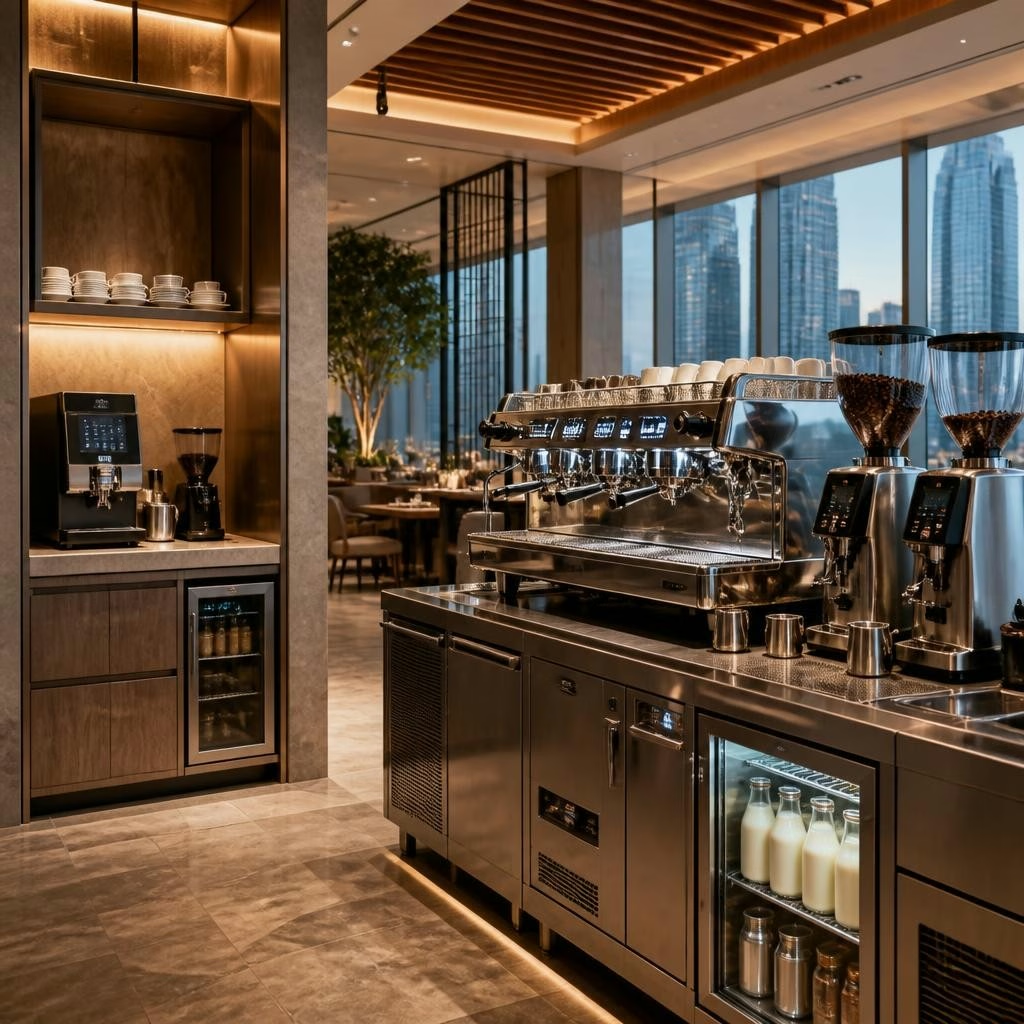
A full barista station expands capacity and menu: multi‑group espresso machine (2+ groups) or dual machines for redundancy, multiple grinders (espresso, decaf, alternative brew methods), an automatic milk steamer or heat‑extraction system, commercial blenders for cold drinks, and display chillers or refrigerated prep counters for milk and toppings. Consider sous‑stations for batch brewing, a pour‑over/drip area, and an espresso machine with programmable dosing for consistent output during peak service.
Grinders, dosing and consistency
Consistent grind and dose are critical. For both corner and full bar setups, choose commercial grinders that can hold a dosing setting and handle your peak shot rate without overheating. In a full bar, dedicate grinders to espresso and to alternative brews or decaf to avoid cross‑contamination of flavours. Regular calibration and simple staff training on grind adjustment will preserve shot consistency across shifts.
Refrigeration, cold line and display needs
Proper cold storage keeps milk, syrups and perishables safe and accessible. For a coffee corner, a compact undercounter fridge suffices; for a full bar, invest in refrigerated prep counters, display chillers and separate milk storage to speed service and comply with food safety standards. Falcon Kitchens supplies a range of cold‑line equipment suitable for both compact and large stations, including display chillers for grab‑and‑go items.
Workflow, staffing and peak‑time planning
Design workflow to minimise cross‑traffic: place grinder, group head and steam wand in a consistent sequence so baristas can work with minimal movement. For a coffee corner, one trained operator can manage basic drinks; a full bar usually needs at least two staff during peaks—one on espresso and one on milk/assembly. Consider simple menu limits during rush hours to maintain speed without sacrificing quality.
Installation, maintenance and service considerations
Commercial equipment requires professional installation and planned maintenance to ensure uptime. Choose suppliers that offer supply, installation and after‑sales service for espresso machines, grinders and refrigeration. Reviews from local customers highlight the importance of professional support when acquiring high‑end machines; a number of buyers note dependable service and technical assistance as decisive factors in their purchasing decisions. Regular preventive maintenance reduces breakdown risk and preserves performance.
Cost considerations and return on investment
Initial equipment cost scales with complexity: a coffee corner has lower capital outlay and simpler maintenance, while a full bar demands higher initial investment but can increase average ticket and guest satisfaction if demand supports it. Budget for grinders, refrigeration, accessories, installation and routine servicing. Track metrics such as drinks per hour, average spend per guest and waste to estimate payback and decide whether to scale a corner into a full bar over time.
Selecting equipment in Dubai and partnering with a supplier
When sourcing in the UAE, prioritise suppliers that stock commercial‑grade espresso machines, grinders and cold‑line equipment and provide local installation and maintenance. Falcon Kitchens lists coffee machines, grinders, coffee line equipment and display chillers among its services for Dubai venues and offers supply, installation and servicing. One recent customer noted buying a high‑end espresso machine through the company and praised the quality of the equipment and supportive service, an example of the kind of local partnership that helps venues launch or upgrade coffee offerings smoothly.
Next steps: checklist for decision makers
Use this quick checklist before committing: estimate peak coffee volume (shots/hour), define your signature drink menu, measure available counter and prep space, determine staff capacity for training and service, and confirm supplier installation and maintenance terms. If you need help sizing equipment or comparing models for a corner vs a full bar, consult a commercial kitchen supplier who can propose scalable options and a maintenance plan tailored to Dubai and UAE operations.
Customer review


Article by
𝐅𝐚𝐥𝐜𝐨𝐧 𝐊𝐢𝐭𝐜𝐡𝐞𝐧𝐬 𝐋𝐋𝐂 - Commercial Kitchen Equipment
Welcome to Falcon Kitchens At Falcon Kitchens, we pride ourselves on being one of the leading suppliers of high-quality commercial kitchen equipment. Our products are designed to meet the varied needs of the food service industry. Whether it is a small café, an up-and-running restaurant, or an industrial kitchen, our commercial kitchen appliances here at Falcon Kitchens will ensure that you have the best solutions for efficiency, reliability, and durability. We have been leading the industry for years now, with the latest technology coupled with craftsmanship in every appliance that leaves our manufacturing line. It’s not about selling kitchen equipment at Falcon Kitchens; it’s building a long-term relationship with clients through support