Commercial Kitchen Layout Mistakes to Avoid in Dubai and Sharjah
Practical guidance for restaurateurs, hoteliers and café owners on common kitchen planning errors in Dubai and Sharjah — and how correct equipment selection and placement improve safety, speed and service.
Why layout matters for UAE commercial kitchens
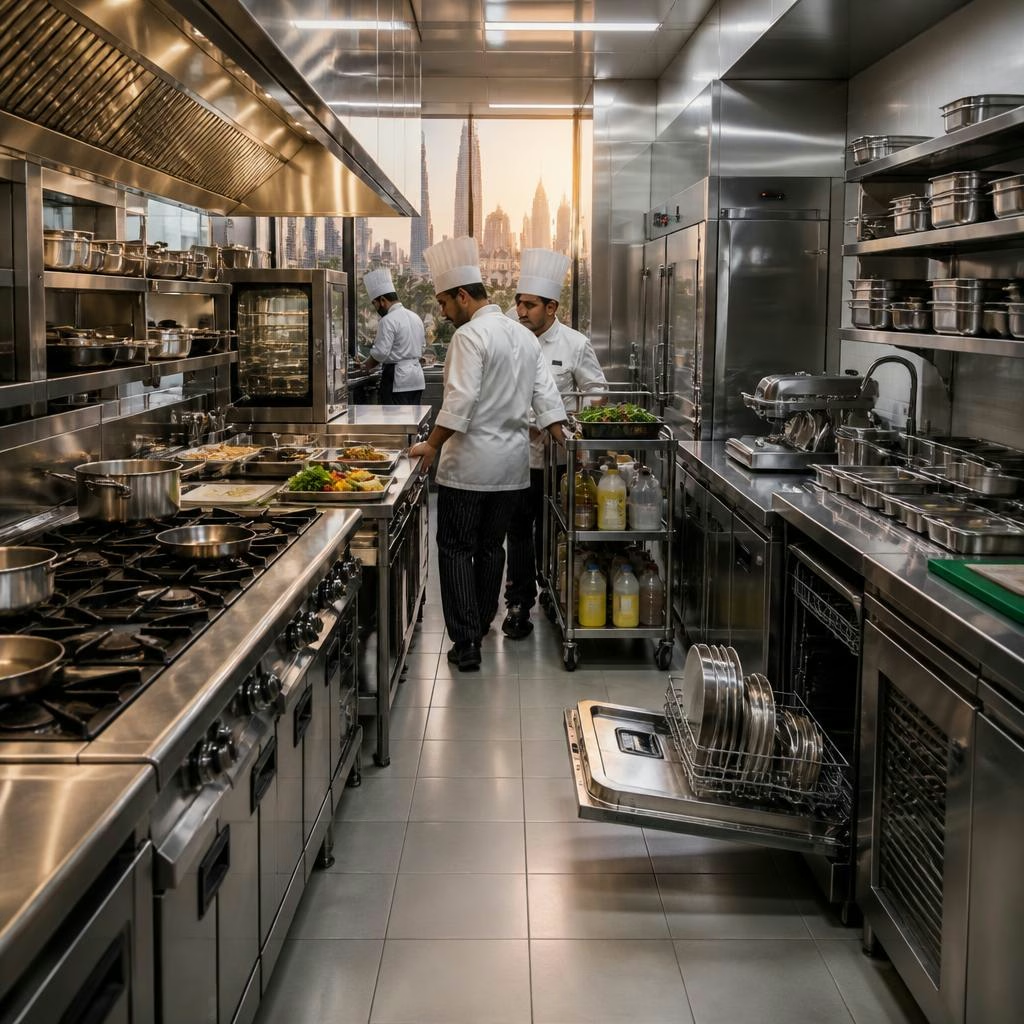
A well-planned kitchen layout is more than aesthetics: it controls workflow, reduces staff fatigue, protects the cold chain, speeds service and helps keep operations compliant and safe. In dense food-service markets like Dubai and Sharjah, kitchens often face tight footprints, high throughput and hot climates; poor planning in these conditions quickly becomes expensive downtime or food safety risk.
Begin with clear workflow zoning
Start your design by zoning the space into receiving, dry and cold storage, preparation, cooking, plating/expedite, service and dishwashing. A common mistake is allowing cross-traffic between 'dirty' (dishwashing/garbage) and 'clean' (plating, prep) areas. Map the sequence of tasks and position equipment so each activity flows logically from one zone to the next — fewer steps mean faster service and fewer mistakes.
Dishwashing flow and washing-line placement
Dishwashers and washing-line machines must be placed where soiled crockery and trays can reach them without crossing the service path. Avoid locating dishwashing where staff carrying clean plates must pass; ensure dedicated dirty-to-clean routes, buffer drying areas and space for manual pre-rinse. Adequate drainage and a nearby grease trap are essential — plan these utilities early so you don’t compromise throughput later.
Chiller and cold-storage mistakes to avoid
Chillers and freezers are often installed in convenient but impractical locations. Placing a chiller too far from prep stations or next to heat sources forces extra handling and breaks the cold chain. Leave service clearances around refrigeration units for maintenance and ensure units have adequate ventilation clearance. When possible, locate display chillers for front-of-house visibility while keeping high-capacity cold storage closer to receiving and prep.
Overcrowded cooking lines and heat management
Packing the cooking line with equipment without suitable clearances causes safety hazards and slows teams. Maintain manufacturer-recommended gaps around fryers, grills, ovens and cookers for ventilation and servicing. Group heat-producing equipment together but ensure extraction capacity is sized to match the combined load. Plan hot-food holding and plating stations so plated food moves straight to service, minimizing traffic across the hot zone.
Design for equipment access and maintenance
A functional kitchen is serviceable. Leave removable panels and service space so technicians can reach compressors, motors and electrical panels without dismantling surrounding systems. Choose equipment models that support easy filter access and routine servicing, and plan routes for replacement units. Falcon Kitchens’ supply and after-sales services emphasize installability and ongoing maintenance — consider those factors when selecting brands and models.
Plan utilities early: power, gas, water and drainage
Utilities determine what equipment you can safely run. Work with electrical and gas specialists during layout design to allocate dedicated circuits, gas manifolds and plumbing risers where equipment will sit. Early planning avoids later relocations that are costly and disruptive. Include isolation valves, circuit labeling and clear access to shut-offs to support safe operation and rapid troubleshooting.
Ergonomics and staff flow reduce errors
Small adjustments in workstation height, reach and storage placement reduce repetitive strain and speed production. Place heavy mixers, cutters and mincers on platforms or at ergonomic heights; keep frequently used ingredients and utensils within easy reach of prep stations. Design aisles wide enough for two people to pass without collision and minimize cross-traffic between cooks, runners and dish staff.
Protect the food chain: separation and hygiene
Ensure separation of raw-food handling from cooked/ready-to-eat areas to reduce contamination risk. Locate handwashing sinks, PPE stations and waste bins so they are convenient and used consistently. Plan hot-holding units and cold-storage near service points to protect product temperatures. Simple choices — such as where to place a pasta cooker, hot-food storage or a cold display — matter to everyday compliance and guest safety.
Practical checklist and next steps with Falcon Kitchens
Before finalising a layout, run through a checklist: confirm clear workflow zones, verify dishwashing and cold-storage locations, check extraction and heat clearances, ensure utility routing and service access, and validate ergonomics for staff. Customers of Falcon Kitchens frequently note that careful listening and collaborative planning produced kitchens that are both attractive and highly functional; our team in Sharjah works with clients across Sharjah and Dubai to supply, install and service commercial dishwashers, chillers, cooking lines, bakery and cold-line equipment. If you are planning a new kitchen or refit, consider engaging equipment suppliers early so selection and placement support your intended workflow rather than hinder it.
Article by
𝐅𝐚𝐥𝐜𝐨𝐧 𝐊𝐢𝐭𝐜𝐡𝐞𝐧𝐬 𝐋𝐋𝐂 - Commercial Kitchen Equipment
Welcome to Falcon Kitchens At Falcon Kitchens, we pride ourselves on being one of the leading suppliers of high-quality commercial kitchen equipment. Our products are designed to meet the varied needs of the food service industry. Whether it is a small café, an up-and-running restaurant, or an industrial kitchen, our commercial kitchen appliances here at Falcon Kitchens will ensure that you have the best solutions for efficiency, reliability, and durability. We have been leading the industry for years now, with the latest technology coupled with craftsmanship in every appliance that leaves our manufacturing line. It’s not about selling kitchen equipment at Falcon Kitchens; it’s building a long-term relationship with clients through support