How to Calculate the Right Cooking Line Capacity for Your Dubai Restaurant
A practical guide that shows restaurant owners how to match cookers, fryers, grills, and ovens to their menu and seating plan using simple, repeatable formulas and planning steps so you avoid under‑ or over‑investing in cooking line equipment.

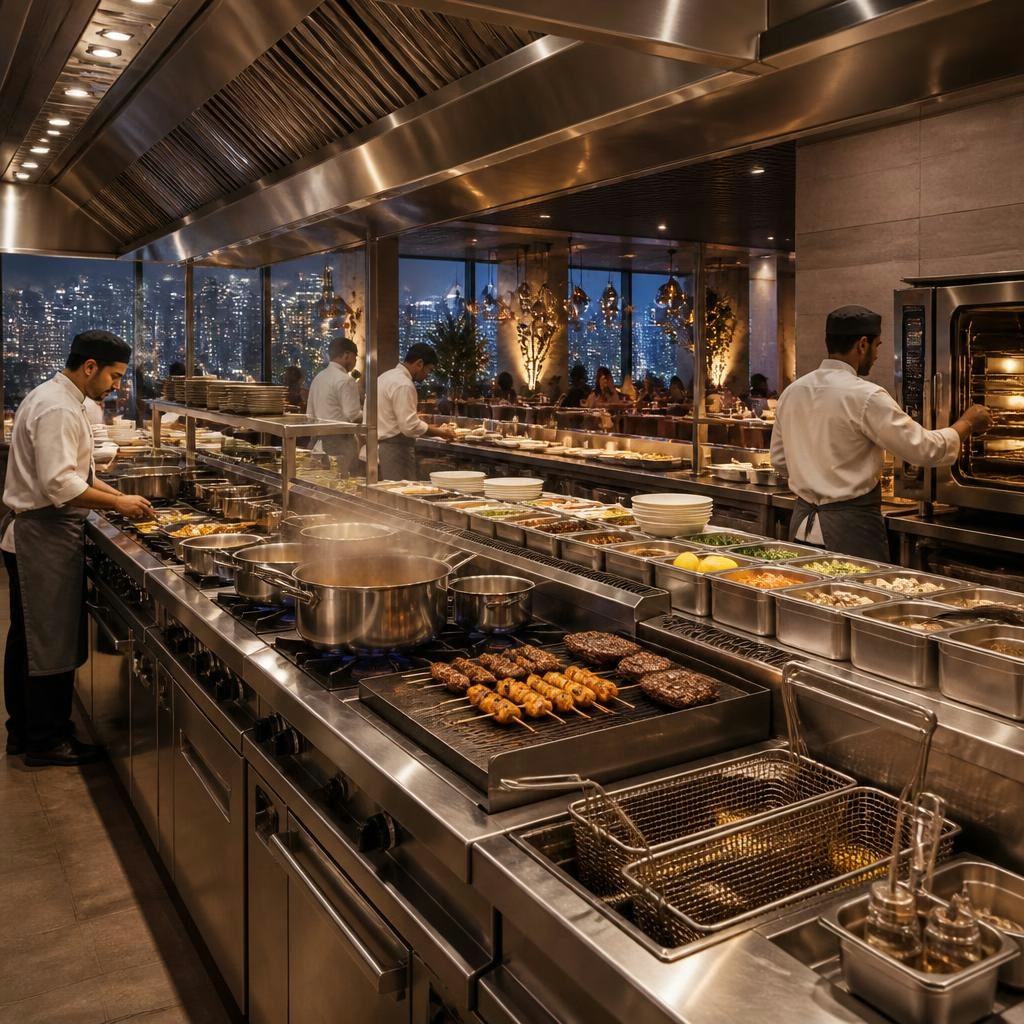
Why cooking line capacity matters
Choosing the correct cooking line capacity affects food quality, service speed, labour efficiency and long‑term operating cost. Too little capacity causes delays and stressed staff; too much capacity ties up capital, increases energy use and creates unused footprint. A deliberate sizing process helps you buy equipment that matches your menu, covers and desired service rhythm rather than guessing.
Start with covers per hour (peak throughput)
Begin by defining peak throughput: the maximum number of covers (customers) you expect to serve in the busiest hour. Use your seating, expected table turns and reservation patterns to calculate this peak. Treat this as a single, firm input—every equipment decision follows from it. If you operate multiple service periods (breakfast, lunch, dinner), do the same calculation for each and size for the largest peak unless you plan to change equipment between services.
Convert covers into dish throughput
Next, translate covers into dishes per hour. Multiply peak covers by the average number of hot dishes per cover (for example, a full menu plate plus side items may count as more than one hot item). This gives you the total hot‑item throughput the cooking line must deliver per hour. Keep this figure as a variable you can refine as menu choices or portioning change.
Understand average cook time and active equipment time
For each dish type, estimate the active cook time on the appliance (not total elapsed time). Active cook time is when the food occupies a burner, fryer basket, grill zone or oven cavity and prevents another item from using it. Use a simple variable for each dish: T_d = average active minutes on the appliance. The sum of (dish throughput × T_d) across dish types equals the total appliance minutes required during peak hour.
A general formula to size burners and cooktop zones
Use this formula: Required appliance minutes per hour = Σ (dishes_per_hour_d × T_d). Then divide by 60 to convert to the number of simultaneous appliance units needed. For cooktop burners or zones, Burner count ≈ (total required appliance minutes per hour) ÷ 60. This yields the number of burners/zones that must be active simultaneously to meet peak demand. Repeat this calculation separately for burners, griddles, induction zones and other distinct cooktop types.
Sizing ovens and batch equipment
Ovens, combi ovens and batch fryers are sized by batch capacity and cycle time. Calculate the number of batches required during the peak hour (dishes_per_hour ÷ items_per_batch) and multiply by cycle time to get required oven minutes. Then use the same minutes‑per‑hour approach: Oven units needed ≈ (required oven minutes per hour) ÷ 60. For multi‑shelf ovens, use shelf capacity as your items_per_batch.
How to approach fryers and grills
Fryers and grills often have continuous throughput rather than discrete batches. For fryers, estimate the weight or number of portions per hour and compare with the fryer’s published throughput (or your expected portion weight multiplied by the fryer cycle time). For grills, treat each grill zone like a burner: calculate the minutes each portion occupies the surface and apply the appliance‑minutes formula. If you plan to serve combo items that require both fryer and grill, include both equipment loads in your calculations to avoid bottlenecks.
Account for holding, plating and recovery time
Don’t forget the non‑cooking steps that affect capacity. Hot holding capacity, plating stations and refrigeration influence how quickly cooked items can be moved to service. Holding cabinets reduce pressure on the line when recovery time is short, but they also require space and energy. Include the minutes food spends in holding or on pass heat lamps in your planning when those steps occupy equipment or staff time.
Layout, workflow and utilization factors
Raw calculated unit counts are a starting point; apply practical factors to convert theory into a usable kitchen. Consider space, staff experience, simultaneous menu items and maintenance downtime. Use a utilization factor (for example, expected percent of continuous use during peak) to adjust counts upward if you’ll run equipment near continuously or downward if you have staggered service. Also evaluate service style—open kitchens and banquet lines have different recovery and staging needs—which affects how many identical units you want vs. flexible multifunction equipment.
Selecting models, installation and long‑term support
When you have equipment counts and functional requirements, choose models that match your duty cycle and hygiene needs. Look for reliable manufacturers, easy service access and energy‑efficient options. Falcon Kitchens supplies, installs and services a wide range of commercial cooking, oven, fryer and hot‑holding equipment and can help translate your calculated requirements into specific models and layouts. Customers consistently praise the company’s professionalism and reliable support, which is valuable when matching equipment to a busy Dubai or Sharjah operation.
A practical checklist to bring to a supplier meeting
Prepare these items before you talk to equipment suppliers: peak covers per hour; average hot dishes per cover; representative menu items with estimated active cook times; desired service rhythm (speed vs. made‑to‑order); planned kitchen footprint and utility availability (gas/electric load, ventilation); and any future growth expectations. Bring photos or a floor plan if possible. With this information a supplier can convert your appliance‑minutes calculations into model recommendations, energy estimates and installation plans.
Next steps and working with a local partner
Sizing a cooking line is a mix of arithmetic and practical judgement. Start with the formulas here, convert your menu into throughput and active cook minutes, then refine with utilization and workflow factors. For a tailored proposal, consult a local commercial kitchen specialist who can validate assumptions against real equipment performance and local utility constraints. Falcon Kitchens, serving Sharjah and Dubai areas, offers supply, installation and ongoing maintenance—making it easier to move from capacity calculation to a functioning, reliable cooking line.
Article by
𝐅𝐚𝐥𝐜𝐨𝐧 𝐊𝐢𝐭𝐜𝐡𝐞𝐧𝐬 𝐋𝐋𝐂 - Commercial Kitchen Equipment
Welcome to Falcon Kitchens At Falcon Kitchens, we pride ourselves on being one of the leading suppliers of high-quality commercial kitchen equipment. Our products are designed to meet the varied needs of the food service industry. Whether it is a small café, an up-and-running restaurant, or an industrial kitchen, our commercial kitchen appliances here at Falcon Kitchens will ensure that you have the best solutions for efficiency, reliability, and durability. We have been leading the industry for years now, with the latest technology coupled with craftsmanship in every appliance that leaves our manufacturing line. It’s not about selling kitchen equipment at Falcon Kitchens; it’s building a long-term relationship with clients through support