How to Size Cold Line Equipment for Dubai’s Heat: Chillers, Freezers, and Display Units
Practical guidance for restaurants, cafés and hotels on calculating the right capacity for upright freezers, tabletop chillers and display chillers in Dubai’s hot climate so you avoid overload, uneven temperatures and food‑safety risks.

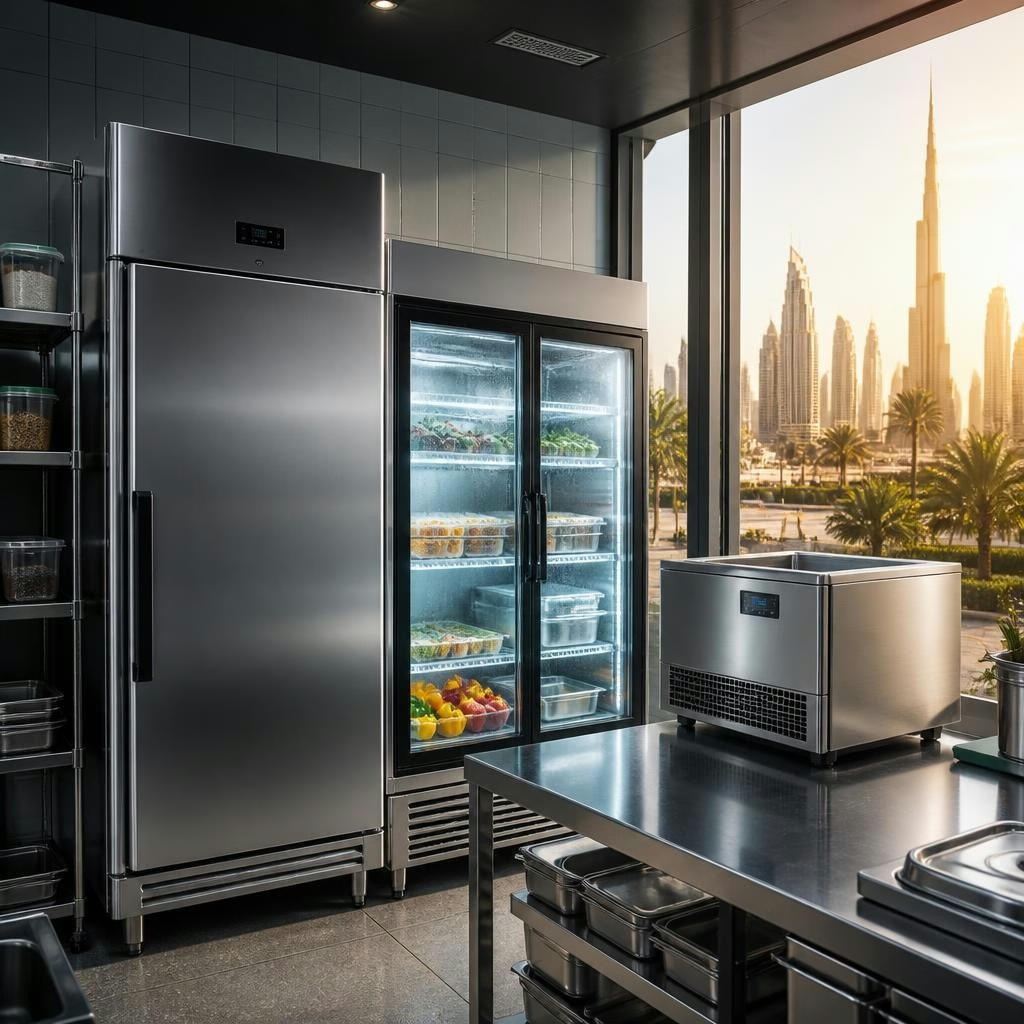
Why correct cold‑line sizing matters in Dubai
Dubai’s high ambient temperatures increase the workload on refrigeration equipment. Undersized chillers or freezers will struggle to maintain target temperatures, leading to frequent warm periods, higher energy use, accelerated wear, and greater risk of food quality loss. Sizing correctly reduces running costs, limits breakdowns, and helps kitchens meet food‑safety requirements.
Typical temperature targets for commercial cold‑line units
Use standard temperature setpoints as a baseline when sizing: upright freezers at around –18°C for long‑term frozen storage; chillers for raw or prepared cold food at 0–4°C; and display chillers at 2–6°C depending on the product (dairy and prepared foods toward the lower end, beverages higher). These targets guide both capacity and refrigeration power requirements.
Step 1 — Calculate your daily throughput and storage horizon
Start with how much product you move per day (kilograms or units) and decide how many days of stock you must hold. For example, a kitchen that uses 200 kg of produce daily and wants two days’ buffer needs about 400 kg of cold storage capacity. Higher turnover needs less storage volume; low‑turnover kitchens require more capacity to avoid repeated replenishment.
Step 2 — Convert weight to storage volume
Different foods have different densities. When you don’t have exact data, use practical density ranges: many prepared foods and meats fall between 0.7–1.0 kg per litre, while vegetables can be lighter. Divide your total stock weight by a chosen density to estimate required litres of storage. Allow additional space for airflow and packaging—don’t plan a perfectly packed cabinet.
Step 3 — Factor in usable volume and airflow
Manufacturers quote gross cabinet volume; usable volume is lower because shelving, trays and airflow space reduce capacity. Expect usable volume to be roughly 70–80% of gross for many upright units. Also allow 20–30% extra circulation space so cold air can move freely—blocking airflow is a common cause of uneven temperatures.
Adjustments for Dubai’s ambient heat and heavy door openings
High kitchen and service area temperatures and frequent door openings increase thermal load. As a rule of thumb, increase refrigeration capacity or cabinet volume by a safety margin — commonly 20–30% — when operating in very hot environments or where doors open repeatedly. If your unit will sit near heat sources or in non‑conditioned areas, consult a refrigeration specialist to quantify additional load.
Sizing specifics: upright freezers vs tabletop chillers vs display chillers
Upright freezers: prioritize insulation, sealed doors and stable –18°C performance for long holds. Choose larger gross volumes when you need multi‑day frozen stock or large batches. Tabletop chillers: best for short‑term holding and fast access; size them for immediate service stock rather than long storage. Display chillers: balance display area with cooling capacity—glass doors and open displays leak cold, so model selection should consider product layout, lighting heat, and desired display temperatures.
Operational considerations that affect real capacity
How staff load and organize stock strongly affects effective capacity. Use consistent tray sizes, avoid stacking to blocking vents, and implement first‑in, first‑out rotation. Regularly monitor internal temperatures at product level (not just cabinet thermostat). Defrost cycles, condenser cleanliness, and door gaskets all change performance—planned maintenance preserves rated capacity.
Energy, efficiency and lifecycle trade‑offs
Oversizing can increase upfront cost and energy use; undersizing causes overload and early failure. Look for efficient insulation, variable‑speed compressors, and well‑designed evaporator coils for better performance in hot climates. Consider units with serviceability—easy access to condensers, replaceable gaskets and clear documentation helps keep performance high over time.
How Falcon Kitchens can help with selection and installation
Falcon Kitchens supplies upright freezers, tabletop chillers and display chillers suited to commercial settings and offers installation and servicing across the UAE. Customers consistently note the company’s quality and service when buying commercial refrigeration equipment, which is important when matching equipment to challenging local conditions. For an accurate recommendation, provide your daily throughput, desired days of stock, typical product mix and the intended location of the unit so the right cabinet size and refrigeration capacity can be specified.
Customer review


Article by
𝐅𝐚𝐥𝐜𝐨𝐧 𝐊𝐢𝐭𝐜𝐡𝐞𝐧𝐬 𝐋𝐋𝐂 - Commercial Kitchen Equipment
Welcome to Falcon Kitchens At Falcon Kitchens, we pride ourselves on being one of the leading suppliers of high-quality commercial kitchen equipment. Our products are designed to meet the varied needs of the food service industry. Whether it is a small café, an up-and-running restaurant, or an industrial kitchen, our commercial kitchen appliances here at Falcon Kitchens will ensure that you have the best solutions for efficiency, reliability, and durability. We have been leading the industry for years now, with the latest technology coupled with craftsmanship in every appliance that leaves our manufacturing line. It’s not about selling kitchen equipment at Falcon Kitchens; it’s building a long-term relationship with clients through support